KOSPI drops 153 points as Samsung Electronics slides 7% on shareholder plan
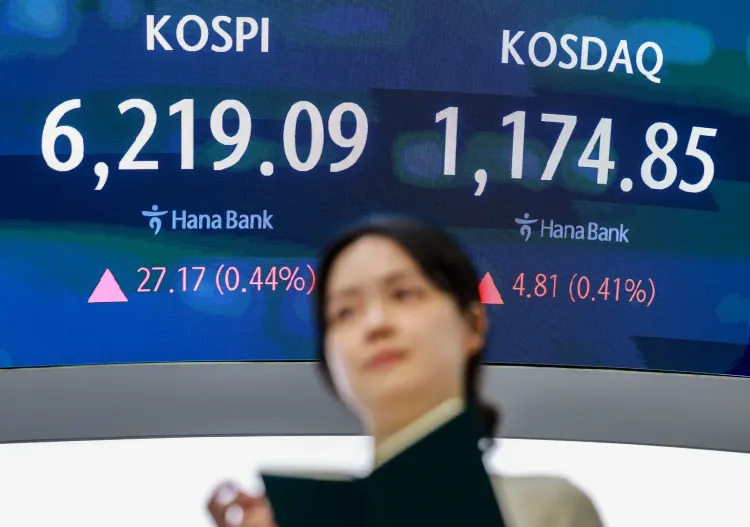
Synopsis
Samsung Electronics' shareholder return plan — promising up to 110 trillion won in payouts — was meant to reassure investors. Instead, it triggered a 7.28% single-session drop and dragged the KOSPI down 153 points. With Nvidia's AI earnings and the Fed's Jackson Hole signals both due this week, Seoul's chip-heavy index is caught between local disappointment and global uncertainty.
Key Takeaways
The KOSPI fell 153.42 points (2.22%) to 6,759.53 as of 11:18 am on 24 August .
Samsung Electronics dropped 7.28 percent after its shareholder return plan disappointed markets; the plan targets up to 110 trillion won in payouts, including 30 trillion won in cash dividends in Q3.
SK hynix fell 0.64% ; Hyundai Motor declined 1.08% ; KB Financial lost 1.64% .
The Korean won strengthened 8.5 won to 1,377.5 won per US dollar .
Investors are watching Nvidia earnings and the US Federal Reserve 's Jackson Hole symposium for direction on AI and global rate policy.
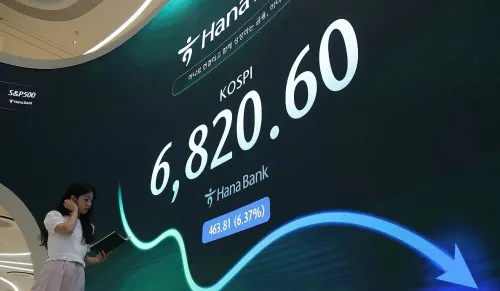
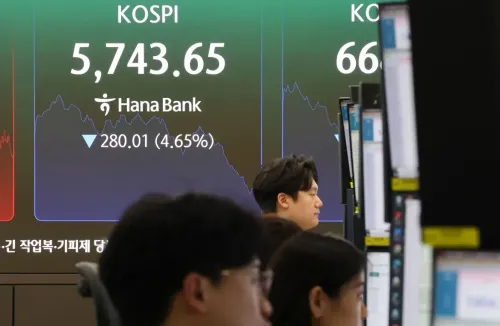
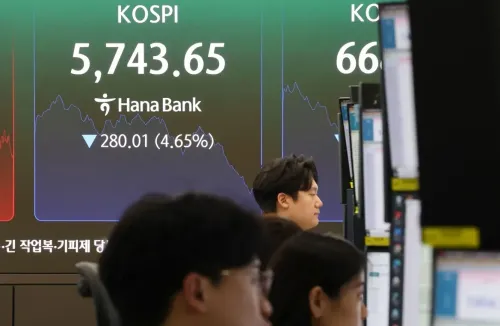
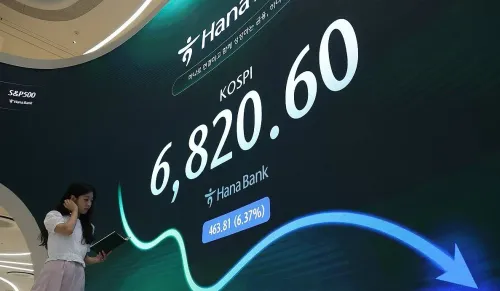
South Korea's benchmark Korea Composite Stock Price Index (KOSPI) shed 153.42 points, or 2.22 percent, to 6,759.53 as of 11:18 am local time on Monday, 24 August, as investors locked in profits from large-cap semiconductor and technology stocks. The sell-off erased the gains that had pushed the index above 6,900 points on Friday.
Samsung Electronics at the Centre of the Sell-Off
Samsung Electronics, the index's top-weighted stock, tumbled 7.28 percent after investors reacted with disappointment to the company's shareholder return plan. The chipmaker announced a payout targeting up to 110 trillion won (approximately US$79.7 billion), which includes cash dividends of around 30 trillion won in the third quarter. Despite the scale of the commitment, the market appeared to have expected more, according to Mirae Asset Securities analyst Kim Seok-hwan.
Rival chipmaker SK hynix declined a more modest 0.64 percent, while Hyundai Motor fell 1.08 percent, KB Financial dipped 1.64 percent, and nuclear power plant builder Doosan Enerbility edged down 0.68 percent.
Nvidia Earnings and AI Market Outlook Weigh on Sentiment
Beyond Samsung's specific news, broader caution gripped the market as investors awaited earnings from Nvidia, widely seen as a bellwether for the global artificial intelligence (AI) investment cycle. A softer-than-expected Nvidia result could signal a deceleration in AI-related chip demand — a scenario that directly threatens South Korean semiconductor exporters.
This is a recurring pattern for the KOSPI: when US tech giants report, Seoul chip stocks move in anticipation, often before the numbers are even out. The index's outsized exposure to semiconductors makes it one of Asia's most sensitive markets to AI sentiment shifts.
Global Cues: Wall Street and the Fed in Focus
Despite Monday's weakness in Seoul, Wall Street closed higher last week even as US government bond yields rose, with both the S&P 500 and the tech-heavy Nasdaq each gaining 0.43 percent as bargain hunters stepped in. The divergence underlines how Seoul's Monday session was driven more by stock-specific and local sentiment than by overnight US signals.
Investors are also monitoring the Jackson Hole symposium of the US Federal Reserve and the upcoming policy meeting of the Bank of Korea, both due this week. Fed Chair commentary at Jackson Hole could reset global rate expectations and further influence capital flows into emerging markets, including South Korea.
Currency and Broader Market Snapshot
The Korean won was trading at 1,377.5 won per US dollar as of 11:20 am, strengthening by 8.5 won against the dollar compared to the previous session's close. A firmer won can marginally compress export earnings for South Korean multinationals, adding another layer of complexity for large-cap stocks.
With the Nvidia earnings release and the Jackson Hole outcome both pending, the KOSPI's near-term direction will likely hinge on external signals rather than domestic fundamentals.
Point of View
But the market's 7-percent-plus response suggests investors were looking for something structurally different — perhaps a clearer earnings recovery roadmap rather than a capital return promise. The KOSPI's semiconductor concentration is both its strength and its vulnerability: when the AI trade is hot, Seoul outperforms; when Nvidia sneezes, Samsung catches cold. The timing of this sell-off — days before a pivotal Nvidia earnings call and a Fed symposium — amplifies the uncertainty. South Korean policymakers at the Bank of Korea face a delicate week: any hawkish Fed signal at Jackson Hole could pressure the won and complicate their own rate deliberations.
NationPress
8 Oct 2026
Frequently Asked Questions
Why did the KOSPI fall on 24 August?
The KOSPI dropped 153.42 points, or 2.22%, to 6,759.53 as investors sold large-cap semiconductor stocks, particularly after Samsung Electronics' shareholder return plan disappointed the market. Caution ahead of Nvidia's earnings and the US Federal Reserve's Jackson Hole symposium also weighed on sentiment.
What was Samsung Electronics' shareholder return plan?
Samsung Electronics announced a shareholder return plan targeting payouts of up to 110 trillion won (approximately US$79.7 billion), including cash dividends of around 30 trillion won in the third quarter. Despite the scale, investors reacted negatively, sending the stock down 7.28 percent on the day.
How did other major South Korean stocks perform?
SK hynix fell 0.64 percent, Hyundai Motor declined 1.08 percent, KB Financial dipped 1.64 percent, and Doosan Enerbility edged down 0.68 percent. Most market heavyweights traded lower during the session.
What global events are South Korean investors watching this week?
Investors are closely tracking Nvidia's upcoming earnings release for signals on the AI market's trajectory, the US Federal Reserve's Jackson Hole symposium for interest rate guidance, and the Bank of Korea's policy meeting scheduled for this week.
How did Wall Street perform ahead of Seoul's Monday decline?
Wall Street closed higher last week despite rising US bond yields, with both the S&P 500 and the Nasdaq gaining 0.43 percent each as bargain hunters bought into the dip. The positive US close did not prevent Monday's sell-off in Seoul, which was driven by local stock-specific factors.