KOSPI plunges 3.59% as AI spending doubts hammer South Korean tech stocks
Synopsis
South Korea's KOSPI posted one of its sharpest single-day drops of the year, shedding 3.59% as Samsung Electronics and SK hynix led a tech rout fuelled by growing doubts about whether enormous AI infrastructure spending will ever deliver the profits investors were promised — a concern now spreading from Wall Street to Asian markets.
Key Takeaways
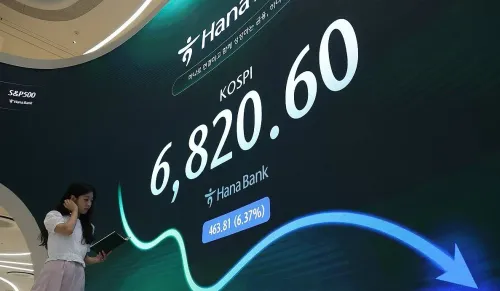
KOSPI closed down 3.59 percent at 5,648.79 on Tuesday, 3 November 2026 — a loss of 210.29 points .
Samsung Electronics fell 4.15% ; SK hynix tumbled 5.03% ; Samsung Electro-Mechanics lost 7.38% .
Oil refiners also collapsed: SK Innovation plunged 9.36% and S-Oil dived 11.77% .
The PHLX chip index fell 3.4% overnight, extending a 7.2% drop from the previous Friday.
Foreigners net-sold 1.5 trillion won ; retail investors net-bought 1.7 trillion won .
The Korean won strengthened slightly to 1,341 per US dollar ; bond yields eased on safe-haven demand.
South Korea's benchmark Korea Composite Stock Price Index (KOSPI) closed 210.29 points lower at 5,648.79 on Tuesday, 3 November 2026, a decline of 3.59 percent, as heavy selling in semiconductor and technology shares rattled the Seoul market. The rout was driven by deepening investor scepticism over the returns on massive artificial intelligence (AI) infrastructure spending, compounded by a weak overnight session on Wall Street.
How the Session Unfolded
The KOSPI opened 2.46 percent in the red before extending its losses through the day. Trade volume was light at 192.4 million shares valued at 14.1 trillion won (approximately US$10.5 billion), with declining stocks outpacing gainers by a margin of 656 to 220. Foreigners and institutions emerged as net sellers, offloading a net 1.5 trillion won and 511.7 billion won respectively, while retail investors absorbed a net 1.7 trillion won.
Semiconductor Stocks Bear the Brunt
Chip stocks were the session's worst performers. Samsung Electronics fell 4.15 percent to 219,500 won, while memory chipmaker SK hynix tumbled 5.03 percent to 1.4 million won. SK Square, the parent company of SK hynix, sank 5.37 percent to 899,000 won, and Samsung Electro-Mechanics — the electronic components arm of Samsung Electronics — lost a steep 7.38 percent to close at 1.1 million won. Internet majors were not spared either: Naver dipped 3.65 percent to 169,000 won, and rival Kakao slid 3.03 percent to 28,800 won.
Wall Street Contagion and AI Profitability Concerns
The Seoul sell-off mirrored overnight weakness on Wall Street, where tech and AI-related stocks stayed under pressure. The Nasdaq Composite fell 1.07 percent and the S&P 500 shed 0.51 percent. The PHLX semiconductor index dropped a further 3.4 percent, following a sharp 7.2 percent plunge the previous Friday. Kim Seok-hwan, an analyst at Mirae Asset Securities, pointed directly to the cause: 'Concerns about profitability of AI investments persist. A sharp drop in chip shares in the U.S. stock market on the first trading day of November weighed heavily on the Korean market.' Investors are questioning whether the productivity and profitability from outsized AI infrastructure spending can justify the capital outlay, particularly after several global technology companies posted disappointing earnings results.
Oil Refiners Slide on Diplomatic Hopes
Selling also spread to energy stocks as crude oil prices fell sharply on optimism over a potential diplomatic resolution to Middle East tensions. Oil refining leader SK Innovation plunged 9.36 percent to 119,100 won, and S-Oil dived 11.77 percent to 114,700 won, making the sector one of Tuesday's worst-performing groups alongside semiconductors.
Currency and Bond Markets
The Korean won bucked the equity trend, strengthening marginally to 1,341 won per US dollar as of 3:30 pm local time, up 2.8 won from the previous session's close. Bond prices firmed: the yield on three-year Treasury bonds eased 0.4 basis points to 3.736 percent, and the five-year benchmark government bond yield dropped 2.2 basis points to 3.870 percent, reflecting a mild flight-to-safety bid. Markets also remain cautious ahead of US midterm election voting, where President Donald Trump's Republican Party faces an uphill challenge to retain its congressional majority — an outcome that could reshape US fiscal and tech policy in the months ahead.
Point of View
And the numbers are not yet adding up. South Korean chipmakers are especially exposed because their fortunes are almost entirely hitched to the capex ambitions of US hyperscalers — when those ambitions wobble, Seoul bleeds. The simultaneous collapse in oil refiners on Middle East diplomacy signals that multiple risk pillars holding up the market are shifting at once. With US midterm uncertainty layered on top, the near-term path for the KOSPI is heavily dependent on narrative repair from US tech earnings — not domestic fundamentals.
NationPress
3 Nov 2026
Frequently Asked Questions
Why did the KOSPI fall more than 3% on 3 November 2026?
The KOSPI dropped 3.59% to 5,648.79 primarily because of heavy selling in semiconductor and technology stocks, driven by investor doubts about the profitability of massive AI infrastructure spending. The decline was amplified by an overnight fall in US chip shares, with the PHLX semiconductor index shedding 3.4%.
Which South Korean stocks fell the most on Tuesday?
Samsung Electro-Mechanics was the biggest blue-chip loser, falling 7.38%. SK hynix dropped 5.03%, SK Square sank 5.37%, and Samsung Electronics lost 4.15%. Oil refiners S-Oil and SK Innovation also crashed, by 11.77% and 9.36% respectively.
What is driving concerns about AI spending profitability?
Several global technology companies have recently reported disappointing earnings, prompting investors to question whether the enormous capital being deployed on AI infrastructure will generate adequate returns. Analyst Kim Seok-hwan of Mirae Asset Securities noted that 'concerns about profitability of AI investments persist' and linked the US chip sell-off directly to Seoul's losses.
How did the Korean won and bond market react?
The Korean won strengthened modestly, trading at 1,341 won per US dollar as of 3:30 pm — up 2.8 won from the previous session. Bond prices rose as yields fell, with three-year Treasury yields easing 0.4 basis points to 3.736% and five-year yields dropping 2.2 basis points to 3.870%, reflecting mild safe-haven demand.
What external factors added to the market pressure?
Beyond AI concerns, markets were cautious ahead of US midterm election voting, where President Donald Trump's Republican Party faces a tough contest to retain its congressional majority. A potential shift in US legislative control could affect fiscal and technology policy, adding another layer of uncertainty for export-reliant South Korean firms.