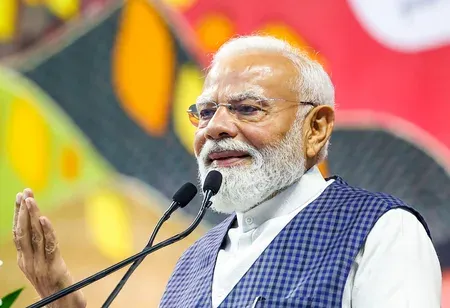
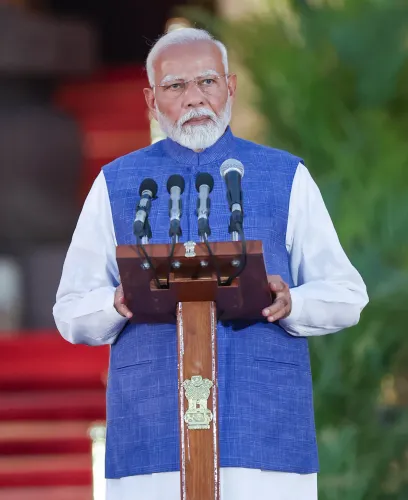
Anand Mahindra congratulates PM Modi on historic PM tenure
Synopsis
Mahindra Group chairman Anand Mahindra on 14 June 2026 congratulated Prime Minister Narendra Modi on becoming India's longest-serving elected Prime Minister, saying an aspiration for a better-quality India and greater global influence unites citizens across political divides.
Key Takeaways
Anand Mahindra posted a congratulatory message on 14 June 2026 marking PM Modi 's milestone as India's longest-serving elected Prime Minister.
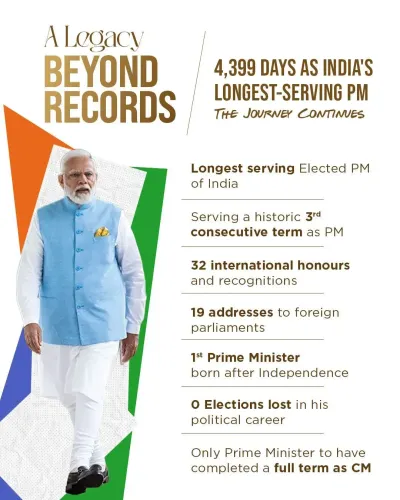
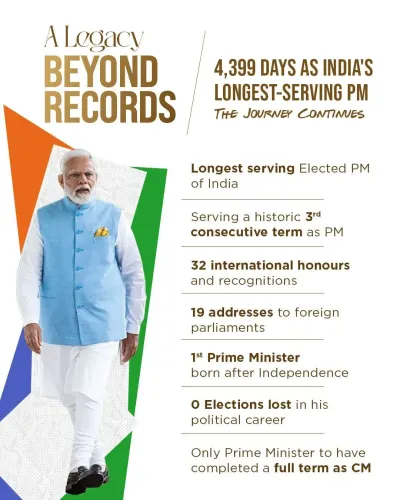
Narendra Modi has served continuously since 26 May 2014 , winning general elections in 2014 , 2019 , and 2024 .
Mahindra described India's political diversity as 'one of our greatest strengths' rather than a weakness.
He attributed the longevity of Modi's tenure to a shared aspiration: better quality of life for citizens and a stronger India on the world stage.
Mahindra framed his congratulation as non-partisan, saying the underlying aspiration is one 'most Indians, irrespective of political views, can subscribe to.'
Mahindra Group chairman Anand Mahindra on Sunday, 14 June 2026 congratulated Prime Minister Narendra Modi on becoming the longest-serving elected Prime Minister in India's history, calling the milestone a reflection of an aspiration shared by most Indians regardless of political affiliation.
Context
Narendra Modi was first sworn in as Prime Minister on 26 May 2014 following the BJP-led NDA's decisive general election victory. He was re-elected for a second consecutive term on 30 May 2019 and for a third term on 9 June 2024, making his unbroken tenure one of the longest in independent India's parliamentary history.
Mahindra, writing on X, framed the achievement in terms of India's defining character: 'In a country as diverse and argumentative as ours, that's no small feat.' He noted that Indians come with 'different political beliefs, different priorities and very different ideas about the path forward,' yet argued that this plurality is 'one of our greatest strengths.'
Policy Backdrop
India's multi-party parliamentary system has historically produced governments that rarely complete back-to-back terms with a single leader at the helm. Sustaining a majority across three successive general elections — 2014, 2019, and 2024 — in a polity of more than 140 crore people and dozens of regional parties underscores the scale of the electoral achievement being recognised.
Successive administrations since independence have pursued overlapping national goals: raising citizens' living standards and expanding India's influence on the world stage. Mahindra's post echoes that continuity, describing the animating force behind Modi's tenure as 'the desire to build an India that offers a better quality of life for its citizens, while growing stronger and more influential on the world stage.'
Stakeholders and Impact
Public endorsements of political milestones by prominent industrialists carry weight in India's public discourse, signalling business-community sentiment toward political stability and long-term economic direction. Mahindra, whose conglomerate spans automobiles, technology, and financial services, is among the most widely followed business voices on social media in the country.
His post was notable for its deliberate inclusivity: 'This aspiration itself is one that I suspect most Indians, irrespective of political views, can subscribe to.' The framing positions the congratulation not as partisan endorsement but as a recognition of a shared national ambition, a distinction Mahindra appears to have made consciously.
What's Next
With Modi's third term well under way, attention in the coming months will turn to the monsoon session of Parliament and any major announcements on economic policy, welfare schemes, or India's diplomatic engagements. The milestone is likely to prompt wider reflection across political and civil-society circles on the nature of electoral mandates and democratic continuity in India.
Point of View
Rather than partisan, language. By invoking India's diversity and argumentativeness as strengths, he implicitly acknowledges the contested nature of Modi's tenure without diminishing the electoral achievement. The framing reflects a broader pattern among India's top industrialists: engaging with political milestones in ways that affirm stability and national ambition without alienating any segment of the market or workforce. The post arrives at a moment when business-political alignment in India is under heightened scrutiny, making the inclusive language a deliberate editorial choice as much as a personal sentiment.
NationPress
14 Sept 2026
Frequently Asked Questions
Who is India's longest-serving elected Prime Minister?
Narendra Modi is recognised as India's longest-serving elected Prime Minister, having served continuously since 26 May 2014 across three successive terms won in 2014 , 2019 , and 2024 .
What did Anand Mahindra say about PM Modi's milestone?
Anand Mahindra said that what has sustained Modi's 'remarkable journey' is a shared aspiration to build an India with a better quality of life for citizens and a stronger global presence, adding that most Indians 'irrespective of political views' can subscribe to that goal.
When did Narendra Modi first become Prime Minister?
Narendra Modi was first sworn in as Prime Minister on 26 May 2014 following the BJP -led NDA 's victory in the general elections that year.
Why is Anand Mahindra's comment on Modi significant?
As chairman of one of India's largest conglomerates and one of the country's most-followed business voices on social media, Mahindra's public endorsement of a political milestone carries weight as an indicator of business-community sentiment toward political stability and economic continuity.
How many terms has PM Modi served?
PM Modi has served three consecutive terms, sworn in on 26 May 2014 , 30 May 2019 , and 9 June 2024 respectively.