Mecca Pact: Why Pakistan can't fund a long war with a crumbling economy
Synopsis
Pakistan signed the Mecca Pact as a show of collective strength — but the week the alliance was activated, all three signatories disowned its consequences. With defence locked at 2.1% of GDP and debt service consuming 5.6%, Islamabad literally cannot afford to honour a long-war commitment without torching its IMF bailout. A pact 'announced before it was built' may already be more liability than leverage.
Key Takeaways
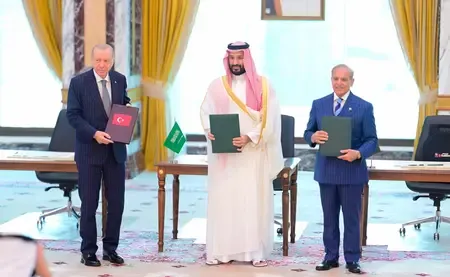
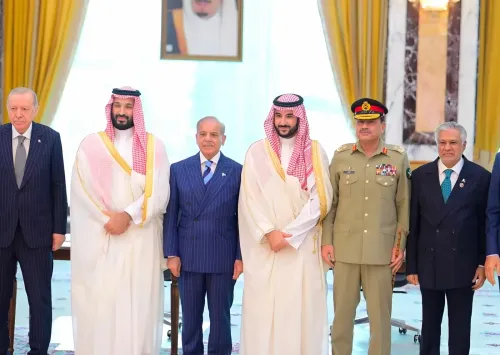
Pakistan signed the Mecca Joint Defence Agreement with Saudi Arabia and Turkey on 7 August 2026 .
Pakistan's FY27 defence budget stands at Rs 3.0 trillion (2.1% of GDP), dwarfed by Rs 8.05 trillion in debt servicing (5.6% of GDP).
Every 10% increase in defence spending costs roughly $1.1 billion — close to the $1.21 billion IMF tranche pending Board approval.
The pact's 'collective deterrence' activation on 5 October 2026 was effectively disowned within five days by Pakistan and Turkey.
Houthi-claimed attacks killed three Saudis at Riyadh's airport , the trigger that forced the pact's activation.
Analysts warn an overstretched Pakistan is a less predictable — not necessarily weaker — neighbour for India.
Pakistan, a signatory to the Mecca Joint Defence Agreement — commonly called the Mecca Pact — alongside Saudi Arabia and Turkey, is caught in a deepening strategic contradiction: the trilateral collective security alliance was announced before it was operationally built, according to an analysis by India Narrative. While Pakistan can field a limited military deployment, it cannot sustain the financial burden of a prolonged conflict.
The Fiscal Straitjacket
The numbers tell a stark story. Pakistan's FY27 budget allocates Rs 3.0 trillion — roughly 2.1 per cent of projected GDP — to defence, while Rs 8.05 trillion, or 5.6 per cent of GDP, is earmarked for debt service alone. Simultaneously, Islamabad has pledged to the International Monetary Fund (IMF) an underlying primary surplus of 2 per cent of GDP, equivalent to Rs 2.83 trillion.
The arithmetic is unforgiving. Every additional 10 per cent rise in defence spending costs Rs 300 billion — approximately 0.21 per cent of GDP, 10.6 per cent of that primary surplus, and roughly $1.1 billion. That figure sits uncomfortably close to the $1.21 billion IMF tranche currently awaiting Board approval.
Squeezed Between Riyadh and the IMF
According to the India Narrative report, Pakistan is caught between two powerful creditors pulling in opposite directions. 'Pakistan is squeezed from both sides: Riyadh's money makes failing to deliver costly, while an IMF that wants any fuel support limited and inside the budget makes overdelivering costly,' the analysis argues.
Saudi Arabia's financial patronage creates political pressure on Islamabad to honour its collective defence commitments. But the IMF's fiscal conditionalities effectively cap how far Pakistan can stretch its defence budget without jeopardising its bailout programme — a programme on which the country's economic survival depends.
The Pact Activated and Disowned in the Same Week
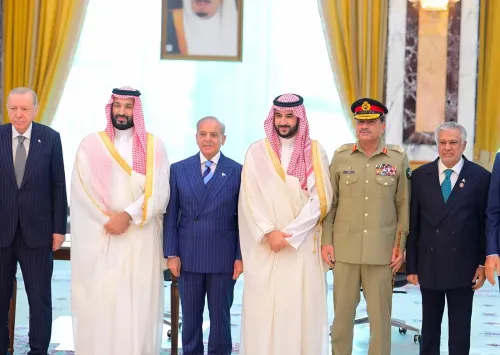
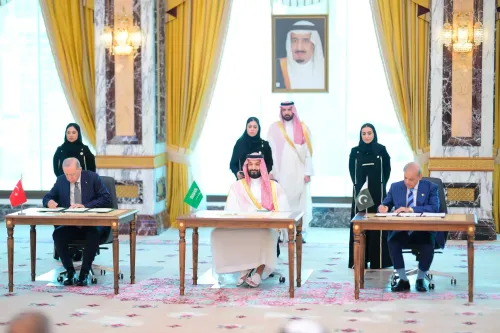
The Mecca Pact was signed on 7 August 2026 as a trilateral collective security arrangement. Four weeks after the first Houthi barrage struck Saudi cities, the pact's committee announced on 5 October that it would activate 'collective deterrence' and ensure the 'rapid deployment' of 'agreed' forces against the threat.
What followed was an immediate unravelling. Within five days, Pakistan's Information Ministry had labelled a New York Times report of Pakistani air strikes on the Houthis as 'fake and fabricated', its Foreign Office had explicitly ruled out any military crossing into Yemen, and Turkey's foreign minister had ruled out deploying troops for attacks on another country. Houthi-claimed attacks had by then killed three Saudis at Riyadh's airport.
The India Narrative analysis delivers a pointed verdict: 'The pact was activated and disowned in the same week. That contradiction is the argument: a collective-defence promise whose content its authors will not state cannot deter.'
What This Means for India
The geopolitical implications extend to New Delhi. An overstretched Pakistan — financially dependent on both Riyadh and the IMF, committed to alliances it cannot fully honour — presents India with a nuanced security calculus. As the India Narrative report cautions, such a Pakistan is 'a less predictable neighbour, not a weaker one.'
Notably, this dynamic arrives at a moment when Pakistan's civilian-military establishment is already managing a fragile domestic economic recovery under IMF supervision. The convergence of external alliance obligations and internal fiscal constraints makes Islamabad's strategic posture harder to read — and harder to manage for all regional stakeholders.
How Pakistan navigates the gap between its Mecca Pact commitments and its IMF obligations will be a defining test of its foreign policy credibility in the months ahead.
Frequently Asked Questions
What is the Mecca Pact?
The Mecca Pact, formally the Mecca Joint Defence Agreement, is a trilateral collective security alliance signed on 7 August 2026 by Saudi Arabia, Turkey, and Pakistan. It was designed to coordinate collective deterrence and rapid military deployment among the three countries.
Why can't Pakistan fund a prolonged war under the Mecca Pact?
Pakistan's FY27 budget allocates Rs 3.0 trillion to defence — just 2.1% of GDP — while debt servicing consumes Rs 8.05 trillion, or 5.6% of GDP. A 10% increase in defence spending would cost roughly $1.1 billion, nearly matching the $1.21 billion IMF tranche awaiting approval, making significant military escalation fiscally untenable.
What happened when the Mecca Pact was activated in October 2026?
On 5 October 2026, the pact's committee announced activation of 'collective deterrence' following Houthi attacks on Saudi cities. Within five days, Pakistan's Information Ministry denied reports of air strikes on the Houthis, its Foreign Office ruled out entering Yemen, and Turkey's foreign minister ruled out troop deployments — effectively disowning the activation.
What does the Mecca Pact's credibility crisis mean for India?
According to the India Narrative analysis, an overstretched Pakistan dependent on both Riyadh and the IMF is 'a less predictable neighbour, not a weaker one' for India. The combination of external alliance obligations and domestic fiscal constraints makes Pakistan's strategic decision-making harder to anticipate.
How does the IMF complicate Pakistan's defence commitments?
Pakistan has pledged a primary surplus of 2% of GDP — Rs 2.83 trillion — to the IMF. The IMF also wants any fuel or defence support kept within budgetary limits. This means Pakistan cannot significantly increase military spending without breaching its IMF programme conditions and risking the $1.21 billion tranche pending Board approval.