Mecca Defence Pact exposes Europe's strategic failure on Pakistan, Turkey
Synopsis
A new trilateral defence pact among Saudi Arabia, Pakistan and Turkey — formalised in Mecca in August — is drawing sharp criticism of Europe's strategic posture. With Pakistan remaining the EU's largest GSP+ beneficiary and Turkey simultaneously a NATO member and Mecca pact signatory, analysts argue Brussels is funding a strategic realignment it appears unwilling to confront.
Key Takeaways
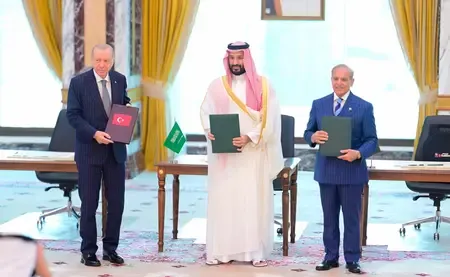
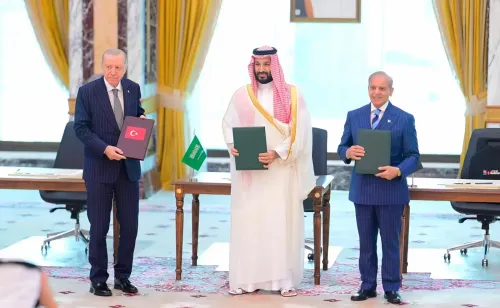
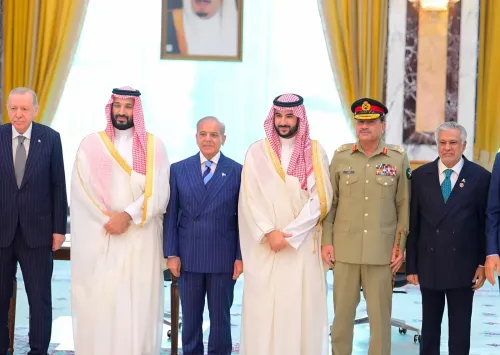
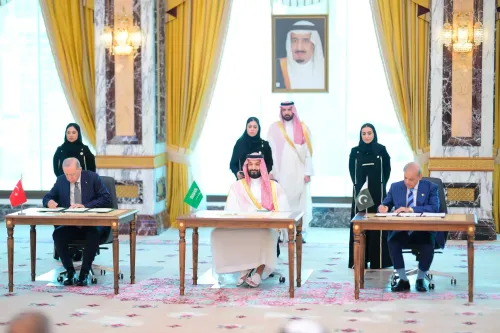
The Mecca Joint Defence Agreement was signed on 7 August 2025 by Saudi Arabia , Pakistan , and Turkey , creating a mutual collective defence arrangement.
An armed attack on any one signatory is to be treated as an attack on all three — mirroring NATO 's collective security framework.
The pact's first test came in mid-September when Houthi strikes hit Saudi energy infrastructure and drones targeted the East-West oil pipeline , forcing suspension on 11 September .
Pakistan is the EU 's largest beneficiary under the GSP+ trade scheme, receiving duty-free market access the report argues subsidises Islamabad's military expansion.
Critics argue Turkey 's dual membership of NATO and the Mecca pact creates an unresolved contradiction that Brussels has so far declined to address.
Brussels Signal has called on the European Commission to reassess trade and diplomatic privileges for Pakistan and Turkey in light of the new alliance.
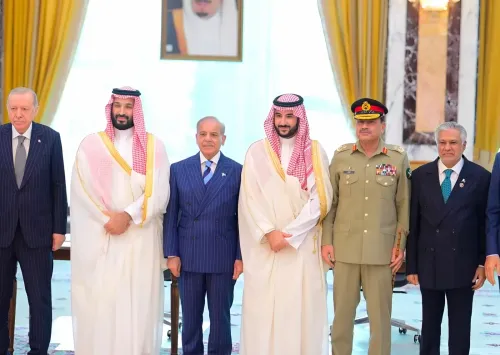
The Mecca Joint Defence Agreement, signed on 7 August 2025 in Mecca, Saudi Arabia, has formalised a mutual collective defence arrangement among Saudi Arabia, Pakistan, and Turkey — a development that analysts say lays bare deep contradictions in Europe's long-standing economic and diplomatic approach toward Islamabad and Ankara, according to a report by Belgian news website Brussels Signal.
The pact bears structural parallels to NATO's collective security architecture: an armed attack against any one signatory is to be treated as an attack against all three. Critics argue the agreement represents a seismic geopolitical realignment on Europe's immediate strategic flank — one that Brussels has, according to the report, largely failed to reckon with.
The Pact and Its First Test
The agreement's first major stress test arrived within weeks of its signing. In mid-September, Houthi drones and missiles struck critical Saudi energy infrastructure, while separate drone strikes launched from Iraq targeted the East-West oil pipeline, forcing Riyadh to suspend pipeline operations on 11 September, the report noted. The episode underscored both the fragility of Gulf energy corridors and the potential obligations the new alliance could impose on its signatories.
This comes amid a broader regional reconfiguration triggered, according to the report, partly by the Iran conflict that began with US and Israeli strikes on 28 February. Deeply disillusioned by what Riyadh reportedly views as unreliable and shifting Western security guarantees, Saudi Arabia has moved to diversify its strategic partnerships — turning, the report argues, not toward European capitals but toward Islamabad and Ankara.
Europe's GSP+ Dilemma
The report singles out the European Commission's Generalised Scheme of Preferences Plus (GSP+) as a focal point of the contradiction. Pakistan has emerged as the scheme's single largest beneficiary, according to the Commission, enjoying duty-free access to European markets ostensibly in exchange for commitments on human rights and governance benchmarks.
'European taxpayer-backed trade preferences bankroll a state that persecutes its own minorities at home while offering its military and nuclear deterrence umbrella to the highest bidder abroad,' the Brussels Signal report stated.
Critics quoted in the report argue that European Commission President Ursula von der Leyen's trade mechanism has, in effect, created a strategic vacuum now being filled by what they characterise as nuclear ambiguity and autocratic alliance-building.
The Turkey Question Inside NATO
Turkey's simultaneous membership of NATO and its role as a founding signatory of the Mecca pact presents what the report describes as an unresolved and largely unasked question in Brussels. If Ankara is treaty-bound to defend Islamabad or Riyadh in a regional escalation, the report asks, where precisely does its commitment to Atlantic collective security begin and end.
'Brussels dares not even ask,' the report stated pointedly, arguing that EU foreign policy has prioritised procedural diplomacy — press releases and summits — over confronting substantive strategic contradictions. Notably, Turkey has over recent years already drawn criticism from NATO partners for arms purchases from Russia and independent military operations in Syria and Libya, making its dual-alliance posture a long-running but unresolved tension.
Broader Strategic Implications
The report frames the Mecca agreement as evidence that a new Sunni security bloc, anchored by a nuclear-armed state, is taking shape with minimal European engagement or strategic response. It calls on Brussels to reassess whether Pakistan and Turkey should continue to enjoy European economic privileges — including GSP+ access and EU candidate or partner status — while their militaries, the report argues, construct non-Western power structures that may actively cut across European interests.
Whether European policymakers will move beyond what critics call strategic passivity — or whether trade and diplomatic inertia will persist — is likely to be a defining question for EU foreign and security policy in the months ahead.
Point of View
Arguably because doing so would require confronting the limits of GSP+ conditionality — a mechanism the Commission touts as a human rights lever but which critics say functions in practice as unconditional market access. The deeper problem is structural: European trade and security policy operate on separate tracks, allowing Islamabad to receive one hand's economic preferences while the other hand builds a nuclear-backed alliance. If the Houthi strikes on Saudi infrastructure escalate and the Mecca pact is activated, Europe may find itself diplomatically caught between a NATO ally and a new Sunni security architecture it quietly helped finance.
NationPress
26 Sept 2026
Frequently Asked Questions
What is the Mecca Joint Defence Agreement?
The Mecca Joint Defence Agreement is a collective defence pact signed on 7 August 2025 in Mecca by Saudi Arabia, Pakistan, and Turkey, under which an armed attack on any one signatory is treated as an attack on all three. The arrangement draws structural comparisons to NATO's collective security framework.
Why is Europe's GSP+ trade scheme controversial in this context?
Pakistan is the European Union's largest beneficiary under the Generalised Scheme of Preferences Plus (GSP+), which grants it duty-free access to European markets. Critics argue this arrangement effectively subsidises a state that, according to the Brussels Signal report, persecutes minorities at home and is now extending its military and nuclear deterrence to regional partners through the Mecca pact.
What was the first major test of the Mecca pact?
Within weeks of the agreement, Houthi drones and missiles struck critical Saudi energy infrastructure in mid-September, while separate drone strikes from Iraq targeted the East-West oil pipeline, forcing Riyadh to suspend operations on 11 September. The episode raised immediate questions about the pact's mutual defence obligations.
How does Turkey's NATO membership complicate the Mecca pact?
Turkey is simultaneously a NATO member and a founding signatory of the Mecca pact, creating a potential conflict of obligations if Ankara is called upon to defend Pakistan or Saudi Arabia in a regional escalation that runs counter to NATO interests. The Brussels Signal report argues that Brussels has so far avoided asking Turkey to clarify where its Atlantic commitments end and its Mecca pact obligations begin.
What is Brussels Signal calling for in response to the Mecca pact?
The Brussels Signal report calls on the European Commission to reassess whether Pakistan and Turkey should continue to enjoy European economic privileges — including GSP+ trade preferences — while their militaries participate in building non-Western power blocs that may cut across European strategic interests.