Pakistan's alliance addiction: loyalty questions and economic strategy gaps
Synopsis
A new report by the Politeia Research Foundation argues that Pakistan's serial alliance-joining — from SEATO in 1954 to the Mecca Joint Defence Agreement in August 2025 — is less a strategic doctrine than an economic coping mechanism. Its track record of selective compliance, from the Vietnam War to the Taliban, raises a pointed question: what exactly are its new partners buying?
Key Takeaways
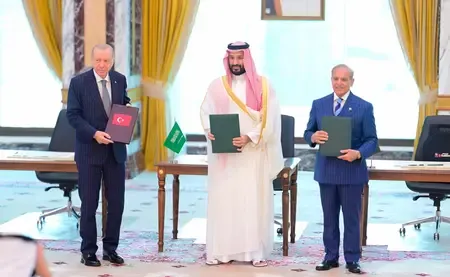
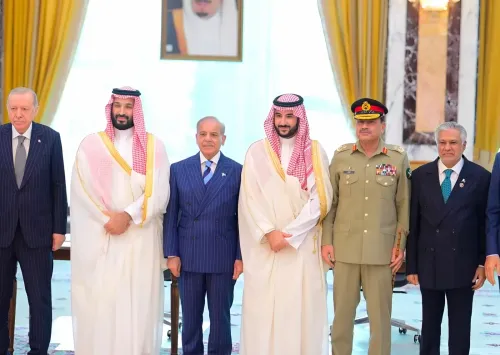
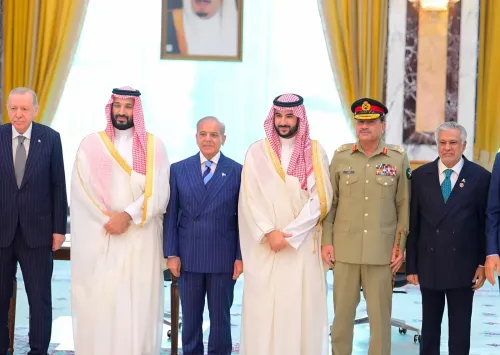
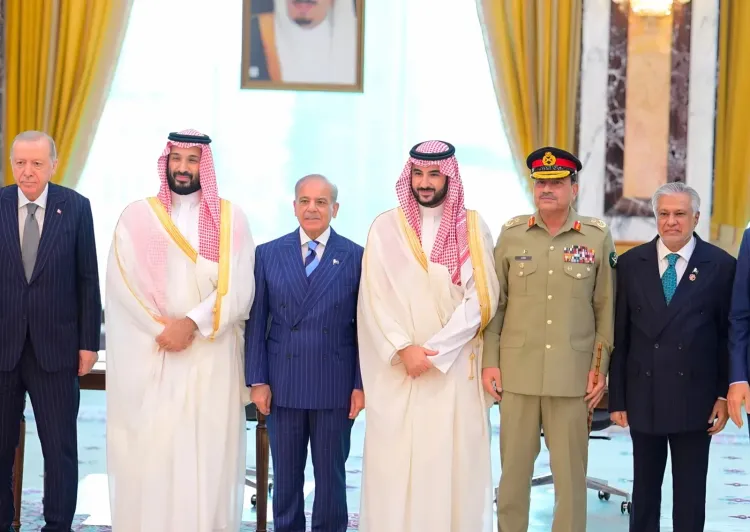
Turkey , Pakistan , and Saudi Arabia signed the Mecca Joint Defence Agreement on 7 August , committing to treat an attack on one as an attack on all.
A Politeia Research Foundation report argues Pakistan's alliance participation is driven primarily by the need for financial relief amid a persistent economic crisis.
Pakistan's alliance history spans SEATO (1954–1973) , CENTO (1955–1979) , the Islamic Military Counter Terrorism Coalition (2015) , and an SMDA with Saudi Arabia (September 2025) .
The report flags Pakistan's record of non-compliance: no support to the US during the Vietnam War, dual policy post-9/11, and neutrality during the Iran War.
Pakistan's nuclear status and value as a defence market for Turkey are cited as reasons Middle Eastern states continue to engage Islamabad despite its reliability concerns.
Pakistan's 'all-weather' partnership with China may constrain its ability to act independently on Middle Eastern issues, the report notes.
Pakistan's growing dependence on multilateral defence pacts is raising sharp questions about its reliability as an alliance partner and the absence of a coherent long-term economic strategy, according to a report by the Politeia Research Foundation. The analysis, published amid Islamabad's deepening economic crisis, argues that Pakistan's alliance choices are driven less by strategic vision and more by the immediate need for financial lifelines from oil-rich partners.
The Mecca Defence Agreement and What It Signals
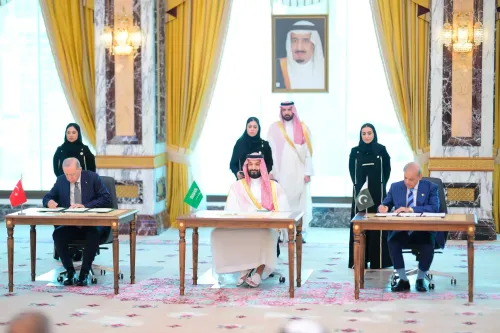
On 7 August, Turkey, Pakistan, and Saudi Arabia formalised the Mecca Joint Defence Agreement, under which 'any armed attack against any one of the three states shall be regarded as an attack against them all.' The pact has prompted analysis of the formation, effectiveness, and durability of alliances in the Middle East, with the Politeia Research Foundation report flagging structural weaknesses in Islamabad's approach to such commitments.
A History of Alliance-Hopping
The report characterises Pakistan as uniquely 'addicted to alliances' compared with its South Asian counterparts. The chronology is extensive: the Mutual Defence Assistance Agreement with the United States in 1954; membership of the Southeast Asia Treaty Organisation (SEATO, 1954–1973); membership of the Central Treaty Organisation (CENTO, 1955–1979); a pivotal role in facilitating the China-Pakistan-US alignment in 1971; membership of the Islamic Military Counter Terrorism Coalition (2015); and a Strategic Mutual Defence Agreement (SMDA) with Saudi Arabia in September 2025. The latest addition is the Mecca Joint Defence Agreement of August this year.
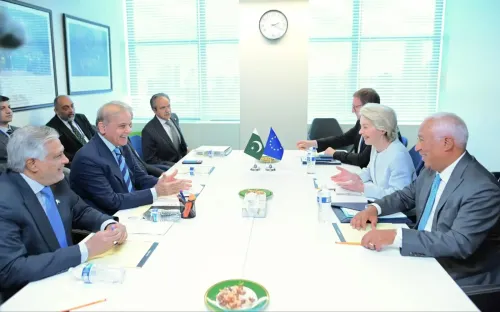
Separately, Pakistan maintains what it describes as an 'all-weather strategic cooperative partnership' with China, coordinating closely on regional and global issues. The report notes that given Pakistan's reliance on Chinese support to manage its rivalry with India, Islamabad 'may find it difficult to act unilaterally on crucial issues in the Middle East without Chinese consent.'
Loyalty Under Scrutiny
Pakistan's track record as an alliance partner draws pointed scrutiny in the report. Despite SEATO membership, Islamabad did not support the United States during the Vietnam War in the 1970s. After receiving what it considered inadequate backing from CENTO members during the 1965 and 1971 conflicts with India, Pakistan withdrew from that framework altogether.
Following the Soviet invasion of Afghanistan in 1979, Pakistan channelled US military assistance to the Mujahideen while simultaneously using that support to bolster its own military capabilities vis-à-vis India. After the 9/11 attacks, Islamabad pursued what the report describes as a dual policy — backing the US-led military intervention while also providing shelter to the Taliban.
More recently, during what the report refers to as the 'Iran War,' Pakistan chose to position itself as a neutral mediator rather than back its Arab partners — a posture the report describes as 'less-than-satisfactory' for an alliance member.
Why Middle Eastern States Still Want Pakistan
Despite this record, Pakistan has been brought into the Mecca Defence Agreement. The report suggests two explanations: Pakistan's status as a nuclear-armed state makes it a strategically valuable partner for Middle Eastern countries; and for Turkey specifically, Pakistan represents a significant defence export market. The economic dimension — Islamabad's dependence on Gulf states for short-term financial relief — runs as an undercurrent throughout, underscoring what the report calls a structural absence of long-term economic planning.
What This Means Going Forward
The convergence of Pakistan's nuclear deterrent, its chronic economic vulnerability, and its layered alliance commitments creates a complex strategic picture. Analysts will be watching whether the Mecca Joint Defence Agreement proves more durable than its predecessors — or whether Islamabad's pattern of selective compliance reasserts itself when alliance obligations conflict with its bilateral interests, particularly with China.
Point of View
Yet its record of selective compliance is equally consistent. The Mecca Joint Defence Agreement is the latest entry in a pattern where Islamabad joins pacts for the financial and diplomatic oxygen they provide, then hedges when obligations become costly. The more revealing detail in the Politeia report is the China constraint: if Pakistan cannot act on Middle Eastern issues without Beijing's consent, its new Gulf partners are not gaining a free agent — they are gaining a proxy with a prior principal. That is a material risk that the Mecca signatories appear to have accepted, possibly because Pakistan's nuclear deterrent is seen as worth the ambiguity. Whether that calculus holds under actual stress is the question no alliance document can answer.
NationPress
7 Oct 2026
Frequently Asked Questions
What is the Mecca Joint Defence Agreement signed by Pakistan?
The Mecca Joint Defence Agreement, signed on 7 August by Turkey, Pakistan, and Saudi Arabia, is a mutual defence pact under which an armed attack on any one of the three states is treated as an attack on all three. It is Pakistan's most recent formal alliance commitment and has drawn scrutiny over Islamabad's reliability as a partner.
Why does Pakistan join so many alliances?
According to a Politeia Research Foundation report, Pakistan's alliance participation is largely driven by the need for short-term financial assistance amid a chronic economic crisis, rather than a coherent long-term strategic vision. Its reliance on oil-rich Middle Eastern states for economic relief is cited as a key motivator.
What is Pakistan's track record as an alliance partner?
The report highlights several instances of non-compliance: Pakistan did not support the US during the Vietnam War despite SEATO membership, withdrew from CENTO after the 1965 and 1971 conflicts, pursued a dual policy post-9/11 by backing the US intervention while sheltering the Taliban, and acted as a neutral mediator rather than supporting Arab allies during the Iran War.
How does Pakistan's relationship with China affect its new Gulf alliances?
The report notes that Pakistan's 'all-weather strategic cooperative partnership' with China means Islamabad may find it difficult to act unilaterally on Middle Eastern issues without Chinese consent, potentially limiting its value as an independent partner to Saudi Arabia and Turkey.
Why do Middle Eastern countries still want Pakistan as an ally despite its record?
The report suggests two main reasons: Pakistan's status as a nuclear-armed state gives it strategic weight that Gulf countries find valuable, and for Turkey in particular, Pakistan is an important defence export market. These factors appear to outweigh concerns about Islamabad's past alliance behaviour.