Mobile Phone Manufacturing Scheme to drive backward integration: Industry

Synopsis
India's Mobile Phone Manufacturing Scheme isn't just another policy announcement — it arrives as 106 ECMS projects are already approved and 38 plants are operational. With mobile exports up 165-fold since FY15 and ₹61,671 crore committed in one ECMS round alone, India is making its most credible bid yet to move from final assembler to full-stack electronics manufacturer.
Key Takeaways
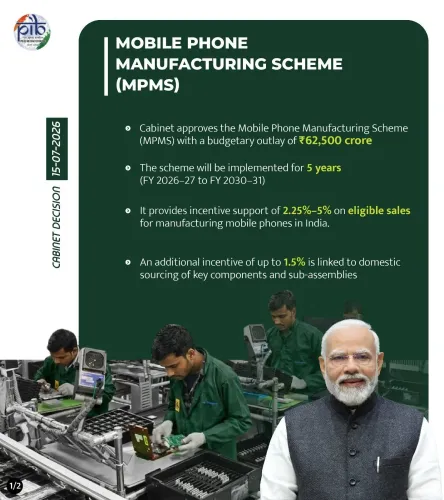
India's newly approved Mobile Phone Manufacturing Scheme (MPMS) aims to accelerate local value addition and backward integration in electronics.
The Electronics Components Manufacturing Scheme (ECMS) has 106 approved projects , 38 operational plants , and 16 more under construction.
31 additional ECMS proposals were approved with projected investment of ₹6,844 crore in under five months of an earlier ₹61,671 crore round.
Mobile phone production has risen 33-fold and exports 165-fold in FY26 compared to FY15 , according to EY India .
The MPMS offers additional incentives for domestic component sourcing and R&D, with a specific focus on Indian mobile phone brands.
India's newly approved Mobile Phone Manufacturing Scheme (MPMS) is set to accelerate local value addition, reduce supply-chain dependencies, and deepen backward integration across the electronics sector, industry leaders said on Saturday, 22 August. The announcement comes as approvals under the companion Electronics Components Manufacturing Scheme (ECMS) have already moved from policy to production.
Key Developments on the Ground
According to industry leaders, the ECMS has seen 106 projects approved, with 38 operational plants and 16 more in advanced stages of construction. The pace signals that India's electronics manufacturing push is gaining tangible traction beyond headline announcements.
Ashok Chandak, President of SEMI India and IESA, said the momentum reflects what the industry had long called for. 'This is exactly the momentum IESA had called for when we said the next phase must focus on scaling up, building strong design teams, local sourcing, and world-class quality — and today's numbers show that shift is already underway,' he said.
From Assembly Hub to Components Powerhouse
India has historically been dependent on imported components — from multilayer PCBs and display modules to sensors and relays. Chandak noted that the country is now repositioning itself from being a market for the world to a production hub for the world.
He pointed to the approval of 31 additional proposals under the ECMS, carrying projected investment of ₹6,844 crore, cleared in under five months of an earlier round that approved 75 applications involving investment of ₹61,671 crore. The projects span first-ever domestic manufacturing of critical components including filters, coils, and speakers, as well as essential raw materials such as acetylene black and electrolyte additives.
This scale, Chandak argued, reflects a structural shift — from an assembly-led model to a components-and-materials-led model with Indian IP, Indian design input, and Indian manufacturing embedded at every stage.
What the MPMS Promises
Prashant Singhal, Telecom and Clients & Industries Leader at EY India, said the MPMS is expected to build on the success of its predecessor scheme. 'The Mobile Phone Manufacturing Scheme is expected to build on the success of the earlier scheme with mobile phone production increasing 33-fold and mobile phone exports increasing 165-fold in FY26 as compared to FY15,' he said.
The scheme also provides additional incentives for domestic component sourcing and R&D, offering strong policy support specifically for Indian mobile phone brands — a deliberate tilt toward nurturing homegrown players rather than solely attracting global assemblers.
Why This Matters for India's Electronics Ambitions
This comes amid India's broader push to position itself as a credible alternative to China in global electronics supply chains. The MPMS and ECMS together signal a two-layer strategy: first, scale up mobile assembly; second, build the component ecosystem underneath it. Without the second layer, India risks remaining a final-assembly node dependent on imported inputs — a vulnerability the government appears determined to address. The next critical test will be whether production milestones and employment outcomes match the investment commitments on paper.
Point of View
But it largely reflects the success of final assembly — the low-margin end of the value chain. The real question the MPMS must answer is whether India can build the component layer underneath: PCBs, sensors, display modules, and the raw materials that feed them. The ECMS approvals are encouraging, but approvals are not output. India has a long history of incentive schemes that fill spreadsheets without filling factories. The structural shift Chandak describes — from assembly-led to components-and-materials-led — is exactly right as an ambition. Whether disbursement conditions are tight enough to enforce it is what mainstream coverage is not yet asking.
NationPress
22 Aug 2026
Frequently Asked Questions
What is the Mobile Phone Manufacturing Scheme (MPMS)?
The MPMS is a newly approved Indian government scheme designed to build on the country's earlier mobile manufacturing push, offering incentives for domestic component sourcing and R&D. It aims to deepen backward integration so that more of the mobile phone supply chain — not just final assembly — is produced within India.
How much has India's mobile phone exports grown under the earlier scheme?
According to EY India, mobile phone exports have risen 165-fold in FY26 compared to FY15, while production has increased 33-fold over the same period. The MPMS is intended to sustain and deepen that trajectory.
What is the Electronics Components Manufacturing Scheme (ECMS) and how is it progressing?
The ECMS is a companion scheme to the MPMS, focused on building India's domestic components ecosystem. As of 22 August, it has 106 approved projects, 38 operational plants, and 16 more in advanced construction stages, with total committed investment exceeding ₹61,671 crore across two approval rounds.
Which components is India manufacturing domestically for the first time under these schemes?
The ECMS projects include first-ever domestic manufacturing of critical components such as filters, coils, and speakers, as well as essential raw materials including acetylene black and electrolyte additives.
Why is backward integration important for India's electronics sector?
India has historically imported critical components — from multilayer PCBs and display modules to sensors and relays — making it vulnerable to global supply-chain disruptions. Backward integration means producing these components domestically, reducing import dependence and building a more resilient, higher-value electronics industry.