NICDC kicks off cross-learning programme at AURIC Smart City to scale industrial corridor best practices
Synopsis
NICDC has turned AURIC Smart City into a live classroom — bringing together state officials, SPVs, and EPC contractors to learn from Maharashtra's Shendra-Bidkin model and carry those lessons to industrial corridor projects across the country. With BHAVYA's plug-and-play parks on the agenda, the programme signals a shift from one-off execution to a replicable national playbook.
Key Takeaways
NICDC and MITL launched a two-day cross-learning site visit to AURIC Smart City in Maharashtra on 23 July .
NICDC CEO Rajat Kumar Saini called AURIC a benchmark for integrated industrial city development under NICDP .
Participants included senior officials from state governments, SPVs , PMNCs , and EPC contractors .
Sessions covered digital governance, integrated master planning, land utilisation, and investor facilitation.
The Bharat Audyogik Vikas Yojana (BHAVYA) — NICDC's flagship plug-and-play industrial parks scheme — was a key agenda item.
Saini stressed giving SPVs greater planning flexibility for efficient land use and future expansion.
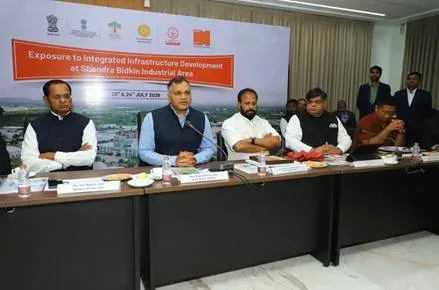
The National Industrial Corridor Development Corporation (NICDC), in partnership with Maharashtra Industrial Township Limited (MITL), on Thursday, 23 July launched a two-day cross-learning site visit to the Shendra-Bidkin Industrial Area (AURIC Smart City) in Maharashtra, aimed at replicating best practices in Greenfield industrial smart city development across India. The initiative brings together senior officials from state governments, Special Purpose Vehicles (SPVs), Programme Managers for New Cities (PMNCs), EPC contractors and other stakeholders to exchange knowledge on planning, implementation and operations.
Why AURIC Was Chosen as the Model
NICDC Chief Executive Officer and Managing Director Rajat Kumar Saini described AURIC as a benchmark for integrated industrial city development under the National Industrial Corridor Development Programme (NICDP). He said the project demonstrates how world-class infrastructure, investor-centric planning, technology-enabled governance and multimodal connectivity can together build globally competitive manufacturing ecosystems.
Saini also stressed the importance of giving Special Purpose Vehicles greater planning flexibility to enable efficient land utilisation, infrastructure optimisation and future expansion — flagging it as a structural priority for scaling the programme nationally.
What the First Day Covered
On the opening day, participants received a detailed overview of AURIC's planning framework and integrated infrastructure. The sessions included presentations on the development of the Shendra-Bidkin Industrial Area, demonstrations of digital planning and monitoring systems, and on-ground visits to operational industrial units, utility infrastructure, connectivity projects and industrial development facilities.
Deliberations covered integrated master planning, project implementation, land utilisation, investor facilitation, digital governance and project monitoring. Participants also exchanged experiences on improving coordination among implementing agencies and accelerating infrastructure delivery across industrial corridors.
BHAVYA Scheme in Focus
A significant portion of the programme was devoted to discussions on the Bharat Audyogik Vikas Yojana (BHAVYA), NICDC's flagship initiative to develop world-class plug-and-play industrial parks nationwide. Participants explored how AURIC's experience in integrated planning, digital governance, utility infrastructure and investor facilitation could be directly leveraged for projects being developed under the scheme.
The Broader Significance
The cross-learning initiative reflects a deliberate institutional strategy by NICDC to move away from siloed project execution toward a shared-knowledge model. As India scales its industrial corridor programme across multiple states, replicating what works at AURIC — from digital governance to plug-and-play infrastructure — could significantly compress timelines and reduce implementation risk at newer sites. The two-day programme concludes on Friday, 25 July, with further site visits and stakeholder deliberations planned.
Point of View
But the speed at which newer corridor sites absorb AURIC's governance and digital infrastructure lessons will ultimately determine whether India's manufacturing ambitions translate into operational industrial cities — or remain on the master plan.
NationPress
22 Oct 2026
Frequently Asked Questions
What is the NICDC cross-learning programme at AURIC Smart City?
It is a two-day site visit launched on 23 July by NICDC and MITL at the Shendra-Bidkin Industrial Area (AURIC Smart City) in Maharashtra, designed to help officials from state governments, SPVs, and EPC contractors learn from AURIC's integrated planning and governance model and replicate it across India's industrial corridors.
What is AURIC Smart City and why is it significant?
AURIC, or the Shendra-Bidkin Industrial Area, is a Greenfield industrial smart city in Maharashtra developed under the National Industrial Corridor Development Programme. NICDC has cited it as a benchmark for world-class infrastructure, investor-centric planning, digital governance, and multimodal connectivity in industrial city development.
What is the Bharat Audyogik Vikas Yojana (BHAVYA)?
BHAVYA is NICDC's flagship scheme to develop plug-and-play industrial parks across India. The cross-learning programme included discussions on how AURIC's experience in integrated planning, utility infrastructure, and digital governance can be applied to projects being developed under BHAVYA.
Who participated in the AURIC cross-learning site visit?
The programme brought together senior officials from state governments, Special Purpose Vehicles (SPVs), Programme Managers for New Cities (PMNCs), EPC contractors, and other stakeholders involved in the planning and implementation of Greenfield industrial smart cities.
What did NICDC's CEO say about SPVs at the programme?
NICDC CEO and MD Rajat Kumar Saini stressed the need to give Special Purpose Vehicles greater planning flexibility to enable efficient land utilisation, infrastructure optimisation, and future expansion — framing it as essential for scaling the industrial corridor programme nationally.