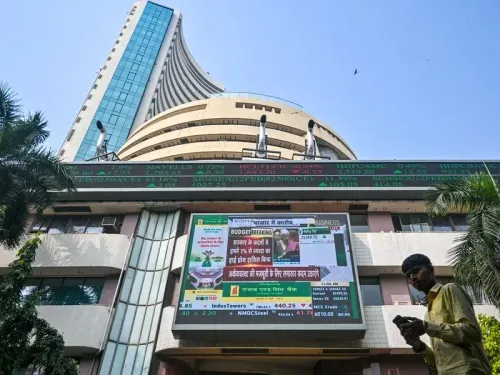
Sensex drops 600 points as Brent crude nears $80 on West Asia crisis

Synopsis
A weekend US military strike on Iran — met by Iranian counterattacks on US bases in Kuwait and Bahrain — sent Brent crude surging past $80 and opened Indian equities sharply lower. With the $90-per-barrel threshold now in focus, the West Asia crisis has moved from background noise to a direct market risk for India's oil-import-heavy economy.
Key Takeaways
Sensex opened 600+ points lower at 76,963.35 on 13 July amid West Asia tensions.
Nifty50 declined 167.50 points to open at 24,039.40 .
Brent crude surged more than 4 per cent to around $80 per barrel ; WTI rose 4.55 per cent to $74.66 .
US forces struck targets in Iran ; Iran's Revolutionary Guards claimed retaliatory attacks on US bases in Kuwait and Bahrain .
Experts warn of 'significant correction' if Brent crosses $90 per barrel .
South Korea's KOSPI slumped more than 6 per cent ; FII inflows offering partial cushion to Indian markets.
Indian equity markets opened sharply lower on Monday, 13 July, as Brent crude surged more than 4 per cent to trade around $80 per barrel, rattled by a fresh escalation in the West Asia conflict. The selloff reflects mounting anxiety over energy costs for oil-import-dependent economies like India.
Opening Bell: How Markets Reacted
The BSE Sensex opened at 76,963.35, shedding over 600 points or 0.78 per cent from its previous close. The Nifty50 began the session at 24,039.40, declining 167.50 points or 0.69 per cent.
Among the top losers were IndiGo, Tata Steel, Asian Paints, Shriram Finance, Bajaj Finance, and HDFC Bank. Sector-wise, Nifty Auto and Nifty Metal led the decline, falling up to 1 per cent. Nifty Consumer Durables, Nifty PSU Bank, and Nifty Private Bank also came under selling pressure. Nifty IT and Nifty Pharma bucked the trend, gaining up to 0.6 per cent.
The West Asia Flashpoint
The geopolitical trigger came over the weekend, when US forces used precision munitions to strike dozens of targets across multiple locations in Iran, according to the US Central Command. Iran's Revolutionary Guards subsequently claimed to have attacked US military bases in Kuwait and Bahrain, further inflaming tensions.
This tit-for-tat escalation pushed Brent crude up more than 4 per cent to around $80 per barrel, while US West Texas Intermediate (WTI) crude rose 4.55 per cent to $74.66 per barrel. This comes amid a pattern of recurring West Asia flare-ups that have repeatedly tested India's macro stability, given that the country imports roughly 85 per cent of its crude requirements.
What Market Experts Said
Market analysts noted that the back-and-forth developments in the West Asia crisis have become the 'new normal', generating persistent uncertainty for energy importers. 'From the market perspective, particularly for India, the price of crude is the crucial factor. Brent is currently trading around $80. So long as Brent trades below $90, the market won't be impacted significantly. But if Brent shoots above $90, there can be a significant correction in the market,' experts said.
They also pointed out that sustained foreign institutional investor (FII) inflows are providing a degree of resilience to domestic markets, with global investors reportedly shifting allocations towards India amid concentration risks in South Korea's chip sector.
Asian Markets Also Under Pressure
The risk-off mood was not confined to India. Across Asia, major indices traded lower: Japan's Nikkei fell 1.6 per cent, Hong Kong's Hang Seng declined 0.20 per cent, and South Korea's KOSPI slumped more than 6 per cent — the steepest fall in the region, compounded by domestic chip-sector concerns.
What to Watch
The trajectory of Brent crude relative to the $90 per barrel threshold will be the key variable for Indian markets in the sessions ahead. Any further military escalation in West Asia — particularly involving oil-transit chokepoints — could accelerate the selloff. Conversely, a de-escalation could quickly reverse the crude spike and restore risk appetite.
Point of View
Not a structural India re-rating. If crude stays elevated and the conflict widens, that rotation trade could reverse quickly. Markets are pricing a contained crisis; the risk is that containment fails.
NationPress
12 Oct 2026
Frequently Asked Questions
Why did the Sensex fall on 13 July 2025?
The Sensex dropped over 600 points at the open on 13 July after Brent crude surged more than 4 per cent to around $80 per barrel, triggered by a US military strike on targets in Iran and retaliatory Iranian attacks on US bases in Kuwait and Bahrain. The geopolitical escalation stoked energy-cost fears for oil-import-dependent India.
What is the crude oil price threshold that could cause a bigger market correction?
Market experts have flagged $90 per barrel as the critical level for Brent crude. Below $90, the impact on Indian markets is expected to remain manageable; above that threshold, analysts warn of a significant correction in domestic equities.
Which sectors and stocks were worst hit in Monday's selloff?
Nifty Auto and Nifty Metal led sectoral losses, falling up to 1 per cent. Among individual stocks, IndiGo, Tata Steel, Asian Paints, Shriram Finance, Bajaj Finance, and HDFC Bank were among the top losers. Nifty IT and Nifty Pharma were the exceptions, gaining up to 0.6 per cent.
How did other Asian markets react to the West Asia escalation?
Asian markets broadly declined: Japan's Nikkei fell 1.6 per cent, Hong Kong's Hang Seng dropped 0.20 per cent, and South Korea's KOSPI slumped more than 6 per cent — the steepest regional fall, compounded by domestic semiconductor-sector concerns.
Are foreign institutional investors still buying Indian stocks despite the crisis?
According to market experts, sustained FII inflows are providing some resilience to Indian markets, with global investors reportedly shifting allocations towards India partly due to concentration risks in South Korea's chip sector. However, analysts caution this cushion could reverse if the conflict widens and crude stays elevated.