Seoul stocks dip 2% as foreign sell-off hits tech on AI boom fears
Synopsis
South Korea's KOSPI shed over 2% in a single session on Monday, with SK Square crashing 7% and SK Hynix down 4.28% — all triggered by Jensen Huang's exit from Nvidia unsettling the AI boom narrative. Paradoxically, the same day's data showed South Korean ICT exports tripled year-on-year to $70.35 billion in October. The market is betting on a cooldown that the trade numbers don't yet confirm.
Key Takeaways
The KOSPI fell 109.57 points (2.07%) to 5,180.96 as of 11:20 a.m. on 16 November 2026 .
SK Square tumbled 7.02% ; SK Hynix plunged 4.28% ; Samsung Electronics fell 2.67% .
The sell-off was sparked by Nvidia CEO Jensen Huang 's departure, which raised fears about the AI boom's sustainability.
South Korea's ICT exports hit US$70.35 billion in October — the sharpest year-on-year growth on record — providing a counterpoint to the equity sell-off.
ICT exports made up 61% of total outbound shipments of $115.28 billion in October, above 60% for three consecutive months.
The Korean won traded at 1,335.2 per US dollar , up 2.4 won from the prior session.
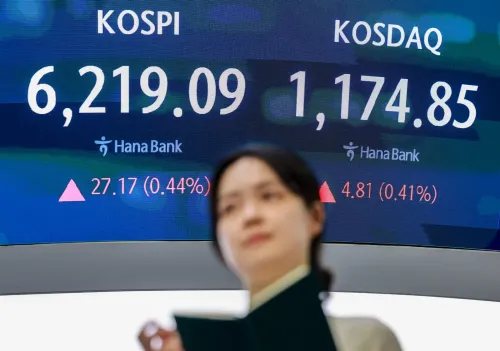
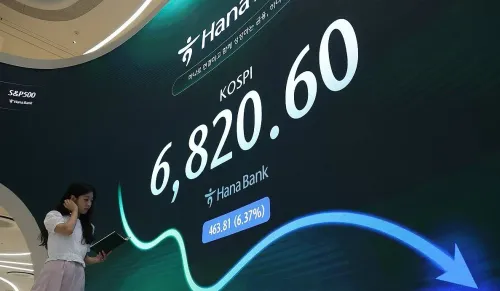
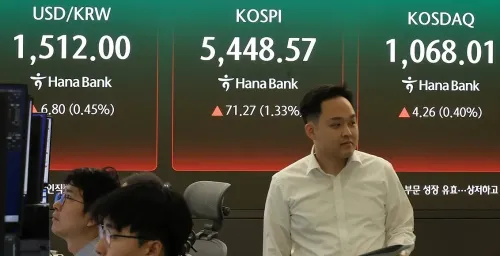
South Korean stocks fell sharply on Monday, 16 November 2026, with the benchmark Korea Composite Stock Price Index (KOSPI) shedding 109.57 points, or 2.07 percent, to 5,180.96 as of 11:20 a.m. local time, driven by heavy foreign selling of technology shares amid renewed doubts about the long-term sustainability of the global artificial intelligence (AI) boom.
What Triggered the Sell-Off
The Monday decline followed a sharp plunge in the KOSPI on the preceding Friday, sparked by uncertainty surrounding the global AI ecosystem after Nvidia CEO Jensen Huang's departure from the company. Huang is widely credited with spearheading the current AI-driven semiconductor upcycle, and his exit has rattled investors with heavy exposure to AI-linked chipmakers. The KOSPI had opened 0.28 percent lower before briefly turning positive, only to extend losses through the mid-morning session.
Heavyweights Lead the Decline
Market heavyweights bore the brunt of the sell-off. Samsung Electronics, the index's top market-cap stock, fell 2.67 percent, while chip giant SK Hynix plunged 4.28 percent. Samsung Electro-Mechanics declined a steeper 5.96 percent, and SK Square — the parent company of SK Hynix — tumbled 7.02 percent. Leading automaker Hyundai Motor slipped a comparatively modest 1.11 percent. The Korean won was trading at 1,335.2 won per US dollar as of 11:20 a.m., up 2.4 won from the previous session's close.
Record ICT Export Data Offers a Counterpoint
The sell-off came on the same day that separate government data highlighted the remarkable strength of South Korea's technology export engine. Outbound shipments of information and communication technology (ICT) products reached US$70.35 billion in October, more than tripling from $23.29 billion a year earlier — the sharpest year-on-year growth rate on record, according to the Ministry of Science and ICT. The October figure was the second-highest monthly total ever recorded, just below the $75.1 billion posted in September. Notably, ICT exports accounted for 61 percent of South Korea's total outbound shipments of $115.28 billion in October, with that proportion holding above 60 percent for three consecutive months — underlining how structurally dependent the economy has become on AI-linked demand.
What This Means for Markets
The divergence between record export data and a sharp equity sell-off illustrates the fragility of sentiment-driven markets. Investors appear to be pricing in a scenario where the AI hardware supercycle — which has turbocharged South Korean chip revenues — could stall if key architects of the boom exit or if US technology spending moderates. This is the second consecutive session of significant KOSPI losses tied to AI ecosystem uncertainty. Watch for further volatility if global technology stocks remain under pressure in the near term.
Point of View
With ICT now above 60% of total exports for three straight months, to absorb a prolonged narrative shift without real earnings pain. The divergence between the export ledger and the trading screen is the story investors will be forced to reconcile in the sessions ahead.
NationPress
16 Nov 2026
Frequently Asked Questions
Why did South Korean stocks fall on 16 November 2026?
The KOSPI fell 2.07% to 5,180.96 on 16 November due to heavy foreign selling of technology shares, triggered by uncertainty over the global AI ecosystem following Nvidia CEO Jensen Huang's departure. Investors fear the AI-driven semiconductor supercycle may lose momentum without its key architect.
Which stocks were hit hardest in the KOSPI sell-off?
SK Square was the biggest loser, falling 7.02%, followed by SK Hynix at 4.28%, Samsung Electro-Mechanics at 5.96%, and Samsung Electronics at 2.67%. Hyundai Motor declined a comparatively modest 1.11%.
What impact did Jensen Huang's exit from Nvidia have on markets?
Huang's departure raised concerns about the sustainability of the AI boom, since he is widely seen as central to Nvidia's dominance in AI chips. This spooked investors in AI-exposed South Korean chipmakers, triggering two consecutive sessions of sharp KOSPI losses.
How did South Korea's ICT export data look in October 2026?
South Korean ICT exports surged to US$70.35 billion in October — more than tripling from $23.29 billion a year earlier — marking the sharpest year-on-year growth on record, according to the Ministry of Science and ICT. The figure was the second-highest monthly total ever, just below September's $75.1 billion.
What share of South Korea's total exports does ICT represent?
ICT products accounted for 61% of South Korea's total outbound shipments of $115.28 billion in October, with the proportion staying above 60% for three consecutive months — underscoring how heavily the economy relies on AI-linked technology demand.