Bangladesh violence surges ahead of Hasina's return; Tarique Rahman rattled
Synopsis
Bangladesh is on edge. With Sheikh Hasina's return reportedly planned for December and her passport request rejected, the banned Awami League has launched nationwide protests — triggering arson, crude bomb blasts and clashes that have rattled a prime minister barely nine months into office. The country is now navigating its most volatile political moment since the August 2024 ouster.
Key Takeaways
Prime Minister Tarique Rahman is reportedly unsettled by the scale of Awami League -led protests ahead of Sheikh Hasina 's planned return to Bangladesh .
Authorities rejected Sheikh Hasina 's request for a fresh passport and identity card, triggering a week-long protest programme that culminated in a nationwide shutdown on 19 November .
The ancestral home of Muhammad Yunus in Chattogram was set ablaze on 18 November ; crude bombs and arson attacks also targeted ministers' residences in Dhaka and Sylhet .
Nearly 30 houses linked to Awami League leaders were vandalised or burned across districts including Patuakhali .
The BNP government formalised a parliamentary ban on the Awami League , which critics argue deepened the political confrontation and foreclosed reconciliation.
Analysts warn of prolonged instability if the cycle of violence and counter-agitation continues ahead of Hasina 's planned December return.
Fresh political violence has erupted across Bangladesh as the country braces for the proposed return of ousted former Prime Minister Sheikh Hasina from exile in India, with reports indicating that Prime Minister Tarique Rahman is visibly unsettled by the scale of public mobilisation behind Awami League-led protests and shutdowns.
The Trigger: Hasina's Planned Return and Passport Rejection
The latest escalation was reportedly set off after Bangladeshi authorities rejected Sheikh Hasina's request for a fresh passport and national identity card — documents she had sought to facilitate a planned return to Bangladesh in December 2026. In response, the banned Awami League announced a week-long programme of protests and demonstrations, culminating in a nationwide shutdown on 19 November. The political mobilisation was swiftly followed by reports of widespread violence, arson attacks, crude bomb explosions and clashes between rival political groups.
Key Incidents of Violence
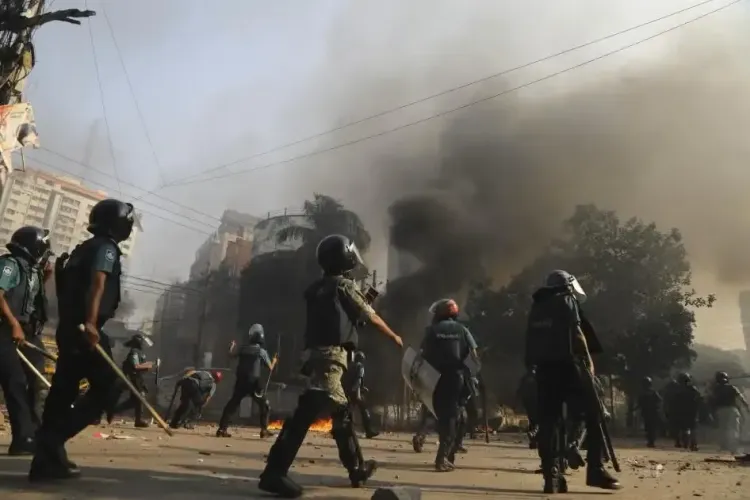
The scale and spread of the unrest has been significant. The ancestral home of Nobel laureate and interim government head Muhammad Yunus in Chattogram was set ablaze late on 18 November, according to police reports. In Dhaka, a crude bomb exploded outside the residence of Cultural Affairs Minister Nitai Roy Chowdhury. An arson incident was separately reported outside the home of State Minister for Foreign Affairs Humayun Kabir in Sylhet.
Further reports indicated that nearly 30 houses linked to Awami League leaders were set on fire or vandalised across multiple districts, including Patuakhali. Clashes between Bangladesh Nationalist Party (BNP) and Awami League supporters were also reported in Pabna. Local media reported that tensions remained high through the weekend with retaliatory attacks continuing across several parts of the country.
What Analysts Are Saying
An opinion article published in Eurasia Review, authored by Subir Bhaumik, offered a pointed assessment of the political situation. 'The Prime Minister (Tarique Rahman), barely into his ninth month in office, is clearly unnerved by the widespread public response to recent strikes and lockdowns by the Awami League ahead of their supremo's planned return to Bangladesh to face justice,' Bhaumik wrote.
The article argued that the BNP government missed a potential opening for political reconciliation by not lifting the ban on the Awami League — a ban originally imposed by the interim administration led by Muhammad Yunus after the party was removed from power in August 2024. Instead, the newly elected BNP government went further by formalising the ban through Parliament, critics argue, deepening the confrontation with the opposition.
The article also alleged that BNP party cadres had been allowed to engage in large-scale violence, citing the unrest in Narail on Friday as a specific example. It warned that the Awami League, fighting for its political survival, could retaliate using whatever means remain available to it.
The Broader Political Stakes
The Awami League remains one of Bangladesh's largest political parties despite its ban, a fact that complicates the BNP's long-term governance calculus. The interim administration under Muhammad Yunus had initially restricted the party's activities — a decision the Eurasia Review article described as going beyond the mandate of a caretaker government. The BNP's decision to legislatively entrench the ban has, according to analysts, foreclosed a diplomatic route out of the standoff.
This comes amid growing concern that Bangladesh risks sliding into prolonged political instability. If the cycle of strikes, counter-violence and reciprocal attacks continues, analysts warn, meaningful reconciliation will become increasingly difficult to achieve.
What Comes Next
All eyes are now on whether Sheikh Hasina's return in December materialises, and how the government responds if she attempts to re-enter the country. The BNP government's posture — and whether it softens its stance on the passport issue — will likely determine the intensity of unrest in the weeks ahead.
Point of View
Where it becomes less predictable and more combustible. The passport refusal was the spark, but the tinder has been accumulating since August 2024. What mainstream coverage understates is how the BNP's overreach may ultimately serve Hasina's interests — every incident of state-aligned violence against Awami League supporters generates international sympathy and domestic grievance that she can convert into political capital the moment she returns.
NationPress
22 Nov 2026
Frequently Asked Questions
Why is Bangladesh experiencing fresh political violence in November 2026?
The violence follows the rejection of former Prime Minister Sheikh Hasina's passport application and her planned return to Bangladesh in December, which prompted the banned Awami League to launch a week-long protest programme culminating in a nationwide shutdown on 19 November. Clashes between BNP and Awami League supporters, arson attacks and crude bomb blasts have since spread across several districts.
Why is Bangladesh PM Tarique Rahman described as 'unnerved'?
According to an opinion article in Eurasia Review authored by Subir Bhaumik, Tarique Rahman — barely nine months into office — is rattled by the widespread public response to Awami League strikes and shutdowns. The article cited the scale of mobilisation as evidence that the ban on the Awami League has not suppressed its political reach.
When is Sheikh Hasina expected to return to Bangladesh?
Hasina's return has been reported as planned for December 2026, though the Bangladeshi authorities' rejection of her passport and national identity card application has cast uncertainty over the timeline. Sceptics, according to reports, continue to view the return with uncertainty.
What is the Awami League's current legal status in Bangladesh?
The Awami League has been banned since it was removed from power in August 2024. The interim government under Muhammad Yunus initially restricted its political activities, and the newly elected BNP government subsequently formalised the ban through Parliament.
What were the most serious incidents of violence reported?
The ancestral home of Muhammad Yunus in Chattogram was set ablaze on 18 November. A crude bomb exploded outside the residence of Cultural Affairs Minister Nitai Roy Chowdhury in Dhaka, and an arson attack was reported at the home of State Minister for Foreign Affairs Humayun Kabir in Sylhet. Nearly 30 houses linked to Awami League leaders were also vandalised or burned across multiple districts.