Bangladesh foreign investor outflows hit $223 mn in FY26 amid policy, banking woes
Synopsis
Foreign investors pulled $223 million out of Bangladesh's stock market in FY26 — a 62% jump from the year before — and the root cause isn't just economics. Years of on-again, off-again floor prices have spooked institutional money so badly that MSCI paused Bangladesh's index reviews entirely. The BNP government has now cleared the last floor price, but market veterans warn that burned investors don't come back quickly.
Key Takeaways
Net foreign portfolio outflows from Bangladesh's stock market reached $223 million in FY26 , up from $138 million in FY25.
Outflows have been negative every year since FY21 , but are accelerating in pace.
BSEC reimposed floor prices on 169 companies in 2023 ; the final restrictions were lifted by the BNP government in June 2025 .
MSCI paused regular index reviews of Bangladesh after the floor price intervention; reviews are expected to resume from November 2026 .
Banking-sector stress and weak private-sector credit growth are compounding the negative outlook for corporate earnings.
Tax, capital-gains levies, and repatriation uncertainty are further reducing the market's appeal to foreign funds.
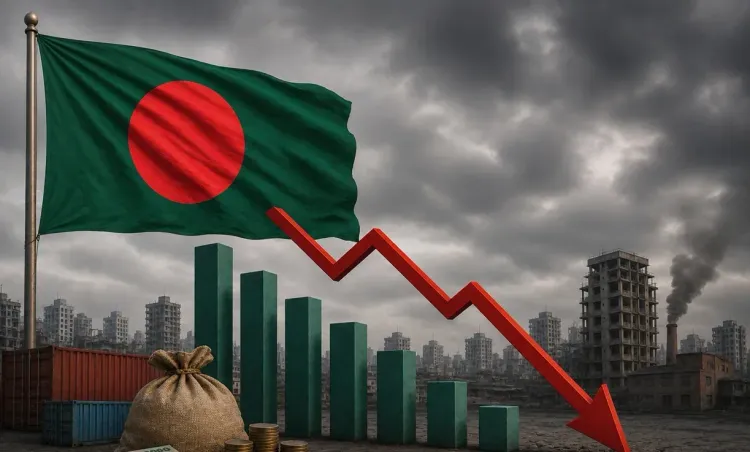
Bangladesh's stock market recorded net foreign portfolio outflows of $223 million in FY26, up sharply from $138 million the previous year, according to Bangladesh Bank data cited in a new report. Policy uncertainty, weak corporate earnings, banking-sector stress, and currency risks are driving the accelerating withdrawal, according to market observers.
Outflows Gathering Pace Since FY21
Net foreign portfolio investment has remained in negative territory every year since FY21, but the pace of outflows is intensifying. The $223 million exit in FY26 marks a 62% increase over the prior year's figure, signalling that investor confidence has not recovered despite some improvement in Bangladesh's broader macroeconomic indicators.
Market insiders have pointed to repeated policy interventions — particularly the use of floor prices in the equity market — as a key deterrent for foreign funds. 'Once investors burn their finger in a place, they cannot forget it easily,' said Kazi Monirul Islam, CEO of Shanta Asset Management, referring to the legacy of regulatory moves that made foreign institutional investors wary.
The Floor Price Controversy
The Bangladesh Securities and Exchange Commission (BSEC) first introduced floor prices in 2020 to arrest a pandemic-era market selloff. The restrictions were lifted in phases over subsequent years, only to be reimposed on 169 companies in 2023. The following year, the floor price was removed from all but 35 of those firms.
After the fall of the Awami League government in August 2024, the floor price was lifted from all but two companies. The BNP government, which took office in February 2025, removed the restriction on the remaining two companies in June 2025.
The repeated imposition and withdrawal of floor prices has had a measurable institutional cost. According to Saiful Islam, President of the DSE Brokers Association of Bangladesh (DBA), global index provider MSCI (Morgan Stanley Capital International) paused its regular index reviews of Bangladesh following the floor price intervention. MSCI is reportedly set to resume regular reviews from November 2026 following the full withdrawal of the floor price — a development that could gradually improve Bangladesh's standing with passive foreign investors.
Banking Stress and Credit Weakness
Beyond regulatory concerns, Bangladesh's banking sector remains under visible strain. Private-sector credit growth has weakened sharply, weighing on corporate investment, profitability, and asset quality across the financial system. Analysts say the deterioration in bank balance sheets has compounded uncertainty over corporate earnings, making equities less attractive to foreign allocators.
Tax and repatriation concerns have added another layer of friction. Capital-gains taxes, transaction costs, and uncertainty over the ability to repatriate funds have collectively reduced the market's appeal, according to the report.
What Comes Next
Experts caution that macroeconomic stabilisation alone will not be sufficient to reverse the outflow trend in the near term. Rebuilding foreign investor confidence will require sustained regulatory consistency, resolution of banking-sector stress, and clarity on repatriation rules. The resumption of MSCI index reviews in November 2026 represents a potential inflection point, though analysts warn that any fresh policy misstep could delay recovery further.
Point of View
But the more damaging number is five — the number of consecutive fiscal years Bangladesh has been in net foreign portfolio outflow territory. Regulatory inconsistency, not macroeconomic fundamentals, is the core problem: floor prices were introduced, lifted, reimposed, and lifted again across multiple administrations, each cycle eroding institutional trust further. The MSCI pause is a concrete, measurable consequence of that inconsistency, and its resumption in November 2026 is not a guarantee of inflows — it is merely a precondition. Bangladesh's new government has done the right thing by removing the last floor price, but without credible banking-sector reform and transparent repatriation rules, the structural deterrents remain firmly in place.
NationPress
1 Oct 2026
Frequently Asked Questions
How much did foreign investors pull out of Bangladesh's stock market in FY26?
Net foreign portfolio outflows from Bangladesh's stock market reached $223 million in FY26, according to Bangladesh Bank data. This is up from $138 million the previous year, marking a roughly 62% increase.
Why are foreign investors leaving Bangladesh's stock market?
Investors have cited policy uncertainty — particularly the repeated use and removal of floor prices — alongside weak corporate earnings, banking-sector stress, currency risks, and concerns over capital-gains taxes and repatriation of funds. Market insiders say the legacy of regulatory interventions has made foreign funds structurally wary.
What are floor prices and why did they cause problems?
Floor prices are regulatory price floors set by the BSEC to prevent stocks from falling below a certain level. First introduced in 2020 during the pandemic, they were lifted, reimposed on 169 companies in 2023, and only fully removed by June 2025. The repeated policy reversals signalled regulatory unpredictability to foreign investors.
What is the MSCI issue and when will it be resolved?
MSCI paused its regular index reviews of Bangladesh following the floor price intervention, which limits the country's visibility to passive global funds. According to the DSE Brokers Association of Bangladesh, MSCI is expected to resume regular reviews from November 2026 after the floor price was fully withdrawn.
Will foreign investor confidence in Bangladesh recover soon?
Experts are cautious. Despite improvements in macroeconomic fundamentals, market veterans warn that rebuilding investor trust takes time after repeated policy missteps. Sustained regulatory consistency, banking-sector reform, and clearer repatriation rules are seen as prerequisites for a meaningful recovery in foreign inflows.