Is Bangladesh's Instability Temporary? BJP Leader Weighs In
Synopsis
As Bangladesh faces instability, BJP leader Ram Madhav believes the situation is temporary. He emphasizes that upcoming elections are crucial for restoring accountability and normalizing India-Bangladesh relations. This perspective sheds light on the interconnected nature of South Asian politics and the necessity for democratic processes.
Key Takeaways
Instability in Bangladesh is seen as temporary.
Upcoming elections are critical for restoring accountability.
Political unrest often leads to minority attacks.
India aims for engagement with an elected government.
Strong cultural ties exist between India and Bangladesh.
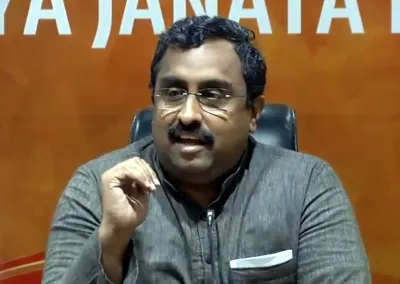
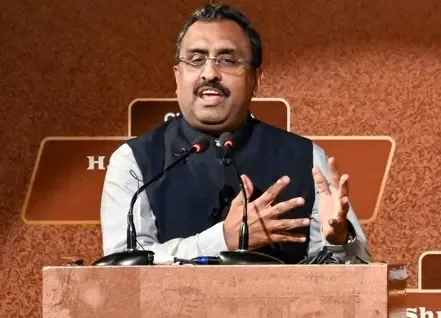
Washington, Jan 12 (NationPress) The current instability in Bangladesh raises concerns for India, but according to senior BJP leader Ram Madhav, it is likely to be a temporary situation. He conveyed optimism that upcoming elections could restore accountability and facilitate the normalization of bilateral relations.
During an interaction with OFBJP, Madhav noted that Bangladesh is experiencing a challenging phase, which he characterized as a street-level uprising that has led to the ascent of leaders lacking a democratic mandate.
"These leaders were never elected through any legitimate process, yet they hold power today," he remarked, emphasizing that such unaccountable governance has strained ties with India.
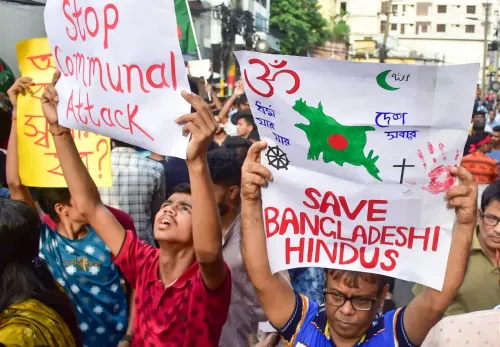
Madhav pointed out that internal instability in Bangladesh often results in assaults on minorities. He stated, "Whenever instability arises in Bangladesh, fundamentalist elements exploit the situation to target minorities, particularly Hindu minorities."
He labeled this situation as a serious concern, but reaffirmed India's perspective that it is merely a passing phase. "We perceive it as a temporary situation," he added.
The BJP leader expressed hope that elections anticipated early next year would usher in a change. "We look forward to the elections facilitating the emergence of an elected government," he stated.
Madhav emphasized that India does not aim to sway voters in neighboring nations. "It's unrealistic to expect the citizens of another country to elect a government favorable to you," he said.
However, he acknowledged that engaging with an elected government is typically more manageable. "An elected government is always easier to interact with compared to an unelected and unaccountable regime," he pointed out.
Madhav highlighted the interconnectedness between India and Bangladesh, stating, "As neighbors, India and Bangladesh are destined to navigate their paths together; there are no alternatives for either nation."
He drew parallels with Sri Lanka, suggesting that relations could improve following elections. "Once in power, it becomes feasible for us to engage with them," he said, referring to New Delhi's interactions with Colombo's new leadership despite previous tensions.
Madhav noted that challenges in the neighborhood are not unprecedented. "There has always been some degree of instability inherent to this region," he observed, mentioning that India is the only consistently stable democracy within South Asia.
He dismissed claims of a growing anti-India sentiment across the region. "That’s not the case," he asserted, explaining that most issues arise from domestic political unrest in neighboring countries.
According to Madhav, India’s approach remains characterized by restraint and engagement. "Elected governments possess a way to interact with each other," he explained.
India shares profound cultural, economic, and civilizational ties with Bangladesh, alongside ongoing political and security concerns. New Delhi has consistently emphasized that protecting minorities and ensuring democratic stability are paramount for achieving long-term regional peace.
Point of View
It is essential to recognize the complexities surrounding Bangladesh's current instability. While the situation poses challenges, the potential for change through democratic processes should not be underestimated. India remains committed to fostering a peaceful neighborhood, emphasizing the importance of cooperation and mutual respect.
NationPress
27 Sept 2026
Frequently Asked Questions
What is the current situation in Bangladesh?
Bangladesh is experiencing instability characterized by political unrest and a lack of democratic governance.
How does this instability affect India?
The instability in Bangladesh raises concerns for India, particularly regarding bilateral relations and minority safety.
What role do elections play in resolving this situation?
Elections are seen as a key factor in restoring accountability and normalizing relations between India and Bangladesh.
Does India seek to influence Bangladeshi elections?
India does not aim to influence voters in Bangladesh but hopes for a government that can be engaged with.
What are the cultural ties between India and Bangladesh?
India and Bangladesh share deep cultural, economic, and civilizational ties, making their relationship crucial for regional stability.