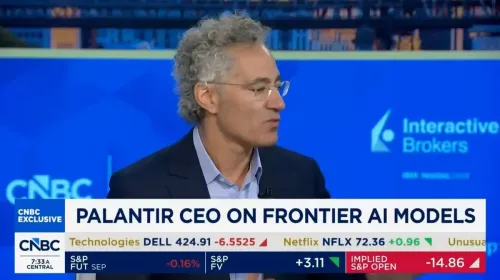
Palantir CEO Alex Karp urges nations: Recall your AI talent from the US

Synopsis
Palantir CEO Alex Karp’s message to governments is stark: stop announcing AI budgets and start recalling the engineers who can actually spend them wisely. His call to bring tech talent home from the US reframes the AI sovereignty debate — it’s not about compute or capital, it’s about who controls the stack, and whether nations have anyone qualified to make that call.
Key Takeaways
Palantir CEO Alex Karp urged governments to recall leading AI and technology experts from the United States to shape domestic AI policy.
Karp argued that ‘knowledge, not money’ is the critical resource — emphasising who controls AI investments over how much is spent.
He defined AI sovereignty as controlling the weights, data, and knowledge of AI systems, warning that bad deployments can transfer sensitive national data to foreign companies.
Karp’s remarks have direct relevance for India , which has a large pool of technology talent currently based in the US.
He criticised regulations drafted without technical expertise, warning that some large language model deployments amount to ‘anti-sovereignty’.
Palantir Technologies , founded in 2003 and headquartered in Denver, Colorado , develops AI and data software for defence, intelligence, and commercial use.
Palantir Technologies chief executive Alex Karp has called on governments worldwide to bring their top technology experts back from the United States to directly shape national artificial intelligence strategies, warning that the AI race cannot be treated as a political abstraction or a theoretical exercise. His remarks were made during a fireside conversation with US Commerce Secretary Howard Lutnick in Chapel Hill, North Carolina, on 3 September.
The Core Argument: Knowledge Over Capital
Karp's central message was blunt — governments are prioritising spending announcements over the far more critical question of who controls those investments. “You don’t need money. You need knowledge,” he said. “I don’t wanna hear how much money you spend. Who’s gonna get the money? Like, the money doesn’t matter as much as who gets it.”
He argued that most individuals capable of making high-stakes AI decisions — on model selection, chip procurement, software architecture, and data governance — are currently based in the US. National leaders, he said, must actively persuade those experts to return and serve their home countries.
“You need to get them to come home to your country and sit next to you and explain what regulations, in your terms, what your regulations look like, what should the stack look like, what model should we use, what software we should use, what chips we should buy,” Karp said.
What AI Sovereignty Actually Means
Karp defined AI sovereignty not as domestic spending or policy declarations, but as a nation’s ability to control the weights, data, and knowledge underpinning its AI systems — without exporting them to third parties. He warned that poorly designed deployments could quietly transfer a country’s proprietary information to foreign model providers, even when governments believed they were strengthening national control.
“This is not sovereignty. This is anti-sovereignty,” he said. “And whoever’s telling you this works needs to be fired because they are hurting your country.”
He outlined the full technology stack governments must account for: computing capacity, data management, model training and control, software, and electricity infrastructure. Countries would have to decide which layers they could build domestically and which would depend on American or other foreign companies.
Relevance for India and the Diaspora Question
Karp’s remarks carry pointed relevance for countries like India, which has produced a substantial cohort of technology executives, engineers, and researchers now leading major American firms. The implicit question his comments raise is whether India—and similarly positioned nations—can convert diaspora expertise into domestic AI governance capacity, rather than continuing to export talent and import policy frameworks.
This comes amid a broader global debate about AI sovereignty, with the European Union, China, and several Gulf states already investing heavily in sovereign AI infrastructure. India’s own AI Mission, announced earlier this year, commits significant public funds but has been critiqued for gaps in technical leadership at the policy level.
Karp’s Warning on Bad AI Implementations
Karp was equally emphatic about the cost of poorly executed AI deployments. “Bad implications of AI are a waste of time; they’re a joke, they’re expensive, they token max, they may even be migrating your data to someone else,” he said. “But the mistake people make is that good implementations of AI are not a joke.”
He stressed that governments, businesses, and security agencies needed application layers capable of controlling data, training models, and keeping sensitive information within protected environments — not off-the-shelf large language model deployments that route data through external servers.
About Palantir Technologies
Palantir Technologies was co-founded in 2003 by Karp, Peter Thiel, and others, and is headquartered in Denver, Colorado. The company develops software for data integration, AI, defence, intelligence, and commercial operations. Its platforms have been deployed by US government agencies, allied governments, and private enterprises for security, battlefield analytics, supply-chain management, and data analysis. Karp has served as its chief executive since the company’s early years.
As AI governance moves from boardrooms to cabinet rooms, Karp’s intervention signals that the next front in the global technology contest may be fought not over chips or models, but over which countries can field the human expertise to use them wisely.
Point of View
Including India’s, are setting AI policy through bureaucrats and consultants rather than practitioners who have built production-scale systems. The diaspora angle is the sharpest edge of his argument: India has exported the very people it needs to govern AI, and importing their advice through foreign vendor contracts is not a substitute. The real test of any national AI strategy is whether it can attract, retain, and empower technical talent at the policy table — something no budget announcement can substitute for.
NationPress
3 Sept 2026
Frequently Asked Questions
What did Palantir CEO Alex Karp say about AI sovereignty?
Karp said true AI sovereignty means controlling the weights, data, and knowledge used by a country’s AI systems — not merely spending on AI infrastructure. He warned that poorly designed deployments can transfer sensitive national data to foreign model providers, calling such arrangements ‘anti-sovereignty.’
Why is Karp urging governments to recall technology experts from the US?
Karp argued that most people capable of making high-stakes AI decisions — on model selection, chip procurement, and data governance — are currently based in the United States. Without them, governments risk setting AI policy without the technical expertise needed to protect national interests.
How does Karp’s message apply to India specifically?
India has produced a large cohort of technology executives, engineers, and researchers working at leading American firms. Karp’s call to bring such experts home to shape national AI policy has direct implications for India, which is building out its own AI Mission but has faced criticism over gaps in technical leadership at the policy level.
What is the full AI technology stack Karp says governments must control?
According to Karp, the stack includes computing capacity, data access and management, the ability to control and train AI models, software, and electricity infrastructure. Governments must decide which layers can be built domestically and which will depend on foreign companies.
What is Palantir Technologies and why is Karp’s view significant?
Palantir Technologies, co-founded in 2003 by Karp and Peter Thiel and headquartered in Denver, Colorado, develops AI and data software for defence, intelligence, and commercial clients globally. Karp’s standing as CEO of a company that works directly with governments on sovereign AI infrastructure lends weight to his critique of technically under-informed policy-making.