IMF cuts China 2026 growth forecast to 4.5% on weak demand
Synopsis
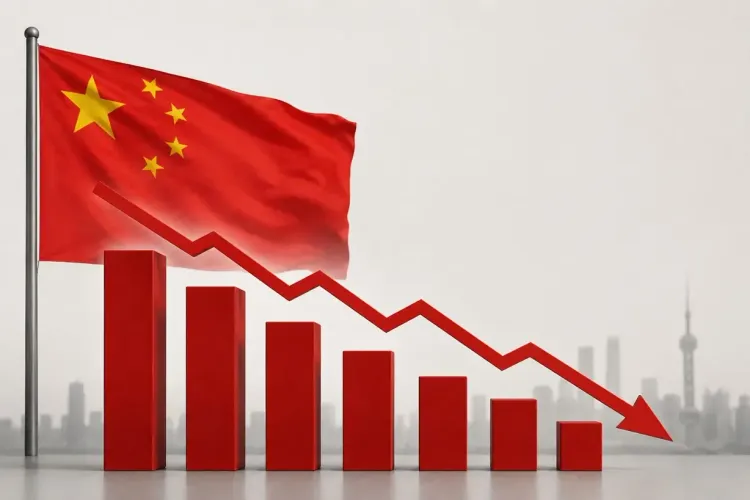
The IMF has trimmed China's 2026 growth forecast to 4.5% — the lowest end of Beijing's own target range — as sluggish consumer spending, a property sector in distress, and rising oil prices overwhelm the country's record export performance. With 2027 growth now seen at just 4%, the structural deceleration of the world's second-largest economy looks less like a blip and more like a new baseline.
Key Takeaways
The IMF cut China 's 2026 growth forecast to 4.5% , down from 4.6% , in its latest World Economic Outlook released on 13 October 2026 .
China 's GDP grew just 4.3% in Q2 2026 — the slowest pace since late 2022 .
The IMF now expects growth to slow further to 4% in 2027 , below its earlier forecast of 4.1% .
China 's trade surplus hit a record $1.2 trillion in 2025 and could widen further in 2026 .
The IMF projects crude oil prices at $130 a barrel between Q4 2026 and Q1 2027 , adding to economic headwinds.
JPMorgan warned that political events could slow stimulus approvals, limiting Beijing's policy response.
The International Monetary Fund (IMF) on Tuesday, 13 October 2026 lowered its growth forecast for China to 4.5% for 2026, citing persistent weakness in domestic demand even as the country's export engine continues to fire. The revision was released in the IMF's latest World Economic Outlook report.
The Revised Forecast
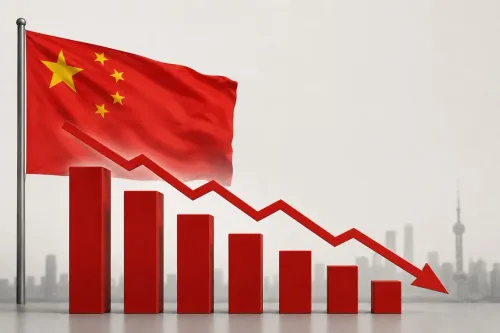
The fund trimmed its 2026 projection from a prior estimate of 4.6%, placing expected growth at the lower bound of Beijing's own annual target range of 4.5% to 5%. Looking further ahead, the IMF now expects China's growth to slow to 4% in 2027, slightly below its earlier projection of 4.1%.
What Is Dragging China's Economy
According to the report, sluggish consumer spending, subdued investment, and a prolonged crisis in the property sector continue to weigh heavily on the economy. Strong exports have only partly offset these headwinds. China's GDP expanded just 4.3% in the second quarter of the year — the slowest pace since late 2022 and below market expectations.
The IMF also warned that elevated global oil prices, prolonged uncertainty, and deep structural challenges could further dampen activity. It projects crude to average around $130 a barrel between the fourth quarter of 2026 and the first quarter of 2027, with average oil prices seen 17% higher in 2026 and as much as 40% higher in 2027.
Export Strength Cannot Fill the Gap
China's exports stood at $401.44 billion in August 2026, while the country's cumulative trade surplus reached $805.51 billion in the first eight months of the year. The IMF cautioned that the trade surplus could widen further in 2026, after already hitting a record $1.2 trillion in 2025 — a figure likely to sharpen trade tensions with major partners.
Beijing's Response and Policy Outlook
China's foreign ministry pushed back on the downgrade, asserting that the country's economic fundamentals remained sound and expressing confidence in long-term growth prospects. The IMF, for its part, acknowledged that policy support from Beijing is likely to prevent a sharper deceleration.
Analysts at JPMorgan, however, noted that weak consumption may necessitate further infrastructure spending and additional fiscal stimulus. They cautioned that upcoming political events could make local officials more risk-averse, potentially slowing project approvals and delaying the rollout of support measures.
What This Means for India and Global Markets
A slower China has direct implications for commodity exporters, Asian supply chains, and global trade volumes. For India, a weakening Chinese economy could dampen demand for certain intermediate goods but may also create openings in export markets where Beijing's share recedes. This comes amid a broader global slowdown narrative that the IMF is tracking across major economies in the same World Economic Outlook release.
Point of View
While flagging further slippage to 4% in 2027, is the fund's clearest acknowledgement yet that China's structural deceleration is not cyclical. The record trade surplus tells a troubling story: China is exporting its way through a demand deficit that its own consumers cannot fill, a pattern that will intensify geopolitical friction with the US and EU. Beijing's confident rebuttal notwithstanding, the property sector implosion and weak consumption are self-reinforcing dynamics that fiscal stimulus alone cannot easily reverse. The real risk is not the 2026 number — it is a 2027 trajectory that locks in a sub-4% growth norm before China has fully escaped its middle-income transition.
NationPress
13 Oct 2026
Frequently Asked Questions
Why did the IMF cut China's growth forecast for 2026?
The IMF cut China's 2026 growth forecast to 4.5% from 4.6% due to persistent weakness in domestic demand, sluggish consumer spending, weak investment, and ongoing stress in the property sector. Strong export performance was not enough to offset these drags, according to the IMF's World Economic Outlook released on 13 October 2026.
What is China's official growth target for 2026?
China's government has set an annual growth target range of 4.5% to 5% for 2026. The IMF's revised forecast of 4.5% places expected growth at the very bottom of that range, leaving little margin for further disappointment.
How does China's GDP growth compare with recent quarters?
China's GDP expanded 4.3% in the second quarter of 2026 — the slowest pace since late 2022 and below market expectations. This underscores the structural nature of the slowdown rather than a short-term dip.
What did the IMF say about oil prices and their impact on China?
The IMF projected crude oil prices to reach approximately $130 a barrel between Q4 2026 and Q1 2027, with average prices seen 17% higher in 2026 and 40% higher in 2027. Higher energy costs represent an additional headwind for China's already-pressured economy.
What is JPMorgan's view on China's stimulus prospects?
JPMorgan analysts noted that weak consumption may require further infrastructure spending and additional fiscal stimulus, but cautioned that upcoming political events could make local officials more cautious, potentially slowing project approvals and delaying economic support measures.