Bangladesh ICT sentences 7 Awami League leaders to death; party calls verdict 'fabricated'
Synopsis
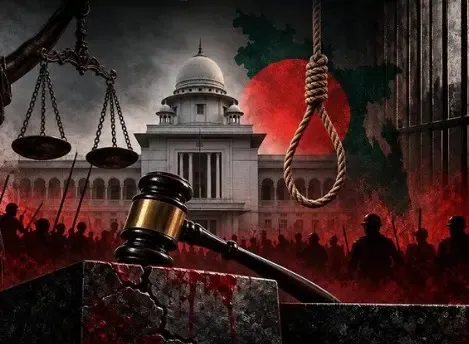
Bangladesh's International Crimes Tribunal has sentenced Awami League General Secretary Obaidul Quader and six other senior leaders to death over the July 2024 uprising — none of them present in court. The party's sweeping rejection, accusing the Yunus-led interim government of packing the tribunal with BNP and Jamaat cadres, escalates what is already one of South Asia's most volatile political confrontations.
Key Takeaways
Bangladesh's International Crimes Tribunal (ICT) sentenced Awami League General Secretary Obaidul Quader and six other senior leaders to death on 16 September 2026 .
The convictions relate to alleged 'crimes against humanity' linked to the July 2024 mass uprising; all accused were tried in absentia .
The Awami League called the ruling 'one-sided, biased and fabricated,' alleging the entire process violated international criminal law standards.
The party accused the former Muhammad Yunus -led interim government of amending the International Crimes Tribunal Act of 1973 by ordinance to target political opponents.
Awami League further alleged the tribunal panels were staffed with Jamaat-e-Islami and BNP office-bearers, and that hundreds of convicted militants — including alleged Al Qaeda affiliates — had been granted bail.
The party warned the sentences would deepen a cycle of political violence it says has already claimed hundreds of lives and imprisoned tens of thousands.
Bangladesh's Awami League has categorically rejected death sentences handed down to seven senior party leaders and activists by the country's International Crimes Tribunal (ICT), calling the ruling 'one-sided, biased and fabricated.' The sentences, pronounced on Tuesday, 16 September 2026, targeted figures including Awami League General Secretary Obaidul Quader and six other senior leaders of the party and its affiliated organisations, convicted for alleged 'crimes against humanity' linked to the July 2024 mass uprising, according to local media reports.
The Tribunal's Ruling
The ICT sentenced the seven individuals — none of whom was physically present before the tribunal — for offences purportedly connected to the violence surrounding Bangladesh's July–August 2024 demonstrations. The Awami League alleged that the verdicts were rendered without affording the accused the minimum legal protections guaranteed under international criminal law, including the right to choose their own legal counsel.
'A fundamental standard of international criminal law is that even in trials conducted in absentia, minimum legal protections — including the right of the accused to choose counsel of their own liking — must be guaranteed. However, these guarantees have been completely ignored in the present tribunal,' the party stated.
Awami League's Rejection and Allegations
The party described the entire judicial process as having been 'rushed through' with 'utter disregard' for universally recognised principles of international human rights law and international criminal law. It went further, alleging that all ICT activities since 5 August 2024 constitute a gross violation of international law and human rights.
Awami League accused the former interim government led by Muhammad Yunus of amending the International Crimes Tribunal Act of 1973 through ordinance — in alleged violation of constitutional processes — transforming, it claimed, the legal proceedings into what it termed a 'judicial killing scheme' directed at the party's leadership.
'To exact political vengeance, the illegal government of Mohammad Yunus constituted the prosecution and judicial panels comprising office-bearers and active cadres of Jamaat-e-Islami and the Bangladesh Nationalist Party (BNP), filing a succession of false and illegal cases against leaders and activists of the Bangladesh Awami League based entirely on falsehood,' the party said.
Concerns Over Rule of Law and Security
Expressing grave concern over what it described as a two-year cycle of political violence, Awami League warned that the death sentences would further fuel mass killings that have already, according to the party's account, claimed hundreds of lives, while exacerbating arbitrary detentions it says have seen tens of thousands imprisoned.
The party also alleged that Islamist extremists have been emboldened by the tribunal's conduct, pointing to reports that hundreds of convicted militants in Bangladesh — including those allegedly affiliated with Al Qaeda — had been granted bail. Critics argue these developments have significantly degraded security conditions in the country.
What the Awami League Said About Democratic Norms
'This latest sham verdict is another blow to the country's democracy, a glaring reminder for citizens and victims of July–August violence that their right to pursue justice has been completely taken away,' the party said in its statement. It further alleged that residences and businesses belonging to tens of thousands of party activists had been 'looted and vandalised with total impunity.'
Notably, this is not the first time the ICT's post-August 2024 proceedings have drawn criticism from international legal observers who have raised questions about due process. The tribunal, originally established to try war crimes from Bangladesh's 1971 Liberation War, has faced recurring scrutiny over its procedures across successive governments.
What Comes Next
The condemned leaders remain outside Bangladesh, and it is unclear whether any extradition proceedings are anticipated. The Awami League has indicated it will continue to contest the tribunal's legitimacy on international platforms. How Bangladesh's current political establishment responds — and whether international human rights bodies formally weigh in — will determine the next phase of this deepening legal and political crisis.
Point of View
But the in-absentia nature of the trials and the speed of proceedings will invite serious scrutiny from international legal bodies — irrespective of how one views the underlying charges. Mainstream coverage has largely framed this as a Bangladesh domestic story, but the alleged stacking of the tribunal with opposition party cadres, if verified, would represent a textbook example of lawfare — using judicial architecture to neutralise a rival. The broader danger is that each escalatory step, from ordinance amendments to mass bail for convicted militants, is eroding the institutional credibility Bangladesh will need for any durable political settlement. History suggests that political vendettas prosecuted through courts rarely close cycles of violence; they extend them.
NationPress
16 Sept 2026
Frequently Asked Questions
Why did the Bangladesh ICT sentence Awami League leaders to death?
The International Crimes Tribunal convicted Awami League General Secretary Obaidul Quader and six other leaders for alleged 'crimes against humanity' connected to the July–August 2024 mass uprising in Bangladesh. All seven were tried in absentia. The Awami League has rejected the charges as politically motivated and legally invalid.
Who are the Awami League leaders sentenced to death?
The seven include Awami League General Secretary Obaidul Quader and six other senior leaders of the party and its affiliated organisations, according to local media reports. The party has not released a full list in its public statement, and the tribunal's formal records have not been independently verified.
What is the International Crimes Tribunal of Bangladesh?
Bangladesh's International Crimes Tribunal (ICT) was originally established to prosecute war crimes and crimes against humanity from the country's 1971 Liberation War. Its mandate and procedures have been amended multiple times, most recently — according to the Awami League — through an ordinance issued by the former Muhammad Yunus-led interim government after August 2024.
Why is the Awami League calling the trial a 'sham'?
The Awami League argues that the tribunal violated basic principles of international criminal law, including the right of in-absentia accused to choose their own legal counsel. It further alleges the prosecution and judicial panels were composed of office-bearers from rival parties, Jamaat-e-Islami and the BNP, making impartial proceedings impossible.
What happens next after the death sentences?
The condemned leaders remain outside Bangladesh, making enforcement of the sentences immediately uncertain. The Awami League has said it will challenge the tribunal's legitimacy internationally. Whether extradition requests are filed, or international human rights bodies formally intervene, will shape the next phase of the crisis.