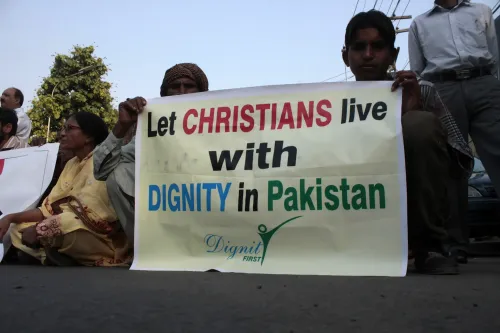
Pakistan court grants custody of 13-year-old Christian girl to accused kidnapper

Synopsis
A Faisalabad court handed custody of 13-year-old Christian girl Amber Nadeem to her accused kidnapper — before a court-ordered medical test to verify her age was even conducted. With forged documents, credible coercion claims, and the European Parliament now formally condemning Pakistan's pattern of minority abuses, this case has become a flashpoint for international scrutiny of Pakistan's legal protections for religious minorities.
Key Takeaways
Faisalabad Additional District and Sessions Judge Rana Sohail granted custody of 13-year-old Amber Nadeem to accused Mohsin Liaqat and released him on bail.
The custody order was issued before a court-ordered medical examination to determine Amber's age had been conducted.
The conversion and marriage certificate lists Amber's birth year as 2008 , but her parents married only in 2012 , casting doubt on the documents' authenticity.
Amber had earlier told a judicial magistrate on 27 June that the accused's family pressured her to falsely claim she was an adult.
The European Parliament adopted a resolution condemning Pakistan's pattern of forced conversions, citing 2025 UN data showing 75% of victims are Hindu and 25% are Christian .
Rights advocate Joseph Janssen of Voice for Justice called the sessions court's decision a 'grave injustice.'
A court in Faisalabad, Pakistan has awarded custody of a 13-year-old Christian girl to the Muslim man accused of kidnapping her, forcibly converting her to Islam, and marrying her — and this before a court-ordered medical examination to determine her age had been conducted. The case has drawn sharp criticism from rights advocates and comes amid growing international scrutiny of Pakistan's treatment of religious minorities.
What Happened in Court
Faisalabad Additional District and Sessions Judge Rana Sohail accepted an affidavit from the minor, Amber Nadeem, in which she stated she had converted to Islam and married the accused, Mohsin Liaqat, of her own free will and had not been kidnapped. On the basis of this statement, the judge granted Liaqat post-arrest bail. Liaqat had been in judicial custody since 26 June. According to reports, Amber then left the courtroom with the accused's relatives and lawyers while her parents stood by in tears.
Credibility Questions and the Suppressed Medical Test
Joseph Janssen, Chairman of the advocacy group Voice for Justice, said the verdict was issued despite a pending court-ordered medical examination to establish Amber's actual age. Janssen noted that on 27 June, Amber had appeared before a judicial magistrate and stated that members of the accused's family had pressured her to falsely claim she was an adult.
Further undermining the documents presented in court, the conversion and marriage certificate submitted by the accused listed Amber's date of birth as June 2008 — yet her parents married only in 2012, raising serious questions about the authenticity of the paperwork. The magistrate had ordered a medical examination and directed that Amber be placed in a government shelter home pending further proceedings. The sessions court's decision to grant custody and bail before that examination was completed is what rights advocates say constitutes the central injustice in this case.
European Parliament Condemns Pattern of Abuses
The case is not isolated. Earlier this month, the European Parliament adopted a resolution specifically condemning the abduction, forced conversion, and child marriage of underage girls from religious minorities in Pakistan. The resolution highlighted the case of Maria Shahbaz, a 13-year-old Pakistani Christian girl who was abducted, converted to Islam, and forcibly married to her abductor in March 2026. Members of the European Parliament (MEPs) called for her to have access to legal representation, family contact, and psychological support.
Citing 2025 UN figures, the resolution noted that among women and girls affected by forced conversion through marriage in Pakistan, approximately 75 per cent were Hindu and 25 per cent were Christian.
Calls for Systemic Reform
The European Parliament urged Pakistan's authorities to fully implement the country's national framework to end child marriage — a framework already operational in some provinces — and to establish a national mechanism for handling complaints from families of abducted or forcibly converted girls from minority communities.
Rights groups argue that the pattern of judicial outcomes in such cases reflects structural failures in Pakistan's legal system when it comes to protecting minority women and girls. With international pressure mounting and the European Parliament's resolution on record, the question of whether Pakistani courts will revisit Amber Nadeem's case before the medical examination is completed remains open.
Point of View
While court-ordered safeguards — such as the pending medical examination — are bypassed. The document inconsistency alone (a birth year predating the parents' marriage) should have triggered immediate scrutiny, yet bail and custody were granted regardless. The European Parliament's resolution adds diplomatic weight, but past resolutions on Pakistan's minority abuses have rarely translated into domestic legal reform. Until Pakistan creates an enforceable national mechanism for such complaints — as the Parliament has demanded — individual cases will continue to be resolved by the very structural pressures that advocates say created them.
NationPress
30 Jul 2026
Frequently Asked Questions
What happened in the Amber Nadeem case in Pakistan?
A Faisalabad court granted custody of 13-year-old Christian girl Amber Nadeem to Mohsin Liaqat, the Muslim man accused of kidnapping, forcibly converting, and marrying her. The court accepted an affidavit from Amber stating the marriage was consensual, and released Liaqat on bail — all before a court-ordered medical examination to verify her age was completed.
Why are rights advocates calling the court verdict unjust?
Advocates, including Joseph Janssen of Voice for Justice, say the sessions court bypassed a magistrate's earlier order for a medical age-verification test and ignored credible evidence of coercion. Amber had previously told a judicial magistrate that the accused's family pressured her to falsely claim she was an adult.
What is wrong with the conversion and marriage certificate submitted in court?
The certificate lists Amber's date of birth as June 2008, but her parents were married only in 2012 — a factual impossibility that raises serious questions about the document's authenticity, according to rights advocates.
What has the European Parliament said about forced conversions in Pakistan?
The European Parliament adopted a resolution condemning the abduction, forced conversion, and child marriage of underage girls from religious minorities in Pakistan. Citing 2025 UN figures, it noted that 75 per cent of victims are Hindu and 25 per cent are Christian, and called on Pakistan to establish a national mechanism for handling such complaints.
Who is Maria Shahbaz and how does her case relate?
Maria Shahbaz is a 13-year-old Pakistani Christian girl who was abducted, converted to Islam, and forcibly married to her abductor in March 2026. Her case was specifically highlighted in the European Parliament's resolution as emblematic of the broader pattern of human rights violations against religious minorities in Pakistan.