Prachanda Clinches Victory in Nepal Elections as Key Rivals Lag Behind
Synopsis
In a significant turn of events, former Prime Minister Prachanda has emerged victorious in the recent Nepal elections, despite challenges faced by traditional political parties. His win from Rukum East-1 positions him at a crucial juncture in Nepalese politics.
Key Takeaways
Prachanda wins from Rukum East-1 .
Traditional parties struggle in recent elections.
Criticism arises over constituency change.
Prachanda's political history spans decades.
Future implications for Nepalese politics are uncertain.
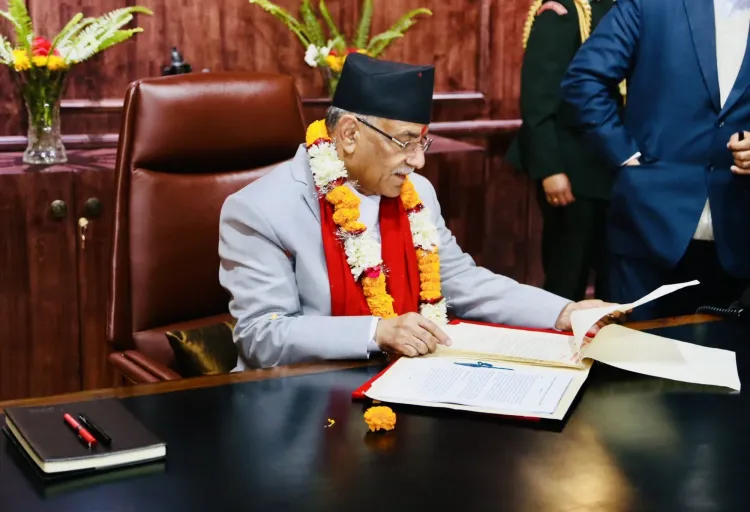
Kathmandu, March 6 (NationPress) Former Prime Minister Pushpa Kamal Dahal, known as Prachanda, has successfully clinched a seat in the House of Representatives from Rukum East-1, marking his position as one of the few prominent leaders from established political factions to achieve victory in the recent elections held on Thursday.
He garnered a total of 10,240 votes to secure his win. His nearest rival, Lilamani Gautam of the Communist Party of Nepal (Unified Marxist–Leninist) (CPN-UML), received 3,462 votes as reported by the Election Commission of Nepal.
Despite Prachanda's victory, his party, along with other traditional political entities such as the Nepali Congress and CPN-UML, did not perform well overall in these elections.
Former Prime Minister K P Sharma Oli, the leader of CPN-UML, and Gagan Thapa, President of the Nepali Congress, are currently trailing behind candidates from the Rastriya Swatantra Party—Balen Shah and Amaresh Kumar Singh respectively. Nevertheless, Prachanda managed to secure a victory from the stronghold of former Maoist insurgents.
Many critics have expressed disappointment, suggesting that he abandoned his previous district, Gorkha-2, where he was elected in 2022, fearing a loss, and instead chose to contest from Rukum East-1, perceived as a safer option.
Having transitioned into mainstream politics following the Comprehensive Peace Agreement in 2006 after leaving armed conflict, Prachanda first entered the Constituent Assembly of Nepal in the 2008 elections representing Kathmandu-10 and Rolpa-2. He went on to win the 2013 elections from Siraha-5 and the inaugural parliamentary elections in 2017 from Chitwan-3. In 2022, he won from Gorkha-2.
Prachanda has been a pivotal figure in Nepalese national politics throughout much of the armed conflict from 1996–2006. Even after his party shifted to peaceful politics, its agenda remained a significant influence in the mainstream political landscape.
Although he has witnessed a gradual decrease in his party's strength since the 2008 elections, Prachanda continues to be a key player in national politics, having served as prime minister multiple times in recent years with support from either the Nepali Congress or the CPN-UML.
Point of View
It's vital to highlight the complexities of the recent elections in Nepal. Prachanda's victory is noteworthy, yet it underscores the broader challenges faced by traditional parties. The dynamics of the political landscape continue to evolve, raising questions about future governance and representation.
NationPress
3 Oct 2026
Frequently Asked Questions
What was the outcome of the recent elections in Nepal?
Prachanda won the election from Rukum East-1, but traditional political parties, including Nepali Congress and CPN-UML, faced challenges.
Why did Prachanda change his constituency?
Critics suggest he switched from Gorkha-2 to Rukum East-1 out of fear of losing in the former.
What has been Prachanda's role in Nepalese politics?
Prachanda has been a significant figure in Nepalese politics since the peace agreement in 2006 and has served as Prime Minister multiple times.
What does this election mean for the future of Nepal?
It indicates ongoing shifts in political power dynamics, particularly for traditional parties amidst rising new political entities.