Bangladesh risks in joining Mecca Pact: Report urges independent policy

Synopsis
A leading Bangladeshi newspaper is warning Dhaka to stay out of the Mecca Joint Defence Agreement — the Saudi-Turkey-Pakistan pact signed on 7 August. The core argument: a NATO-style collective-defence clause could drag Bangladesh into a Gulf war it never chose, threatening its shipping lifelines through the Strait of Hormuz and Bab el-Mandeb.
Key Takeaways
A Daily Star report has warned Bangladesh against joining the Mecca Joint Defence Agreement signed by Saudi Arabia , Turkey , and Pakistan on 7 August .
The pact's collective-defence clause mirrors NATO's Article 5 — an attack on one member is treated as an attack on all.
Bangladesh has no territorial dispute with Iran , but membership could pressure Dhaka to take sides in a Saudi-Iran confrontation.
Key economic risks include Bangladesh's dependence on shipping through the Strait of Hormuz and the Bab el-Mandeb Strait .
The report advocates an independent foreign policy — engaging all sides and remaining outside military blocs.
A prominent analysis has cautioned Bangladesh against joining the Mecca Joint Defence Agreement — or any comparable military alliance — warning that such a step could entangle Dhaka in conflicts where it has no direct stake. The report, published in Bangladesh's leading newspaper The Daily Star, argues that the country's interests are best served by maintaining an independent foreign and security policy that allows engagement with all sides.
What the Mecca Pact Is
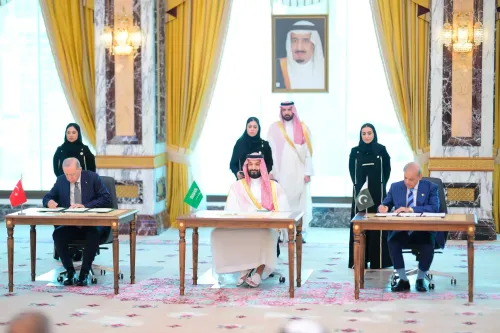
The Mecca Joint Defence Agreement was signed by Saudi Arabia, Turkey, and Pakistan on 7 August. Its collective-defence clause mirrors NATO's Article 5, treating an armed attack on any one member as an attack on all. Critics argue this architecture, designed around the security priorities of its founding signatories, does not necessarily align with Bangladesh's national interests.
The Iran Scenario and Strait of Hormuz Risk
Bangladesh currently has no territorial dispute or military conflict with Iran. The report warns, however, that membership in the pact could change that calculus overnight. 'If Saudi Arabia were drawn into a future confrontation with Iran while Bangladesh was a member of the Mecca Pact, Dhaka could come under pressure to take sides in a war it had no role in starting,' the report stated. Such a situation, it cautioned, could jeopardise Bangladesh's economic and energy interests — particularly its dependence on shipping routes through the Strait of Hormuz and the Bab el-Mandeb Strait.
The Case for Strategic Autonomy
The analysis makes a pointed case for non-alignment. 'A country with which Dhaka has no dispute today could become a source of diplomatic tension tomorrow simply because it becomes the adversary of a treaty partner,' the report noted. It urged Bangladesh to assess each crisis on its own merits rather than being bound by the geopolitical calculations of military partners. 'Bangladesh has never built its foreign policy around military confrontation, and there is little reason to begin doing so now,' it stressed.
Broader Implications for Dhaka's Foreign Policy
The report argued that Bangladesh should not be compelled by any treaty to treat another country's enemy as its own, or to commit military resources to conflicts it did not choose. It called for a foreign policy 'firmly centred on Bangladesh itself — guided by its own national interests, strategic priorities and independent judgement rather than by the conflicts and rivalries of others.' This comes amid growing pressure on smaller South and Southeast Asian nations to align with emerging bloc arrangements in the Middle East and beyond. Notably, Pakistan's membership in the pact adds a South Asian dimension that directly affects Dhaka's regional calculations.
What Analysts Say Should Come Next
The report advocates that Bangladesh manage each bilateral relationship on its own merits, cooperate broadly, and remain outside military blocs that could compel it to take sides. Whether Dhaka formally responds to the Mecca Pact invitation — if one is extended — will be closely watched as a signal of the interim government's foreign policy direction.
Point of View
No ideological stake in a Sunni security bloc, and significant economic exposure to stable shipping lanes. What the report does not fully address is the cost of staying out: whether non-membership forecloses economic or diplomatic benefits that the pact's signatories might otherwise extend. The harder question for Dhaka is not whether to join, but how to decline without straining ties with Riyadh — Bangladesh's single largest source of remittances.
NationPress
24 Aug 2026
Frequently Asked Questions
What is the Mecca Joint Defence Agreement?
The Mecca Joint Defence Agreement is a collective-defence pact signed by Saudi Arabia, Turkey, and Pakistan on 7 August. Its core clause mirrors NATO's Article 5, meaning an armed attack on any one member is treated as an attack on all members.
Why is Bangladesh being warned against joining the Mecca Pact?
A report in The Daily Star warns that membership could drag Bangladesh into conflicts — particularly a potential Saudi-Iran confrontation — in which it has no direct stake. It also flags risks to Bangladesh's trade routes through the Strait of Hormuz and the Bab el-Mandeb Strait.
Does Bangladesh have a dispute with Iran?
No. According to the report, Bangladesh currently has no territorial dispute or military conflict with Iran, making a pact that could pit it against Tehran contrary to its national interests.
What does the report recommend for Bangladesh's foreign policy?
The report recommends that Bangladesh retain strategic autonomy — managing each bilateral relationship on its own merits, cooperating widely, and staying outside military blocs that could compel it to take sides in conflicts it did not choose.
How does the Mecca Pact affect Bangladesh's economy?
Bangladesh depends heavily on shipping lanes through the Strait of Hormuz and the Bab el-Mandeb Strait for energy and trade. A Gulf conflict triggered by the pact's collective-defence clause could disrupt these routes and strain Dhaka's relations with both Riyadh and Tehran simultaneously.