Rubio: Cuba on 'irreversible path' to change before Trump term ends
Synopsis
Secretary of State Marco Rubio has staked a bold claim: Cuba will be on an irreversible path to change before the Trump administration ends. Invoking Poland’s post-communist transition as a model, Rubio framed the issue not as personal heritage but as core US strategic interest — yet offered no concrete policy roadmap to back the confidence.
Key Takeaways
US Secretary of State Marco Rubio said Cuba will be on an ‘irreversible path’ toward change before the Trump administration leaves office.
Rubio cited Eastern Europe’s post-communist transitions — particularly Poland — as a three-to-five-year model for Cuban change.
He framed a stable, US-aligned Cuba as a US national interest , extending the same logic to Venezuela .
No specific policy steps against Havana were outlined in the interview.
Rubio revealed he speaks with President Donald Trump multiple times daily, including calls as early as just after 6 a.m.
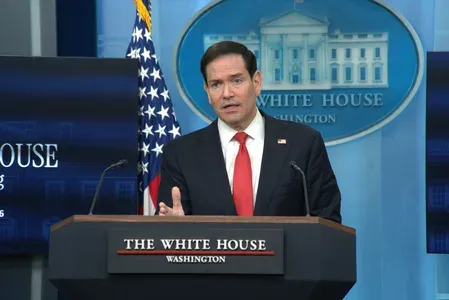
US Secretary of State Marco Rubio said on Tuesday that he is confident Cuba will be set on an “irreversible path” toward a fundamentally different future before the Trump administration leaves office, framing democratic transformation on the communist-ruled island as a direct US national interest. Rubio made the remarks in an interview with The Katie Miller Podcast, released by the State Department.
Rubio’s Core Assertion
“I am confident that Cuba, by the time this administration’s over, before this administration ends, will be on an irreversible path towards a much different future,” Rubio said. The Secretary of State, himself a Cuban American who has long advocated a hardline stance toward Havana, was careful to temper expectations on timing, acknowledging that durable political change cannot be forced overnight.
“You can’t have something in place for 70 years, it grows roots, and then think overnight you’re just going to rip out the whole thing and put something brand-new into the ground,” he said.
The Eastern Europe Parallel
Rubio drew a pointed historical comparison, arguing that the post-communist transitions in Eastern Europe offer a realistic template for what change in Cuba might look like. “Eastern Europe is instructive of that. You saw it took countries in Eastern Europe three to five years to truly become what we know them to be today. Poland is probably the best example,” he said. The analogy signals that the administration is thinking in terms of a multi-year process rather than a swift regime change scenario.
National Interest, Not Personal Sentiment
Rubio acknowledged his personal ties to the island but drew a clear line between sentiment and policy rationale. “I care about Cuba, obviously I have a personal connection to it, but I don’t work for Cuba; I work for the United States,” he said. He added that a “safe and stable” Cuba aligned with Washington serves American strategic interests — a framing he extended to Venezuela as well. Notably, Rubio stopped short of outlining any specific policy steps the administration intends to take against Havana.
Trump Access and Daily Coordination
In the same interview, Rubio revealed the intensity of his working relationship with President Donald Trump, saying the two speak “every day, multiple times.” He recalled receiving calls from the President shortly after 2 a.m. and as early as just after 6 a.m. — an indication of how closely the top diplomat coordinates with the White House on foreign policy priorities.
What Comes Next
The administration has not yet detailed the specific mechanisms — sanctions, diplomatic pressure, or other tools — it plans to deploy toward Cuba. Analysts note that the US has maintained a trade embargo on the island for over six decades, and past administrations have oscillated between engagement and maximum-pressure strategies with limited results. Whether Rubio’s confidence translates into measurable change on the ground before the administration’s term concludes remains to be seen.
Point of View
Two administrations of maximum pressure, and one brief Obama-era thaw have not dislodged Cuba’s political structure. Invoking Poland is rhetorically powerful but structurally misleading — Eastern Europe’s transitions were driven by internal economic collapse and Soviet withdrawal, not external US pressure. The real question is what lever Washington has today that it did not have in 2018 or 2020. Without a credible mechanism, this reads more as political signalling — particularly to Cuban-American constituencies — than as a foreign policy blueprint.
NationPress
26 Sept 2026
Frequently Asked Questions
What did Marco Rubio say about Cuba’s future?
Rubio said he is confident Cuba will be on an ‘irreversible path’ toward a fundamentally different future before the Trump administration ends. He described the transformation of the communist-ruled island as a US national interest, though he did not specify what policy steps the administration plans to take.
Why does Rubio compare Cuba to Eastern Europe?
Rubio cited Eastern Europe’s post-communist transitions — particularly Poland ’s — as evidence that deep political change takes three to five years rather than happening overnight. He used the comparison to argue that a gradual transition process is realistic and necessary for Cuba.
What is the US position on Cuba under the Trump administration?
The Trump administration has described a stable, US-aligned Cuba as a national interest. Rubio, a Cuban American with a longstanding hardline stance toward Havana, has made Cuba a priority, but the administration has not publicly detailed the specific sanctions or diplomatic tools it intends to use.
How often does Rubio speak with President Trump?
Rubio said he speaks with President Donald Trump every day, multiple times, including calls received shortly after 2 a.m. and as early as just after 6 a.m., indicating close daily coordination on foreign policy.
Has the US embargo on Cuba changed under Trump?
No change to the embargo was announced in this interview. The US has maintained a trade embargo on Cuba for over six decades, and successive administrations have alternated between engagement and pressure strategies without fundamentally altering the island’s political system.