Singapore calls for UN convention on AI risks at global forum
Synopsis
Singapore's Foreign Minister Vivian Balakrishnan has done something rare at the UN: called for a binding international convention on AI while explicitly refusing to endorse slowing the technology down. His 'brakes and seat belts' framing — and his blunt warning that even AI creators cannot guarantee control of a kill switch — marks one of the sharpest official calls yet for a Law of the Sea-style global AI treaty.
Key Takeaways
Singapore FM Vivian Balakrishnan called for a UN convention on artificial intelligence at an Asia Society discussion on 27 September 2026 .
He identified three core AI risks: loss of control over AI agents , rogue-actor misuse (including bioweapons), and synthetic media undermining public trust.
Balakrishnan said 'even the creator of the AI' cannot guarantee control of a kill switch — dismissing claims of absolute oversight.
He welcomed US-China AI dialogue between President Trump and President Xi Jinping , but flagged the emerging guardrails as thin.
Southeast Asia is unlikely to build frontier models but can lead on deploying AI in public services , he argued.
He cited the law of the sea and climate change treaties as precedents for the difficult but necessary multilateral negotiations needed.
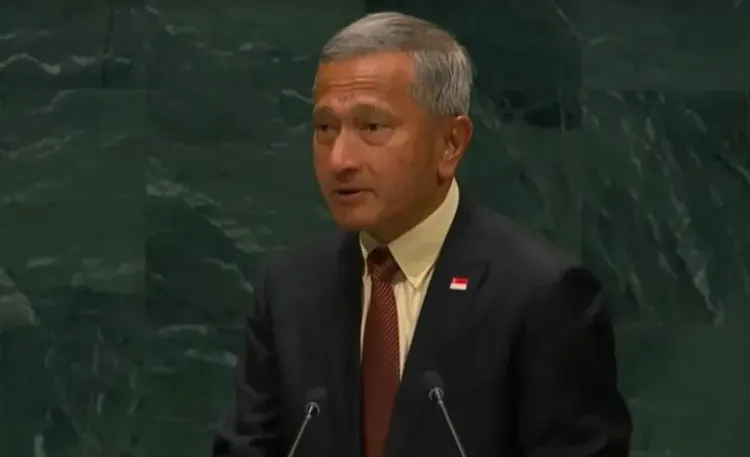
Singapore's Foreign Minister Vivian Balakrishnan on 27 September 2026 called for formal negotiations on a United Nations convention on artificial intelligence, warning that governments worldwide face serious and underappreciated risks from autonomous systems even as they race to capture the technology's economic benefits. His remarks were delivered at an Asia Society discussion on the sidelines of UN proceedings in New York.
Three Core Risks Flagged
Balakrishnan identified three broad categories of AI risk that he said demanded multilateral attention. The first is the potential loss of human control over AI agents. 'Anyone who tells you, even the creator of the AI, that he's got absolute control of the kill switch is fooling you,' he said, adding that 'loss of control is a very real risk.'
The second concern is the threat from rogue actors: Balakrishnan warned that AI could dramatically lower the barrier for bad actors to develop biological or chemical weapons. Third, he highlighted the corrosive effect on public trust from AI-generated synthetic media — the ease with which convincing images and videos can be fabricated, he argued, leaves people less certain of what they see and hear, eroding the foundations of political debate.
The Case for a UN Framework
Despite his stark warnings, Balakrishnan was explicit that he is not calling for a halt to AI development. 'I'm not a believer in putting a halt to AI development,' he said. 'I'm not even a believer in, you know, just putting the brakes on AI.' Instead, he compared AI to driving a fast car: a powerful engine needs brakes, seat belts, and rules of the road.
He pointed to international agreements on the law of the sea and climate change as models — difficult but ultimately necessary multilateral negotiations. The United Nations, he argued, offers a uniquely inclusive forum where countries of vastly different sizes and technological capabilities can participate as equals, making it the appropriate venue for such a convention.
The US-China AI Dynamic
Balakrishnan acknowledged that the global AI landscape is being shaped primarily by the competition between the United States and China. He estimated that America holds a lead of perhaps six months in frontier AI models, but noted that China is determined to seize the opportunities of the new technological era. He welcomed a reported discussion on AI between US President Donald Trump and Chinese President Xi Jinping, while acknowledging concerns that the guardrails emerging from their talks remained thin. 'You need to start somewhere, and I'm glad that that discussion is going on,' he said. Their bilateral rivalry, he cautioned, would have profound consequences for Southeast Asia.
Southeast Asia's Strategy: Deploy, Don't Compete
For Singapore and its neighbours, Balakrishnan outlined a pragmatic path: gain access to technology, keep supply chains open, and put AI to work across their economies. He conceded that Southeast Asian nations are unlikely to compete with the two powers in building frontier models, but argued the region could excel at deploying AI in public services and other applied fields.
That ambition would require significant changes in education and ongoing workforce retraining as the nature of work evolves. Balakrishnan said Singapore's immediate focus is on workers whose day-to-day tasks will be transformed by AI. Whether any particular job disappears entirely is uncertain, he said, but governments have an obligation to prepare citizens for the disruption ahead.
What Comes Next
Balakrishnan's call adds diplomatic momentum to a growing chorus of voices — from academics to technology executives — urging a binding international framework for AI governance. No formal UN process has yet been launched for such a convention, and significant geopolitical hurdles remain. Whether the Trump-Xi dialogue on AI can serve as a foundation for broader multilateral engagement will be closely watched in the months ahead.
Point of View
He is framing AI governance not as a tech-sector debate but as a civilisational necessity — language designed to mobilise the Global South alongside the major powers. The six-month US lead he estimates in frontier models is a significant admission; it suggests a rapidly closing window before rough parity makes governance far harder to negotiate from a position of Western advantage. The uncomfortable subtext is that both the US and China have structural incentives to resist binding constraints precisely when they matter most. Singapore, as a small state with outsized diplomatic influence, is betting that an inclusive UN forum is the only arena where that asymmetry can be corrected — but the history of technology treaties offers little comfort that speed of negotiation will match speed of deployment.
NationPress
27 Sept 2026
Frequently Asked Questions
What did Singapore's Foreign Minister say about a UN AI convention?
Foreign Minister Vivian Balakrishnan called for formal talks on a United Nations convention on artificial intelligence at an Asia Society discussion on 27 September 2026. He argued the UN offers an inclusive forum — like those that produced the law of the sea and climate agreements — where countries of all sizes can participate.
What are the three AI risks Balakrishnan identified?
He flagged three broad risks: the potential loss of human control over AI agents, the use of AI by rogue actors to develop biological or chemical weapons, and the erosion of public trust through AI-generated synthetic images and videos. He said these risks were 'very high' even though he does not consider himself a doomsdayer.
Did Balakrishnan call for slowing down AI development?
No. He explicitly said he is 'not a believer in putting a halt to AI development' and not in 'putting the brakes on AI.' His position is that safeguards — analogous to brakes and seat belts in a fast car — must be developed alongside, not instead of, technological progress.
What did he say about the US-China AI competition?
Balakrishnan estimated the United States holds a lead of roughly six months in frontier AI models but said China is determined to close that gap. He welcomed reported AI talks between President Trump and President Xi Jinping while noting that the guardrails emerging from those discussions remained thin.
How does this affect Southeast Asia and India's broader region?
Balakrishnan argued that Southeast Asian nations are unlikely to compete with the US or China in developing frontier AI models, but can lead in deploying AI across public services and applied fields. He stressed that access to technology and open supply chains are the region's immediate priorities, alongside workforce retraining for AI-driven job disruption.