Tharoor Defends India's Diplomatic Restraint Amid West Asia Crisis
Synopsis
Congress MP Shashi Tharoor articulates a defense of India's diplomatic silence regarding the US-Israeli war on Iran, describing it as 'responsible statecraft.' He counters critics and emphasizes the importance of balancing national interests with global justice.
Key Takeaways
Tharoor emphasizes India's diplomatic restraint as a form of responsible statecraft.
He argues for a balance between national interests and global justice.
The criticism from Sonia Gandhi highlights internal party dissent regarding the government's stance.
Tharoor recalls Nehru's non-alignment policy to justify current strategies.
He warns that condemnation of the US-Israeli war could destabilize crucial trade and diplomatic relationships.
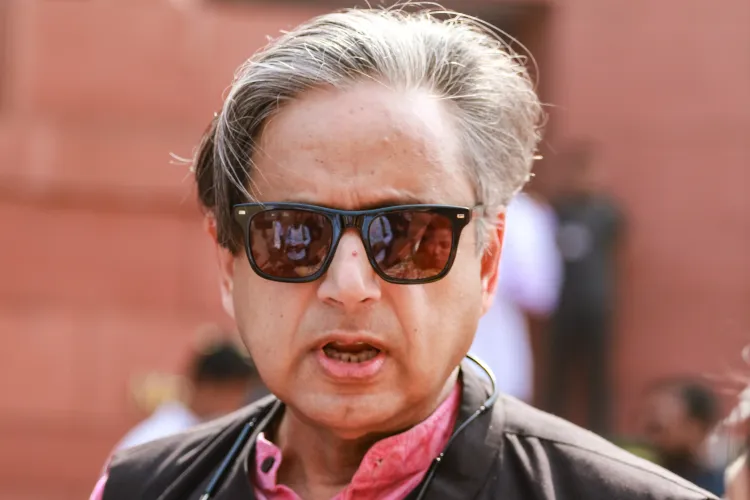
New Delhi, March 19 (NationPress) Congress MP Shashi Tharoor has addressed the ongoing crisis in West Asia, presenting a thoughtful defense of India's diplomatic restraint. He counters critics who label the government's silence regarding the US-Israeli conflict with Iran as a moral shortcoming, describing New Delhi's stance as “responsible statecraft”.
In an opinion piece featured in The Indian Express, Tharoor contended that although the conflict may contravene international law, India's foreign policy should strike a balance between principle and pragmatism, giving precedence to national interests, regional stability, and strategic alliances over mere condemnations.
“In recent weeks, numerous Indian liberals have directed their frustrations inward, accusing those of us who haven’t condemned the government’s silence on the US-Israeli offensive against Iran of moral cowardice. Following the American idiom, it has turned into a ‘circular firing squad’ -- self-inflicted wounds. They insist India should adopt the moral high ground, denouncing the war as a blatant breach of international law,” he articulated.
His comments arise amidst criticism from factions within his own party regarding the government’s “silence.” Just days prior, Congress Parliamentary Party (CPP) Chairperson Sonia Gandhi expressed her discontent with the Central government's lack of response to the US-Israel aggression against Iran. She emphasized that the absence of an official statement signifies not neutrality, but an “abdication” of responsibility.
In her op-ed in The Indian Express, titled 'Government's silence on killing of Iran leader is not neutral, it is abdication', Sonia Gandhi remarked, “The killing of a sitting head of state amid ongoing negotiations represents a significant disruption in modern international relations. Yet, beyond the shock of the incident, what is equally striking is New Delhi's silence.”
Interestingly, Tharoor also referenced the late Prime Minister Jawaharlal Nehru's non-alignment policy to substantiate the current government's position on the West Asia conflict.
In response to these criticisms, Tharoor made his stance clear, stating, “I agree that the war cannot be justified under international law. It contravenes the very principles India has historically championed -- respect for sovereignty, non-aggression, and peaceful resolution of conflicts. Moreover, as I have previously articulated, there is no basis for pre-emptive self-defense either.”
He noted that India “should have swiftly expressed condolences” regarding the death of Iran's Supreme Leader, Ayatollah Ali Khamenei, akin to how it responded when its former President perished in a helicopter accident.
“I am entitled to express this, as are my liberal colleagues in the opposition or the commentariat. However, I will not criticize the government for opting for silence rather than confrontation,” he said.
Reflecting on India’s historical diplomatic principles, he said the nation has traditionally balanced principle and pragmatism, referencing Nehru's non-alignment policy.
He emphasized that this was “not a refusal to adopt moral positions, but a recognition that India's sovereignty and survival depended on evading entanglement in Cold War conflicts.”
“In today’s increasingly multipolar world, India practices ‘multi-alignment’ -- engaging with a variety of powers, sometimes at odds with one another, while keeping our national interests at the forefront,” he mentioned.
The Congress leader underscored that India’s fundamental objective remains unchanged: to safeguard sovereignty while promoting global justice.
“No one possesses a monopoly on patriotism, nor on the interpretation of the values imparted by Gandhi or Nehru. The true homage to their legacy lies in judiciously applying their values to the realities of our time, rather than indulging in self-satisfying condemnations that could jeopardize our interests,” he stated.
He also noted that India has previously opted for restraint when principles conflicted with strategic interests.
Pointing to the country’s posture during Soviet interventions in Hungary in 1956, Czechoslovakia in 1968, and Afghanistan in 1979, he remarked, “That silence did not imply we endorsed Soviet aggression. It indicated our understanding of the costs of confrontation and a preference for prudence over posturing. This same rationale applies to our stance on the Russian incursion into Ukraine and the Israeli-American offensive against Iran.”
Tharoor further emphasized India’s substantial interests in the region, highlighting that nearly $200 billion in annual trade traverses West Asia, with the nation’s energy security significantly reliant on Gulf oil and gas, as well as the welfare of approximately nine million Indians reliant on regional stability.
“Engaging in self-righteous moralizing by condemning the US-Israeli invasion of Iran could destabilize these relationships and threaten remittances that support millions of Indian families, the energy supplies that drive our economy, and trade relations that underpin our growth,” he cautioned.
“In this context, silence is not cowardice. It is a sober acknowledgment of the interconnectedness of our national interests with the regional realities,” he added.
Commenting on the current US administration, Tharoor noted, “We must also recognize the nature of the government in Washington. Today's United States does not prioritize international law in the manner we would prefer. President Donald Trump is frequently inclined to retaliate against those who obstruct his objectives. While the war violates the tenets we uphold, jeopardizing our other strategic interests with the US would be imprudent.”
Underlining the significance of stable India-US relations, he stated that defense cooperation, technological partnerships, and shared concerns over China's ascent hinge on maintaining robust ties with Washington. “To antagonize the US with a moralistic denunciation of its military actions would jeopardize these crucial interests. Loud lecturing pairs poorly with low leverage,” he emphasized.
“Foreign policy fundamentally revolves around protecting sovereignty, pursuing prosperity, and preserving peace. Our interests are not served by indulging in the gratification of grandstanding -- unless we are confident in our ability to withstand the consequences. And presently, we cannot,” he added.
Tharoor further argued that recognizing geopolitical realities does not equate to submission.
“India has frequently advocated for global justice in multilateral forums. However, we have also understood when to remain silent. That equilibrium is the essence of responsible statecraft,” he stated.
“Silence, in the absence of leverage, can be a strategy. It enables us to safeguard our interests while leaving open the possibility of quiet diplomacy, avoiding unnecessary confrontations and preserving communication channels with both sides that may facilitate constructive actions towards peace,” Tharoor concluded.
Targeting his critics, he asserted, “Indian liberals who demand condemnation of the war conflate moral absolutism with moral courage. They overlook that foreign policy is not an academic lecture. It is the domain where principles intersect with power, and where choices bear consequences for millions. To insist on denunciation without regard for outcomes indulges in the luxury of rhetoric at the cost of responsibility.”
He also referenced the legacies of Mahatma Gandhi and Jawaharlal Nehru, stating, “Yes, Gandhi taught us the strength of moral witness. Yes, Nehru advocated for international law as the cornerstone of peace. But both also recognized the imperatives of national interest. Their legacy is not one of rigid dogma but of wise adaptation.”
In conclusion, Tharoor affirmed that while the war against Iran is “unjustifiable under international law,” India’s “silence” should not be interpreted as an endorsement of that conflict.
“It acknowledges that our national interest necessitates prudence, not posturing. If I were advising any Indian government, I would also recommend restraint. Restraint is strength: the strength to balance principle with pragmatism, to uphold our values while protecting our interests, and to navigate a perilous world with wisdom rather than bravado,” he stated.
“For a government to acknowledge geopolitical realities and assess consequences for India's economy and strategic positioning before issuing a public statement is not 'moral surrender.' It represents responsible statecraft,” he concluded.
Point of View
Emphasizing the need to prioritize national interests while navigating international relations.
NationPress
25 Sept 2026
Frequently Asked Questions
What is Shashi Tharoor's stance on India's silence regarding the West Asia crisis?
Tharoor defends India's diplomatic restraint, asserting that it reflects responsible statecraft rather than moral cowardice.
How does Tharoor relate India's foreign policy to Nehru's principles?
He invokes Nehru's non-alignment policy to justify India's approach, emphasizing the balance between principle and pragmatism.
What criticisms did Sonia Gandhi express about the government's silence?
Gandhi criticized the lack of an official statement on the US-Israeli war as an abdication of responsibility.
Why does Tharoor believe silence can be a strategic choice?
He argues that silence can preserve national interests and maintain diplomatic channels without provoking confrontation.
What is the main argument of Tharoor's opinion piece?
Tharoor contends that while the war is unjustifiable under international law, India's silence should not be seen as an endorsement but as a necessity for prudence.