Trump Rolls Back Biden EV Mandates, Claims $1,300 Car Price Cut
Synopsis
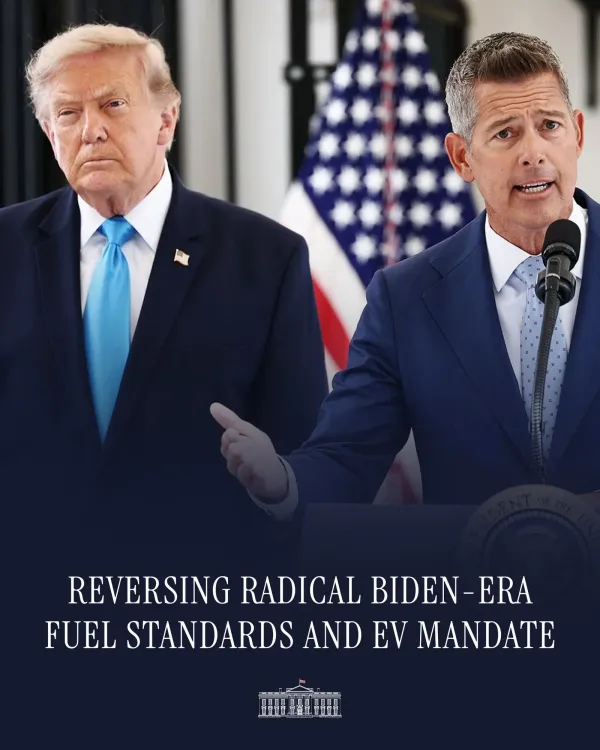
The White House says President Trump and Transportation Secretary Duffy are dismantling Biden-era fuel economy and EV mandates, claiming the move will cut the average new-vehicle price by $1,300 for American families and save hundreds of billions of dollars overall.
Key Takeaways
The White House announced President Trump and Secretary Duffy are rolling back Biden-era fuel economy standards and EV mandates.
The administration claims the action will reduce the average cost of a new vehicle by $1,300 for American families.
Total projected savings are described as 'hundreds of billions' — a figure that has not been independently verified.
This continues a decades-long pattern of alternating CAFE rule tightening and rollbacks between Democratic and Republican administrations since the original 1975 law.
The Obama-era CAFE targets through 2025 were first rolled back by Trump's 2020 SAFE Vehicles Rule , reinstated under Biden, and are now being dismantled again.
Formal revised rules from NHTSA and EPA are expected in the Federal Register , with legal challenges from states and environmental groups widely anticipated.
In a direct swipe at his predecessor's climate agenda, The White House announced on Tuesday, September 29, 2026 that President Donald Trump and Transportation Secretary Duffy are dismantling the fuel economy and electric vehicle mandates put in place by the Biden administration — a move the administration claims will shave an average of $1,300 off the price of a new vehicle for American families.
What Biden built — and Trump is tearing down
The rules in question are rooted in a regulatory push that accelerated under President Joe Biden, who directed the EPA and the National Highway Traffic Safety Administration (NHTSA) to tighten Corporate Average Fuel Economy (CAFE) standards and set ambitious electric vehicle sales targets for automakers. The White House post labels these 'radical fuel economy standards and electric vehicle mandates' that would have 'drastically raised car prices.' The claim of a $1,300 average cost reduction and 'hundreds of billions' in total savings is the administration's own figure and has not been independently verified.
This is not new terrain in Washington. The original CAFE law dates to 1975, and every administration since has pulled the dial in one direction or the other. The Obama administration locked in progressively higher fleet-wide fuel economy targets through 2025. The first Trump term answered with the 2020 SAFE Vehicles Rule, rolling those targets back and revoking California's authority to set its own stricter emissions standards. Biden reversed course again. Now, Trump's second term is executing the same playbook — faster and louder.
The automaker calculation
For carmakers — already navigating supply-chain pressure and a slower-than-forecast EV consumer uptake in the United States — the rollback removes the compliance cost pressure that had been forcing fleet electrification timelines. The administration frames this as relief for ordinary buyers; critics are expected to argue it delays the US pivot away from fossil fuels and weakens long-term American competitiveness in a global EV market increasingly dominated by China.
Legal turbulence ahead
The pattern is well established: revised NHTSA and EPA rules get published in the Federal Register, and litigation follows almost immediately — from states with their own emissions frameworks, environmental groups, and sometimes the auto industry itself, depending on timing and transition costs. Watch the Federal Register for the formal rule text, and watch the courts for the first injunction filing. The fight over what American cars must do — and cost — is far from over.
For Indian audiences, the stakes extend beyond US borders: American regulatory standards have historically influenced global auto platform decisions, including for manufacturers that sell in India. A softer US floor on fuel economy could ease pressure on shared global platforms — or widen the standards gap that Indian regulators and automakers must navigate independently.
Point of View
And it follows an entirely predictable script — one that has played out three times since 2017 alone. The political logic is straightforward: frame EV mandates as elite coastal policy that punishes ordinary car buyers, then offer a dollar figure ($1,300) concrete enough to land in a headline. What the framing obscures is that CAFE standards have also historically driven long-run fuel savings for consumers and shaped US automakers' global platform strategy. The real test will come in federal courts, where California and allied states have consistently mounted credible legal challenges to CAFE rollbacks, and in the Federal Register, where the technical rule text will determine whether the savings claim holds up to independent scrutiny.
NationPress
29 Sept 2026
Frequently Asked Questions
What are CAFE standards and why does Trump want to roll them back?
Corporate Average Fuel Economy (CAFE) standards set minimum fleet-wide fuel efficiency targets for automakers selling vehicles in the United States. The Trump administration argues the Biden-era tightening of these standards, combined with EV sales mandates, would have significantly raised vehicle prices, and has directed agencies to reverse them to reduce costs for American consumers.
How much will new car prices fall under Trump's fuel economy rollback?
The White House claims the rollback will reduce the average cost of a new vehicle by $1,300 for American families and save 'hundreds of billions' in total. These figures are the administration's own projections and have not been independently verified.
Who is Secretary Duffy and what role did he play?
The White House post names Transportation Secretary Duffy as a co-architect of the move to dismantle Biden-era fuel economy and EV standards. The Department of Transportation's NHTSA is one of the two main agencies — alongside the EPA — that administer and enforce vehicle efficiency rules.
Can Trump legally roll back Biden's EV and fuel economy rules?
Regulatory rollbacks require a formal rulemaking process through NHTSA and the EPA, including publication in the Federal Register and a comment period. Previous rollbacks, including Trump's 2020 SAFE Vehicles Rule, have faced legal challenges from states like California and environmental groups — and that pattern is widely expected to repeat.
How does the US EV mandate rollback affect India and Indian automakers?
US fuel economy and emissions standards influence global auto platform decisions. A softer US regulatory floor could ease compliance pressure on shared platforms used by manufacturers that also sell in India, though it may also widen the gap between US and Indian regulatory trajectories that Indian policymakers and carmakers manage independently.