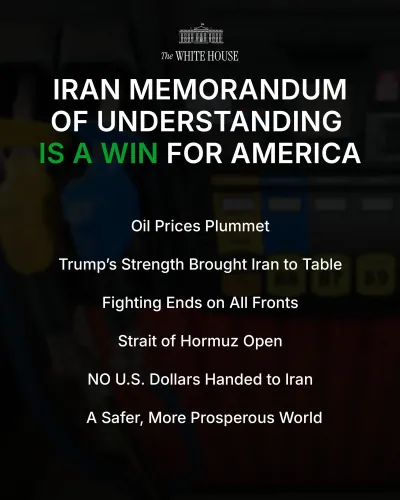
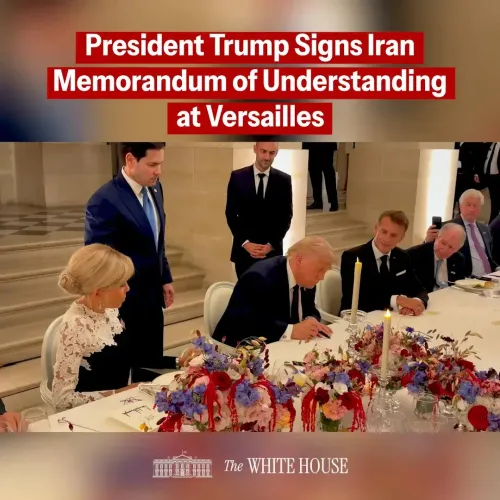
Trump Signs Iran Memorandum of Understanding
Synopsis
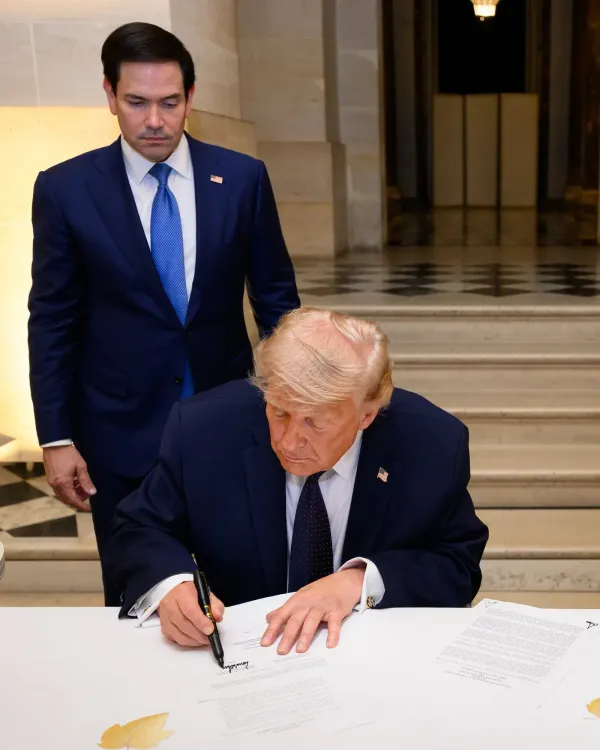
The White House announced on 18 June 2026 that President Donald J. Trump has signed a Memorandum of Understanding with Iran. The move, framed as 'Peace through strength,' marks a significant bilateral diplomatic step after Trump withdrew the US from the JCPOA in 2018 and imposed maximum-pressure sanctions on Tehran.
Key Takeaways
Trump signed an Iran Memorandum of Understanding on 18 June 2026 , as announced by the White House.
The announcement was accompanied by the phrase 'Peace through strength,' a signature of Trump's deterrence-oriented foreign policy.
Trump withdrew the US from the multilateral JCPOA nuclear deal in May 2018 and reimposed broad sanctions on Iran.
A bilateral MoU differs structurally from a multilateral treaty, reflecting a preference for direct engagement over broad international frameworks.
Gulf allies and Israel are expected to scrutinise the document's terms for implications on regional security.
For India, the development could affect energy procurement from Iran and the strategic Chabahar Port project.
The White House announced on Thursday, 18 June 2026, that President Donald J. Trump has signed a Memorandum of Understanding with Iran, marking a significant diplomatic development in US-Iran relations under the current administration's foreign policy framework.
Context
The White House shared the announcement with the phrase 'Peace through strength' — a formulation long associated with American deterrence doctrine and one that has defined Trump's approach to adversarial states since his first term. The signing of a Memorandum of Understanding, a formal but sub-treaty instrument, signals a structured bilateral engagement between Washington and Tehran without the multilateral architecture of previous nuclear accords.
The development is notable given the deep estrangement between the two countries. Trump, during his first term (2017–2021), withdrew the United States from the Joint Comprehensive Plan of Action (JCPOA) — the landmark 2015 multilateral nuclear deal — in May 2018, and reinstated sweeping sanctions on Iran under a maximum-pressure policy.
Policy Backdrop
The JCPOA had been negotiated under the Obama administration and involved the United States, United Kingdom, France, Germany, Russia, China, and the European Union alongside Iran. Trump's 2018 withdrawal dismantled that framework and triggered a cascade of Iranian counter-steps, including the acceleration of uranium enrichment beyond agreed limits.
A bilateral Memorandum of Understanding — as opposed to a multilateral treaty — fits a pattern of preferring direct, bilateral instruments over broad international agreements. The 'Peace through strength' framing echoes deterrence messaging that US administrations have used toward Iran since the 1980s, suggesting the document is as much a signal of American resolve as a diplomatic concession.
Stakeholders and Impact
Gulf allies, particularly Saudi Arabia, the United Arab Emirates, and Israel, will be watching closely, as any easing of pressure on Tehran carries direct regional security implications for them. US diplomats and Congressional oversight committees will be central to any implementation or ratification process that follows.
For India, the development carries economic significance. India was historically one of Iran's largest oil customers before US sanctions curtailed those purchases. Any shift in the sanctions landscape — depending on the MoU's specific terms — could affect Indian energy procurement options and the future of the Chabahar Port project in southeastern Iran, which New Delhi has developed as a strategic trade corridor to Afghanistan and Central Asia.
What's Next
The specific terms of the Memorandum of Understanding have not been publicly detailed in the announcement. Congressional briefings, statements from US Gulf partners, and any follow-up guidance from the State Department will be critical to understanding the document's scope and enforcement mechanisms.
If the MoU includes provisions touching on Iran's nuclear programme, sanctions relief, or regional conduct, it could reshape the diplomatic architecture that has governed US-Iran relations for nearly a decade. The world will be watching whether 'Peace through strength' translates into durable stability or a new phase of managed tension.
Point of View
Transactional diplomacy over institutionalised accords. The 'Peace through strength' framing is deliberate: it allows the White House to present the document as a product of American leverage rather than compromise. For regional powers and US allies, the critical question is whether this MoU constrains Iranian nuclear or proxy activities or merely formalises a temporary de-escalation. The announcement, light on specifics, leaves significant interpretive room — and significant geopolitical uncertainty.
NationPress
19 Sept 2026
Frequently Asked Questions
What is the Iran Memorandum of Understanding signed by Trump?
The White House announced on 18 June 2026 that President Donald J. Trump signed a Memorandum of Understanding with Iran. The specific terms have not been publicly detailed, but it represents a formal bilateral agreement between the US and Iran.
How does this differ from the Iran nuclear deal JCPOA?
The JCPOA was a multilateral 2015 nuclear agreement involving six world powers and the EU alongside Iran. A Memorandum of Understanding is a bilateral, sub-treaty instrument and does not carry the same multilateral legal architecture as the JCPOA, from which Trump withdrew in May 2018.
What does 'Peace through strength' mean in Trump's Iran policy?
'Peace through strength' is a deterrence doctrine that holds that military and economic power — rather than concession — is the foundation of stable diplomacy. Trump has used this framing consistently to signal that any agreement with Iran is a product of US leverage, not compromise.
How does the Trump Iran MoU affect India?
India was historically a major buyer of Iranian oil before US sanctions curtailed those imports. Any shift in the sanctions landscape could reopen energy options for India and affect the Chabahar Port project, a strategic trade corridor India has developed in southeastern Iran.
What happens next after the Iran MoU signing?
Congressional briefings and statements from the State Department and Gulf allies will clarify the MoU's scope. If it touches on Iran's nuclear programme or sanctions relief, it could significantly reshape US-Iran relations and regional security dynamics.