Trump Signs Iran MOU at Versailles in France
Synopsis
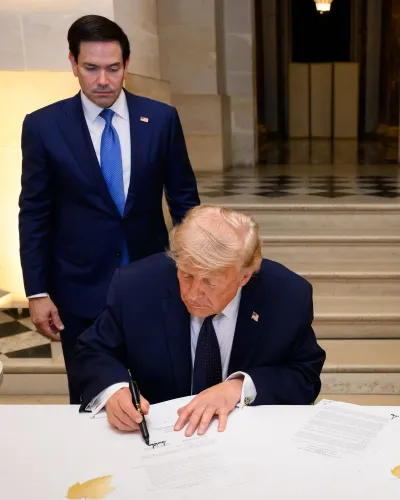
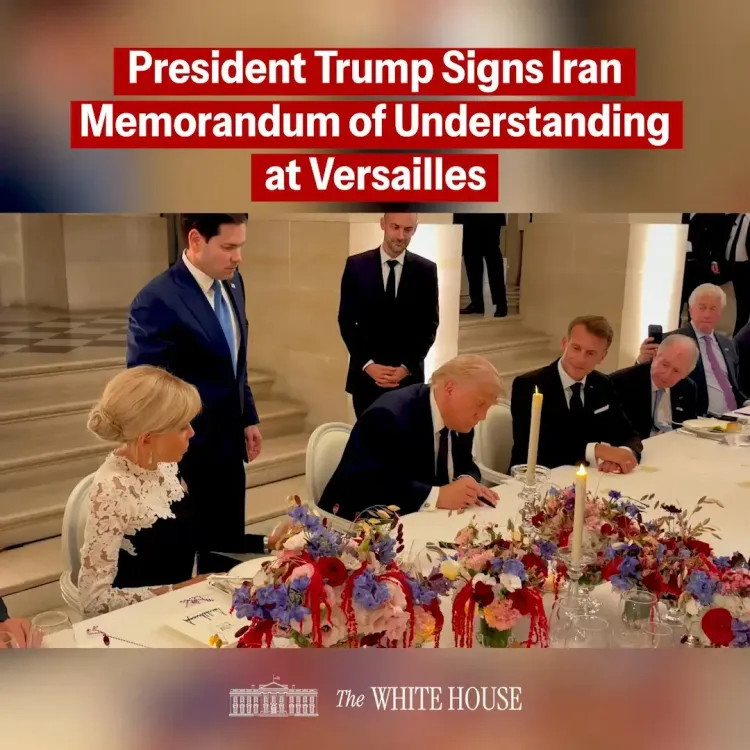
US President Donald J. Trump signed a Memorandum of Understanding with Iran at Versailles, France, on 18 June 2026. The signing at the historic venue marks a major shift in US-Iran relations, reversing the maximum pressure policy Trump himself launched in 2018 when he withdrew from the JCPOA nuclear agreement.
Key Takeaways
Trump signed a Memorandum of Understanding with Iran at Versailles, France on 18 June 2026 .
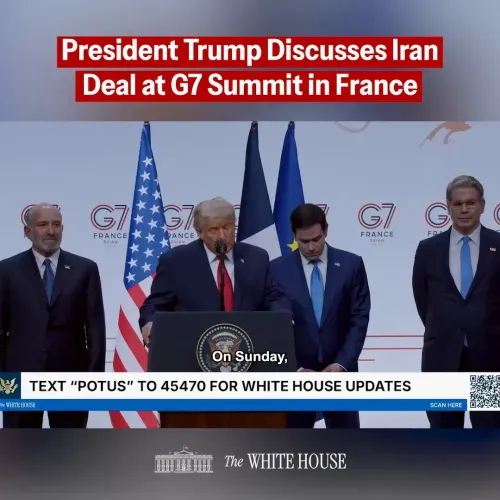
The White House announced the signing via its official communications channel, describing the event as a significant diplomatic moment.
Trump withdrew the US from the 2015 JCPOA nuclear deal in May 2018 and imposed maximum pressure sanctions on Iran .
The choice of Versailles — site of the landmark 1919 Treaty of Versailles — signals an intent to frame the agreement as historically significant.
France , a key JCPOA participant and host of the signing, has long maintained independent diplomatic channels with Tehran .
The MOU could have direct implications for India 's energy ties with Iran and the Chabahar port project.
US President Donald J. Trump signed a Memorandum of Understanding with Iran at Versailles, France, on Thursday, 18 June 2026, marking a significant diplomatic development in one of the most contentious bilateral relationships in modern geopolitics. The White House announced the signing via its official communications channel, calling attention to the historic venue chosen for the occasion.
Context
The signing at Versailles — the same French estate that lent its name to the landmark 1919 Treaty of Versailles — carries unmistakable symbolic weight. By choosing this venue, the parties appear to be signalling that the agreement is intended to carry historic significance, moving beyond routine diplomatic correspondence into the realm of foundational commitments. France has long maintained independent diplomatic channels with Tehran and was a key participant in earlier multilateral nuclear negotiations.
The White House post described the event with urgency, stating that 'President Donald J. Trump has SIGNED the Iran Memorandum of Understanding at Versailles in France.' The use of a Memorandum of Understanding — a non-binding or pre-treaty instrument — suggests the two sides have reached a framework agreement, with formal treaty negotiations potentially to follow.
Policy Backdrop
US-Iran relations have been defined by sharp swings between engagement and confrontation for more than a decade. The 2015 Joint Comprehensive Plan of Action (JCPOA), negotiated under the Obama administration with France, Germany, the United Kingdom, Russia, China, and the European Union, placed verifiable limits on Iran's nuclear programme in exchange for phased sanctions relief.
In May 2018, during his first term, President Trump withdrew the United States from the JCPOA and reimposed sweeping sanctions on Iran as part of a 'maximum pressure' campaign. That withdrawal strained ties with European allies and left the nuclear deal in a fragile state, with Iran progressively stepping back from its own commitments in the years that followed. The new MOU, signed in France, therefore represents a notable reversal — or at minimum a significant evolution — of the posture Trump himself established in his first term.
Stakeholders and Impact
Iranian officials and US diplomats are the primary parties to the agreement, though European allies — particularly France, which is hosting the signing — are closely invested in the outcome. Any easing of sanctions or nuclear commitments would have immediate implications for global oil markets, given Iran's position as a major crude producer.
For India, the development carries direct consequence. New Delhi has historically maintained energy and trade ties with Tehran and navigated US sanctions pressure carefully. A new US-Iran framework could reopen avenues for Indian companies to engage with the Iranian market, including the strategically important Chabahar port project. Regional dynamics across West Asia — affecting energy supply chains, shipping lanes, and security arrangements — would also be subject to recalibration.
What's Next
Attention now shifts to follow-up statements from the US State Department and the Iranian Foreign Ministry on the specific terms and implementation roadmap of the MOU. Whether the agreement addresses Iran's nuclear enrichment activities, sanctions relief, or broader security guarantees remains to be detailed publicly.
Multilateral forums — including the upcoming UN General Assembly session — are expected to provide the next major platform for parties to the agreement to articulate their positions. The durability of the MOU will also depend on whether US Congress and domestic constituencies in both countries accept the framework, a political test that has historically proven difficult in US-Iran diplomacy.
Point of View
And it places his administration in the unusual position of advancing engagement with Tehran that his own 2018 JCPOA withdrawal had dismantled. Choosing Versailles as the venue is a deliberate act of diplomatic theatre, invoking the weight of a 1919 peace settlement to lend legitimacy and permanence to what is, in legal terms, a non-binding instrument. For European allies — particularly France, which hosted the event — the development vindicates years of quiet shuttle diplomacy aimed at keeping communication channels with Iran open. The harder test will be whether the MOU translates into a verifiable, enforceable agreement that survives domestic political scrutiny in both Washington and Tehran.
NationPress
20 Sept 2026
Frequently Asked Questions
What is the Iran Memorandum of Understanding signed by Trump?
The Iran Memorandum of Understanding is a diplomatic agreement signed by US President Donald J. Trump and Iranian counterparts at Versailles, France on 18 June 2026 . An MOU typically establishes a framework or statement of intent between parties, with binding treaty terms to be negotiated subsequently.
Why was the Iran MOU signed at Versailles in France?
Versailles is a historically resonant venue — site of the landmark 1919 Treaty of Versailles — and its selection signals that both sides intended to frame the agreement as a moment of significant diplomatic consequence. France also has longstanding independent ties with Iran and was a participant in the original 2015 JCPOA .
How does this affect the 2015 Iran nuclear deal JCPOA?
The JCPOA , concluded in 2015 by the Obama administration with France , Germany , the UK , Russia , China , and the EU , was abandoned by Trump in May 2018 . The new MOU suggests a fresh framework is being constructed, though whether it incorporates or supersedes JCPOA commitments depends on terms not yet made public.
What does the Trump Iran deal mean for India?
India has historically maintained energy and trade ties with Iran , including the strategically important Chabahar port project. A new US-Iran framework could ease sanctions pressure and reopen avenues for Indian companies to engage with the Iranian market, though the specifics depend on the MOU's final terms.
What happens next after the Iran MOU is signed?
Follow-up statements from the US State Department and the Iranian Foreign Ministry are expected to detail implementation steps. The agreement may be referenced at the upcoming UN General Assembly , and its durability will depend on ratification or acceptance by domestic constituencies in both Washington and Tehran .