Trump's AI export control nominee Abby Warren vows to curb China tech access
Synopsis
Abby Warren, Trump's pick to run the Bureau of Industry and Security, told the Senate Banking Committee she will keep America's most advanced AI and semiconductor technology out of China's hands — while senators flagged loopholes involving Nvidia and AMD chips and questioned a UAE tech deal with potential Beijing links. Her confirmation could reshape how Washington fights the global AI race.
Key Takeaways
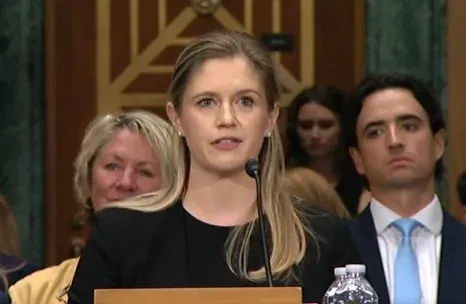
Abby Warren appeared before the Senate Banking Committee on 25 July as Trump's nominee for Assistant Secretary for Export Administration at the Bureau of Industry and Security (BIS) .
Warren pledged to prevent US advanced technologies from contributing to the 'military modernization or strategic ambitions' of adversaries, particularly China .
Senator Jack Reed questioned her on reports that Chinese-owned firms imported Nvidia and AMD chips through an alleged loophole; Warren said she was unaware but vowed to review the rules.
Senator Chris Van Hollen raised concerns over eased export restrictions involving UAE firm G42 and its alleged links to China.
Warren said her regulatory philosophy is grounded in the Export Control Reform Act , balancing national security concerns with economic impact.
The BIS oversees export controls on semiconductors, AI hardware, and dual-use technologies — a portfolio that has expanded significantly amid US-China tech rivalry.
Abby Warren, President Donald Trump's nominee to head the Bureau of Industry and Security (BIS) at the Commerce Department, pledged before the Senate Banking Committee on 25 July to prevent America's most advanced technologies from bolstering the military and strategic ambitions of adversaries, with China firmly in focus. Warren, nominated as Assistant Secretary for Export Administration, called export controls 'among the most important tools available' to safeguard US technological leadership amid an intensifying global race in artificial intelligence and advanced semiconductors.
Warren's Core Commitments
Testifying before the committee, Warren framed the BIS as a linchpin of US national security. 'The Bureau of Industry and Security plays a vital role in protecting the national security, economic security, and unmatched technological achievement and scientific innovation of the United States,' she told lawmakers.
She pledged that, if confirmed, she would 'faithfully execute the laws enacted by Congress, work to ensure that BIS's export controls are effective and enforceable, and collaborate closely with Congress, our international partners and stakeholders across the government and industry to advance US national security interests.' Warren also stressed the need for a regulatory system that is 'effective, adaptable and grounded in close coordination with our allies and partners,' citing the rapid evolution of emerging technologies and increasingly complex global supply chains.
China AI Race at the Centre of Senate Debate
Several senators used the hearing to underscore the geopolitical stakes. Senator Ted Cruz introduced Warren by arguing that the United States was in 'a race with China on who will lead in artificial intelligence,' and said that placing the right people in leadership positions would give the country a competitive edge. Committee Chairman Tim Scott echoed that framing, stating that decisions made by BIS leadership would directly influence national security, the technology sector, and American competitiveness — and that the 'global AI race' must be won in the United States, not China.
Scrutiny Over Semiconductor Loopholes and UAE Deal
Senator Catherine Cortez Masto raised concerns that easing restrictions on advanced semiconductors could inadvertently accelerate China's AI capabilities. Warren, drawing on her legal background, said her approach would be anchored in the Export Control Reform Act: controls should be imposed where there are 'significant national security concerns' while also weighing their economic impact. She acknowledged that 'technology is always evolving' and committed to keeping staff and herself continuously updated.
Senator Jack Reed pressed Warren on reports that Chinese-owned companies had imported advanced Nvidia and AMD chips before an alleged loophole was closed. Warren said she was 'not aware of any such loophole' but pledged to review existing rules and work closely with export enforcement officials 'to vigorously enforce those rules' if confirmed.
Democratic Senator Chris Van Hollen raised questions about the administration's recent decision to ease certain export restrictions involving the United Arab Emirates, citing reports that career officials had expressed concerns over potential links between UAE technology company G42 and China. Warren said she was 'not aware of any specific concerns' but emphasised that she valued the expertise of career BIS officials and would consult them closely.
BIS and the Expanding Scope of Tech Export Controls
The Bureau of Industry and Security has emerged as one of Washington's most consequential agencies in recent years, overseeing export controls on semiconductors, AI hardware, and other dual-use products with both commercial and military applications. Successive administrations have progressively tightened restrictions on technology exports to China, arguing that maintaining America's technological edge is inseparable from national security. Warren's confirmation hearing reflects the growing bipartisan consensus that export controls — once a niche regulatory tool — are now a frontline instrument of great-power competition.
If confirmed, Warren will inherit a portfolio that includes ongoing reviews of chip export rules, allied coordination frameworks, and enforcement actions against entities suspected of circumventing controls. The Senate Banking Committee is expected to advance her nomination in the coming weeks.
Point of View
Combined with the G42-UAE deal that career officials reportedly flagged, suggest enforcement has not kept pace with the rhetoric. Warren's repeated 'I am not aware' answers are legally safe but politically thin. The deeper challenge for BIS is not philosophy — it is speed: technology evolves faster than rulemaking, and adversaries exploit every lag. Whether Warren can close that gap, or whether she will manage a bureaucracy still catching up to the last round of controls, is the question her confirmation does not yet answer.
NationPress
23 Oct 2026
Frequently Asked Questions
Who is Abby Warren and what role has she been nominated for?
Abby Warren is President Donald Trump's nominee for Assistant Secretary for Export Administration at the Commerce Department's Bureau of Industry and Security (BIS). If confirmed, she will oversee US export controls on advanced technologies including AI hardware and semiconductors.
What did Warren promise regarding China and advanced technology exports?
Warren pledged that export controls would be used to ensure US technologies do not contribute to the 'military modernization or strategic ambitions' of adversaries, with China the primary concern. She committed to keeping BIS controls effective, enforceable, and continuously updated as technology evolves.
What concerns did senators raise about semiconductor loopholes?
Senator Jack Reed questioned Warren about reports that Chinese-owned companies had imported advanced Nvidia and AMD chips before an alleged loophole was closed. Warren said she was unaware of such a loophole but pledged to review existing rules and vigorously enforce them if confirmed.
What is the controversy around the UAE export restriction decision?
Senator Chris Van Hollen raised concerns about the administration's decision to ease certain export restrictions involving UAE technology company G42, citing reports that career officials had flagged potential links between G42 and China. Warren said she was not aware of specific concerns but pledged to work closely with career BIS officials.
Why has the Bureau of Industry and Security become so prominent?
BIS has become a central agency in the US-China technology rivalry, overseeing export controls on semiconductors, AI hardware, and dual-use products. Successive administrations have expanded restrictions on technology exports to China, making BIS a frontline instrument of national security policy rather than a routine regulatory body.