Trump Declares Naval Blockade on Hormuz After Failed Iran Talks
Synopsis
In a bold move, President Trump has ordered a naval blockade of the Strait of Hormuz, citing Iran's refusal to abandon its nuclear ambitions after extensive negotiations. This escalation raises concerns about global maritime security.
Key Takeaways
Trump's blockade aims to ensure maritime security in response to Iran's nuclear ambitions.
The negotiations were extensive but ultimately unproductive.
Navy will actively intercept vessels linked to Iran.
Trump emphasizes the need to restore free navigation.
Relations with Iran remain tense amid ongoing nuclear discussions.
Washington, April 12 (NationPress) - On Sunday, US President Donald Trump declared a comprehensive naval blockade of the Strait of Hormuz, accusing Iran of persisting in its nuclear aspirations following nearly 20 hours of discussions mediated in Pakistan.
In a series of extensive updates on Truth Social, Trump remarked that the negotiations "went positively" and that "most points were agreed upon". However, he claimed that Tehran remained "inflexible regarding the singular most critical issue", stating: "IRAN IS UNWILLING TO GIVE UP ITS NUCLEAR AMBITIONS!"
The President mentioned that he received a complete briefing from Vice-President JD Vance, Special Envoy Steve Witkoff, and his son-in-law Jared Kushner after the Islamabad discussions, which he stated were facilitated by the leadership of Pakistan.
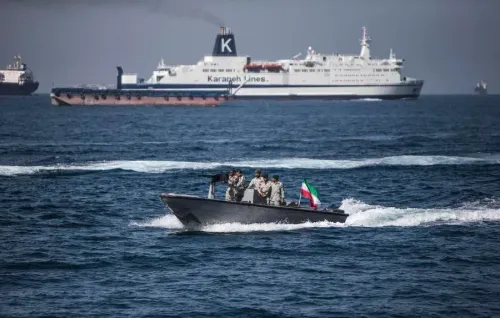
Trump also accused Iran of breaking promises to maintain the freedom of navigation through the Strait of Hormuz, indicating that the ongoing tensions have led to "anxiety, dislocation, and suffering for many individuals and nations globally".
"They claim to have placed mines in the waters," Trump noted, emphasizing that the uncertainty surrounding maritime security has effectively deterred shipping activities.
"What ship owner would take that risk?" he questioned.
Labeling the situation as "WORLD EXTORTION", Trump stressed that the US would take prompt and decisive actions.
"Effective immediately, the United States Navy will initiate the process of BLOCKADING any and all vessels attempting to enter or exit the Strait of Hormuz," he stated.
He warned that US forces would "seek and intercept every vessel in International Waters that has rendered payment to Iran", cautioning that "no one who pays an illegal toll will be granted safe passage on the high seas".
Trump further declared that US naval units would commence the destruction of mines allegedly laid by Iran in this vital waterway, issuing a stern warning: "Any Iranian who opens fire on us or on peaceful vessels will be BLOWN TO HELL!"
The blockade will persist until unrestricted navigation is restored, with Trump characterizing the current state as a breach of international standards governing maritime trade routes.
He acknowledged that "eventually, we will reach a point where 'ALL BEING ALLOWED TO GO IN, ALL BEING ALLOWED TO GO OUT' will be established", attributing the delay to Iran's actions.
Additionally, he associated this escalation with ongoing tensions regarding Tehran's nuclear program, reiterating his long-held stance: "IRAN WILL NEVER POSSESS A NUCLEAR WEAPON!"
The Islamabad discussions, which Trump indicated lasted "nearly 20 hours", included senior Iranian officials such as Mohammad-Bagher Ghalibaf, Abbas Araghchi, and Ali Bagheri.
While describing the interactions between the delegations as "very amicable and respectful", Trump noted that the fundamental dispute remains unresolved.
In his comments, Trump commended Pakistan's leadership, including Field Marshal Asim Munir and Prime Minister Shehbaz Sharif, referring to them as "incredibly extraordinary individuals".
Point of View
The U.S. government's decision to implement a naval blockade is a pivotal moment in international relations. The ongoing nuclear negotiations with Iran remain unresolved, highlighting the complexity of maintaining peace while addressing security concerns.
NationPress
18 Sept 2026
Frequently Asked Questions
What prompted Trump's blockade of the Strait of Hormuz?
Trump announced the blockade in response to Iran's continued nuclear ambitions despite lengthy negotiations, claiming that Iran refused to yield on critical issues.
How long were the discussions between the U.S. and Iran?
The discussions lasted nearly 20 hours and were mediated in Pakistan.
What does the blockade entail?
The blockade involves the U.S. Navy preventing any vessels from entering or leaving the Strait of Hormuz, particularly those that have paid tolls to Iran.
What was Trump's warning regarding Iranian actions?
Trump warned that any Iranian forces that attack U.S. vessels or peaceful ships will face severe consequences.
Who were the key Iranian officials involved in the talks?
The talks included prominent figures such as Mohammad-Bagher Ghalibaf, Abbas Araghchi, and Ali Bagheri.