U.S. Launches Pax Silica Initiative to Secure AI Supply Chains

Synopsis
The U.S. is unveiling Pax Silica, a strategic initiative aimed at securing artificial intelligence supply chains. This coalition seeks to mitigate dependencies and enhance economic security, as highlighted by Jacob Helberg during a recent Congressional testimony.
Key Takeaways
Pax Silica aims to secure AI supply chains.
Focus on reducing strategic dependencies.
Partnerships include nations like India, Japan, and South Korea.
Emphasis on the importance of industrial capacity for sovereignty.
Promoting a Pro-Innovation, Pro-Adoption policy approach to AI.
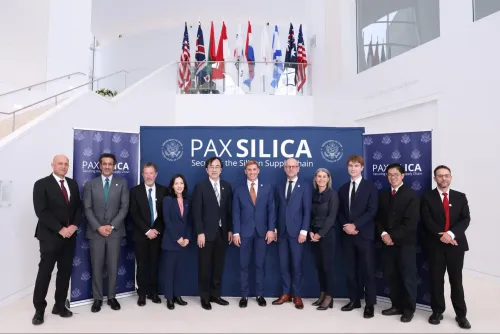
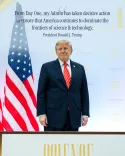
Washington, Feb 24 (NationPress) The United States is constructing a new framework for economic security aimed at safeguarding artificial intelligence supply chains, Under Secretary of State for Economic Affairs Jacob Helberg informed lawmakers on Tuesday, presenting Pax Silica as the U.S. response to strategic dependencies in the age of AI.
“I did not come here today to engage in discussions about tariffs. I did not come to delve into trade deficits or the technicalities of logic chips. My purpose here is to discuss survival,” Helberg stated during his testimony before a Congressional committee.
Describing the moment as historic, he remarked: “History does not progress in a straight line. It is composed of intersections. Today, the United States and its closest allies find themselves at the most significant crossroads we have encountered in a century.”
The key question, Helberg posited, is not if artificial intelligence will revolutionize the global economy, but rather “who will control the industrial foundations that enable AI, and who will become dependent on those who do.”
This necessity forms the core of Pax Silica, which he characterized as “a coalition for the AI era, dedicated to restoring supply chain security concerning the infrastructure, industrial capabilities, and essential technologies that now determine national power.”
“In the age of AI, supply chains are exploited,” he cautioned, asserting that “dependency equates to vulnerability.” Pax Silica, he stated, represents “an economic security framework designed to diminish strategic dependency, establish reliable redundancies, and excel against coercive systems without emulating them.”
Referencing growth statistics, Helberg indicated, “G7 nations average a growth rate of 1.5 percent; countries involved in Pax Silica average 4.7 percent. Thanks to President Trump’s pro-growth strategies, balanced trade initiatives, energy dominance, deregulation, and tax incentives, the U.S. is again leading at 4.3 percent.”
He outlined two foundational elements for the forthcoming phase: execution and alignment.
Regarding execution, the U.S. and its partners will release joint Requests for Proposals to integrate logistics infrastructure — encompassing ports, railways, and highways — with secure data flows and comprehensive visibility. On industrial capacity, he emphasized that “industrial capacity is not a matter of nostalgia. In this century, it signifies sovereignty.”
Helberg also underscored the significance of the American AI Exports Program, labeling it “the United States’ premier AI diplomatic initiative” and “a comprehensive government effort to disseminate the benefits of American AI technologies to partners globally.”
On policy alignment, he stated that Pax Silica would advocate for a “Pro-Innovation, Pro-Adoption approach to AI policy.” “We champion AI opportunities rather than fear,” he noted, adding that the U.S. would “resist the extraterritorial reach of censorship and burdensome regulations.”
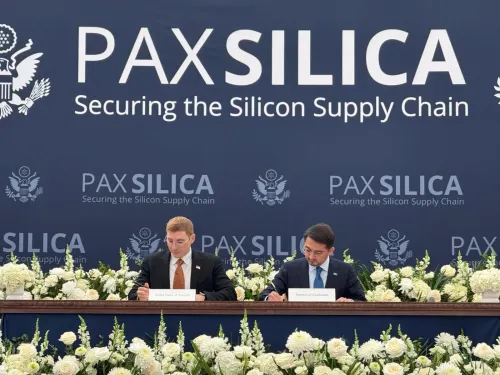
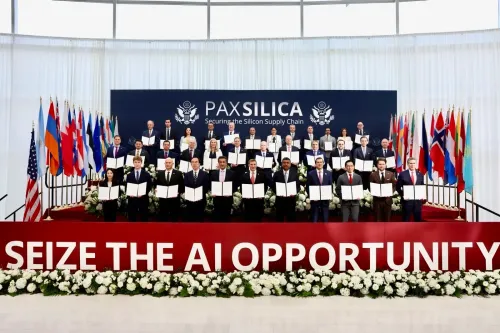
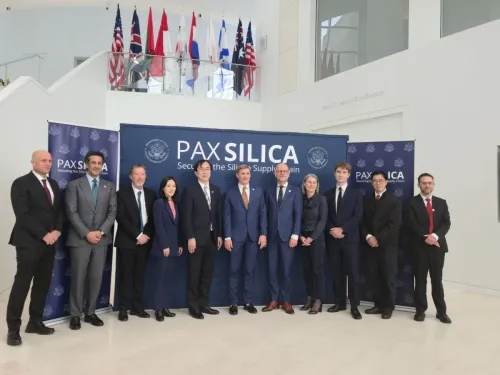
The coalition is expanding, with India formally joining the initiative last week by signing the Pax Silica Declaration in New Delhi alongside U.S. officials. “India joins Pax Silica, the coalition that will shape the 21st-century economic and technological landscape,” U.S. Ambassador Sergio Gor stated before the signing in New Delhi.
The alliance comprises nations such as Japan, South Korea, the UK, and Israel, aiming to fortify critical minerals supply chains and enhance cooperation on artificial intelligence.
Point of View
The U.S. government's emphasis on establishing Pax Silica highlights a proactive approach to economic security in the context of artificial intelligence. This initiative appears necessary, given the strategic dependencies that could undermine national interests in the AI domain.
NationPress
9 Oct 2026
Frequently Asked Questions
Why is the U.S. focusing on AI supply chains?
The U.S. aims to enhance economic security and ensure that it and its allies do not become overly dependent on other nations for critical AI technologies.
How does Pax Silica impact global partnerships?
Pax Silica fosters collaboration among countries like India, Japan, and South Korea to strengthen supply chains and deepen cooperation on AI technologies.
What are the goals of the American AI Exports Program?
The American AI Exports Program aims to share the benefits of U.S. AI technologies with global partners, enhancing international collaboration.
What is the significance of the recent signing by India?
India's formal joining of Pax Silica represents a significant step towards a unified approach to economic and technological cooperation in the 21st century.