US tightens Ebola travel curbs after American tests positive in Africa
Synopsis
An American citizen has tested positive for the Bundibugyo strain of Ebola in Africa — and the Trump administration's response was immediate: entry bans for travellers from Uganda, Congo, and South Sudan, a full interagency mobilisation, and an evacuation to Germany. With no domestic cases yet, Washington is betting on containment at the border.
Key Takeaways
An American citizen tested positive for the Bundibugyo strain of Ebola in Africa, confirmed on 19 May .
The infected American and six high-risk contacts will be evacuated to Germany for specialised treatment.
The Trump administration imposed immediate entry restrictions on non-US citizens who visited Uganda, DRC, Congo, or South Sudan in the past 21 days .
A 'full interagency response' involving the State Department , CDC , and Department of War has been activated.
Officials confirmed no Ebola cases currently exist inside the United States .
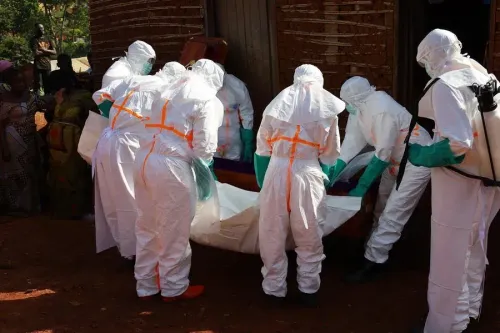
The Trump administration on 19 May announced sweeping travel restrictions and emergency containment measures after an American citizen tested positive for the Bundibugyo strain of Ebola in Africa, even as senior officials emphasised that there are currently no confirmed Ebola cases inside the United States. The announcement was made during a White House event where President Donald Trump addressed the outbreak publicly for the first time.
What Officials Said
Asked whether Americans should be worried, President Trump acknowledged concern while stressing containment. 'I'm concerned about everything,' he said. 'It's been confined right now to Africa, but it's something that has had a breakout.'
Trump then invited Dr Heidi Overton, a senior administration health official, to detail the government's response. Overton confirmed the diagnosis and outlined the scale of the federal reaction. 'There is an American that is symptomatic and has tested positive for the Bundibugyo virus, a strain of Ebola,' she said.
Evacuation and Treatment Plan
According to Overton, the infected American and six other high-risk contacts will be evacuated from the affected region and transferred to Germany for treatment at a specialised viral haemorrhagic fever facility. 'We want to thank our German counterparts,' she said. 'That is an internationally recognised location for viral haemorrhagic fever treatments.'
The administration confirmed it had launched a 'full interagency response' involving the State Department, the Centers for Disease Control and Prevention (CDC), and the Department of War. US officials did not disclose the precise location of the infected American, but confirmed the case remains linked to the active outbreak zone.
Entry Restrictions and Travel Warnings
Effective immediately, the administration imposed entry restrictions on non-US citizens who had been in Uganda, the Democratic Republic of Congo, Congo, or South Sudan within the past 21 days. 'We have instituted just today entry restrictions for non-US citizens that have been in the region in the past 21 days,' Overton stated.
Separate travel warnings had already been issued for Americans present in the region. Overton stressed that authorities were taking 'very serious measures' to prevent the virus from reaching US soil. 'Right now there are no cases of Ebola in America,' she said. 'We want to keep it that way.'
About the Bundibugyo Strain
The Bundibugyo strain is one of several known variants of the Ebola virus and is capable of causing severe haemorrhagic fever in humans. Symptoms typically include fever, vomiting, diarrhoea, and internal bleeding. The virus spreads through direct contact with infected bodily fluids and does not transmit through the air, according to established medical understanding.
The White House announcement followed a separate press briefing held by the CDC on the outbreak and ongoing containment efforts in Africa. This marks one of the more significant US government responses to an Ebola-related case involving an American national in recent years, and signals a shift toward pre-emptive border measures even before any domestic transmission is recorded.
Point of View
Interagency activation, and a Germany evacuation announced in a single briefing — reflects lessons learned, or at least lessons remembered, from the 2014 West Africa outbreak when delayed US action drew fierce political criticism. Yet the decision to name specific countries for entry restrictions while withholding the infected American's precise location raises a familiar tension: maximum optics, minimum transparency. The Bundibugyo strain is less lethal than the Zaire strain that defined the 2014 crisis, but any Ebola case involving a US national triggers a political alarm that outpaces the epidemiological risk. The real test will be whether the interagency machinery holds together as the outbreak evolves — or whether, as in past episodes, coordination fractures under media pressure.
NationPress
19 Sept 2026
Frequently Asked Questions
What Ebola strain did the American citizen test positive for?
The American citizen tested positive for the Bundibugyo virus, a strain of Ebola that causes severe haemorrhagic fever. It spreads through direct contact with infected bodily fluids, not through the air.
Are there any Ebola cases inside the United States?
No. Senior administration health official Dr Heidi Overton confirmed on 19 May that there are currently no cases of Ebola in the United States. The infected American remains in Africa and is being evacuated to Germany for treatment.
Which countries are covered by the new US entry restrictions?
Non-US citizens who have been in Uganda, the Democratic Republic of Congo, Congo, or South Sudan within the past 21 days are now barred from entering the United States, effective 19 May.
Where will the infected American be treated?
The infected American and six other high-risk contacts will be evacuated from the outbreak region and transferred to Germany, which hosts an internationally recognised facility for treating viral haemorrhagic fever cases.
Which US agencies are involved in the Ebola response?
The Trump administration has activated a full interagency response involving the State Department, the Centers for Disease Control and Prevention (CDC), and the Department of War, according to Dr Heidi Overton.