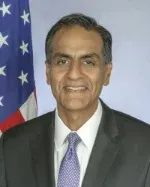
Richard Verma flags tariffs, visa cuts as US-India ties face new stress
Synopsis
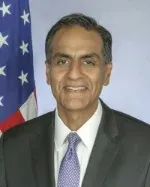
Richard Verma, former US Ambassador to India, delivered a rare public reckoning this week: the world's most strategically hyped bilateral relationship is buckling under 50% tariffs, a 60–70% crash in Indian student visa approvals, and gutted clean energy cooperation. The man who helped build the partnership is now its most credible alarm bell.
Key Takeaways
Former US Ambassador Richard Verma warned this week that US-India ties face serious stress from tariffs, visa cuts, and reduced clean energy cooperation.
Verma said F-1 student visa approvals for Indian applicants had fallen by 60–70% , with rival nations including Australia , Canada , and Germany competing aggressively for those students.
He flagged 50% tariffs on India — shared only with Brazil — as 'unexplainable.' Two-way US-India trade has grown from $20 billion to over $200 billion , and defence trade from $0 to $20 billion , since 2000 .
Verma cited AI , semiconductors , and critical minerals as areas where the partnership retains forward momentum.
He called for reform of the UN Security Council , describing it as 'a place where things go to basically perish.'
Former US Ambassador to India Richard Verma has cautioned that the US-India relationship is entering a turbulent phase, citing 50% tariffs, a sharp decline in student visa approvals, and reduced clean energy cooperation — even as he reaffirmed India's status as America's 'defining partnership' of the century. Verma made the remarks this week at the Council on Foreign Relations' 2026 International Affairs Fellowship keynote in Washington.
A Partnership Built Over 25 Years — Now Under Pressure
Verma, currently Chief Administrative Officer at Mastercard and a former Deputy Secretary of State, traced the trajectory of US-India ties to then-President Bill Clinton's landmark visit to India in 2000. 'We went from $0 in defence trade in 2000 to $20 billion,' he said. 'We went from $20 billion in two-way trade over $200 billion.' He also noted that Indian students now represent the largest foreign student population in the United States — a people-to-people bridge he described as strategically vital.
Yet Verma was candid about the fault lines. 'The architecture and the importance of the relationship continues to be of a paramount US national security interest,' he said. 'And I continue to believe, as former President Obama used to say, this is the defining partnership for the United States in this century.'
Tariffs and Visa Curbs: The Pressure Points
Verma singled out the tariff regime as particularly difficult to justify. 'India and Brazil were the only two countries that had 50 per cent tariffs,' he said. 'It was kind of unexplainable. And still scratch your head about 50 per cent tariffs.' He acknowledged that immigration flows, student visa issuances, and clean energy collaboration had all contracted — 'if not eliminated' — under the current US administration.
On F-1 student visas specifically, Verma said approval rates for Indian applicants had fallen sharply. 'I think the rates, at least on Indian students, were down 60–70 per cent,' he said. The decline comes as competitor nations including Australia, Canada, Japan, Germany, and Britain are, according to Verma, aggressively courting international students. 'They want these students desperately because they know what they can add to American society,' he warned.
India's Strategic Weight Looking Ahead to 2030
Despite the current friction, Verma argued that India's centrality to the global balance of power would only grow. 'The India of 2030, just a few years away, is going to have the largest middle class, the most college graduates, the most internet users,' he said. He invoked historical American assessments of India's importance, recalling that President Dwight Eisenhower had predicted that close US-India friendship would make the world safer, and that President John F. Kennedy had described India as 'the hinge of fate in Asia.'
UN Security Council Reform and Tech Cooperation
Asked about India's aspirations for a permanent seat on the UN Security Council, Verma said global institutions were 'in desperate need of reform,' describing the Security Council as 'a place where things go to basically perish.' He stopped short of endorsing India's bid directly but framed the question within a broader call for multilateral institutions to reflect contemporary geopolitical realities.
Verma also highlighted deepening cooperation in artificial intelligence, semiconductors, and critical minerals as areas where the bilateral relationship retains significant momentum. 'If you think about bringing these incredible research scientists together, whether it's in space, or the seabeds, or on AI, or on medicine, it's really powerful,' he said.
What Comes Next
Verma's remarks land at a sensitive moment, with Indian students and technology professionals navigating tighter US immigration policies under the Trump administration's second term. Whether the strategic logic he outlined — rooted in defence trade, technology, and demographic complementarity — can withstand the current policy headwinds remains the central question for both capitals in the months ahead.
Point of View
And no senior US official has offered a coherent explanation. What Verma is really warning is that strategic logic alone cannot hold a bilateral relationship together when transactional policy runs in the opposite direction.
NationPress
30 Sept 2026
Frequently Asked Questions
What did Richard Verma say about US-India relations in 2026?
Richard Verma, former US Ambassador to India, said the relationship is entering a difficult phase marked by 50% tariffs, a 60–70% drop in Indian student visa approvals, and reduced clean energy cooperation. He made the remarks at the Council on Foreign Relations' 2026 International Affairs Fellowship keynote, while still describing India as America's 'defining partnership' of the century.
How much have Indian student visa approvals fallen in the US?
According to Verma, F-1 student visa approval rates for Indian applicants have fallen by 60–70%. He warned that countries such as Australia, Canada, Japan, Germany, and Britain are aggressively competing to attract those students away from the United States.
Why did Verma call the 50% tariff on India 'unexplainable'?
Verma noted that India and Brazil were the only two countries facing 50% US tariffs, calling the situation 'kind of unexplainable.' The tariff level stands in tension with the broader US framing of India as a top strategic partner.
How has US-India trade grown since 2000?
Verma said two-way trade has grown from $20 billion to over $200 billion since 2000, and defence trade has risen from $0 to $20 billion over the same period, following President Bill Clinton's visit to India in 2000.
What areas of US-India cooperation does Verma see as still strong?
Verma highlighted artificial intelligence, semiconductors, critical minerals, space, and medicine as areas where bilateral cooperation retains significant momentum. He also pointed to India's projected standing by 2030 — largest middle class, most college graduates, most internet users — as reinforcing its long-term strategic importance to the United States.