Report Highlights Failures in Women's Political Leadership in Pakistan
Synopsis
A recent report sheds light on the struggles faced by women in Pakistan's Parliament, revealing that their representation is primarily quota-driven, with an urgent call for political reform to enable female leadership.
Key Takeaways
Women in Pakistan's Parliament are largely quota-driven.
Only one woman has been elected on a general seat.
Female Senators contributed 20% of the Senate's agenda.
Women outperform men in submitting legislative items.
Political reform is essential for gender equality in leadership.
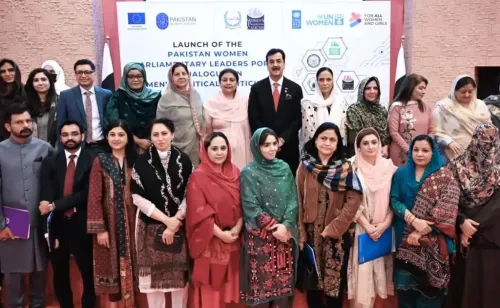
Islamabad, April 12 (NationPress) The representation of women in Pakistan's Parliament is largely reliant on quotas. Currently, only one female representative has been elected through a general seat, while the majority have obtained their positions via reserved seats. Leadership roles, including Chairman and Opposition leader, are still predominantly held by men, highlighting a significant shortcoming from political parties, according to a report.
A recent analysis from the Free and Fair Election Network indicates that female Senators contributed to 20% of the Senate's agenda in the 2025-2026 Parliamentary year, exceeding their 18% share of seats, as noted in an editorial by Pakistan's prominent newspaper, Dawn.
Dawn's editorial states, "The Fafen report illustrates that women in Pakistan's Parliament have demonstrated their skills, diversity, and dedication. The pivotal issue is not their capability to perform, but whether the political framework will permit them to take on leadership roles."
Women in Parliament have gone beyond their numerical representation, effectively engaging in various policy discussions spanning economic management, national security, and taxation.
When assessed on a per capita basis, female legislators outperformed their male peers, presenting an average of 12 agenda items each, compared to 11 by their male counterparts.
The legislative agenda of women lawmakers challenges the notion that they only focus on 'women's issues', with over half of their agenda addressing national matters. This suggests that if given the opportunity, women parliamentarians can be both present and impactful contributors.
However, the report also underscores the limitations of this advancement. The Senate's Gender Responsiveness Score is just 0.9, indicating that women's legislative proposals garner less attention than those of their male colleagues. Furthermore, a significant number of female Senators are categorized as having 'rarely spoken' in plenary debates. A deeper issue, as highlighted by Dawn's editorial, lies beyond the Senate chamber.
The overwhelming reliance on quotas for women's representation in Parliament persists. Of the current representatives, only one woman has secured a general seat; the remainder has entered via reserved quotas. Leadership roles continue to be male-dominated, marking a failure of the political parties. These parties control the flow of power by primarily offering general seat tickets to men, thereby limiting women's political advancement and confining them to the peripheries of electoral politics, despite their contributions within legislative bodies. This exposes a paradox: women are deemed capable of legislating, scrutinizing, and representing but are not allowed to contest and win elections.
To address this imbalance in Pakistan, reform must commence at the party level. Political parties should actively endorse women as candidates for general seats, which necessitates investment in candidate development, fair ticket distribution, and pathways to leadership within the party.
Point of View
The findings underscore a systemic issue within Pakistan's political framework. The persistence of quota-driven representation reflects a larger failure by political parties to foster an environment where women can ascend to leadership roles, thereby impeding progress toward gender equality in governance.
NationPress
25 Sept 2026
Frequently Asked Questions
What is the current status of women's representation in Pakistan's Parliament?
Women's representation in Pakistan's Parliament is primarily quota-driven, with only one woman elected through a general seat, while others have gained seats via reserved quotas.
How do female Senators perform compared to their male counterparts?
On average, female Senators submit more agenda items than their male counterparts, with 12 items per woman compared to 11 by men.
What are the main challenges faced by women in Pakistani politics?
Women face significant barriers, including a lack of leadership roles, reliance on quotas for representation, and limited attention to their legislative initiatives.
What reforms are necessary for improving women's political representation in Pakistan?
Reforms should focus on political parties actively promoting women as candidates for general seats, equitable ticket distribution, and pathways to leadership roles.
What does the Senate's Gender Responsiveness Score indicate?
The Senate's Gender Responsiveness Score of 0.9 indicates that women's legislative initiatives receive significantly less attention compared to those of their male colleagues.