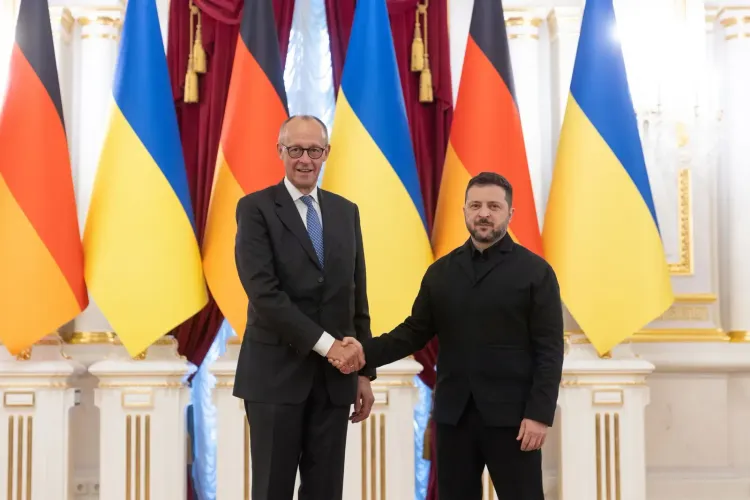
Zelensky, Merz seal €1.3 billion Germany-Ukraine support package in Kyiv
Synopsis
On a single day, Ukraine received more than €4.2 billion in combined German and EU support — a €1.3 billion package from Berlin covering air defence interceptors, long-range weapons, and energy repairs, plus a €2.9 billion EU tranche including the first-ever disbursement under a new €90 billion Ukraine Support Loan. The scale and coordination signal a deliberate Western push to fortify Ukraine before winter sets in.
Key Takeaways
Germany and Ukraine agreed a support package worth more than 1.3 billion euros ( $1.46 billion ) on 5 October 2026 in Kyiv .
The package includes air defence systems , joint production of drone interceptors , long-range weapons , satellite technology , and combat drones .
350 million euros ( $394 million ) is earmarked to repair Ukraine's energy infrastructure ahead of winter.
Total Germany-Ukraine agreements now stand at 15 deals worth more than 8.5 billion euros .
The EU separately disbursed 2.9 billion euros to Ukraine on the same day, including the first 800 million euros under the new 90-billion-euro Ukraine Support Loan for 2026–2027 .
This is Chancellor Merz's second visit to Kyiv since taking office.
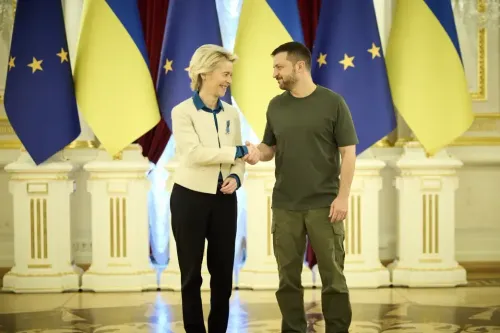
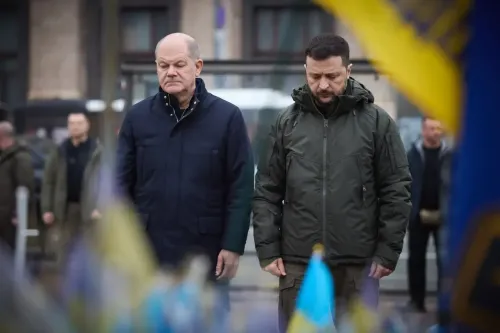
Ukrainian President Volodymyr Zelensky and visiting German Chancellor Friedrich Merz on 5 October 2026 finalised a new support package worth more than 1.3 billion euros ($1.46 billion) for Ukraine, with a strong focus on air defence and energy infrastructure ahead of winter. The announcement was made by Zelensky following a bilateral meeting in Kyiv.
What the Package Contains
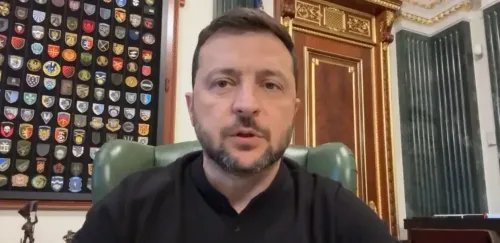
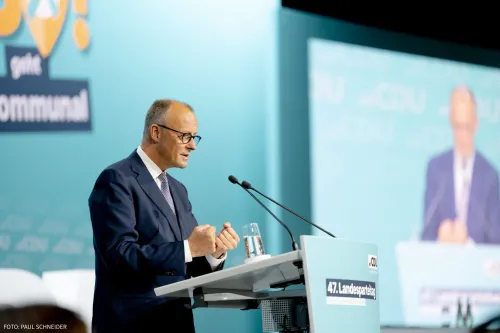
'It includes weapons that will help us now, as well as support for our energy sector ahead of winter — an important energy package,' Zelensky said, adding that he specifically raised the need for stronger air defence systems with Merz. According to the German government, the new military aid package centres on air defence capabilities, including the joint production of interceptors against jet-powered drones. Chancellor Merz noted that recent technical breakthroughs in this area would help rapidly reinforce Ukrainian air defences.
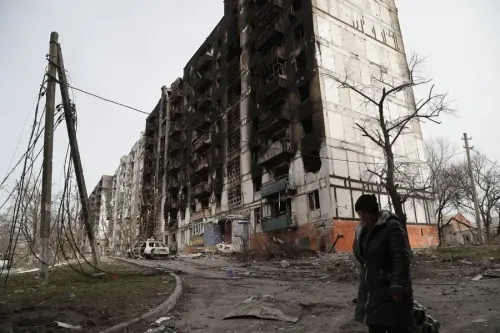
Beyond air defence, Germany will also supply long-range weapons, satellite technology, and combat drones to Ukraine. An additional 350 million euros ($394 million) has been earmarked specifically to repair Ukraine's energy infrastructure before the onset of winter — a critical vulnerability that Russian strikes have repeatedly targeted.
Broader Germany-Ukraine Agreements
Zelensky noted that the two countries currently hold 15 agreements collectively worth more than 8.5 billion euros. These documents cover security cooperation, Ukraine's procurement orders for German industry, and joint reconstruction projects within Ukraine, among other areas. This is Merz's second visit to Kyiv since he assumed office, signalling continued high-level German engagement with the Ukrainian leadership.
EU Funding Adds to the Support
The bilateral package came on the same day that Ukraine's Finance Ministry announced the receipt of 2.9 billion euros ($3.26 billion) from the European Union to bolster macroeconomic stability, fund priority budget expenditures, and support recovery and modernisation. Of this total, 800 million euros ($898 million) was disbursed for the first time under the Ukraine Support Loan (USL) — an EU financial instrument with a total value of 90 billion euros ($101 billion) for 2026–2027, designed to underwrite Ukraine's budgetary and defence needs on its path toward EU membership.
Why This Matters
The combined German and EU financial flows — totalling more than 4.2 billion euros in a single day — underline Western resolve to sustain Ukraine economically and militarily as a fresh winter approaches. Notably, the emphasis on drone interceptors and energy infrastructure repair reflects hard lessons from previous winters, when Russian strikes on power grids caused widespread civilian suffering. With Merz's Kyiv visit coming shortly after a new EU funding tranche, Germany and Brussels appear to be coordinating the timing and messaging of support packages to maximise strategic signalling.
Point of View
Timed to deter Russian escalation before winter. The focus on drone interceptors and energy repair is a direct response to the strategic pattern of the past two winters: Russia targeting power infrastructure to break civilian morale. What is less discussed is the structural dependency this builds — Ukraine's budget, defence, and reconstruction are now deeply reliant on EU and German institutional cycles, which carry their own political risks as domestic pressures mount in both Germany and EU member states. The €90 billion Ukraine Support Loan, largely unscrutinised in coverage so far, is arguably the more consequential long-term commitment announced today.
NationPress
5 Oct 2026
Frequently Asked Questions
What does the €1.3 billion Germany-Ukraine support package include?
The package, announced on 5 October 2026 after a meeting between President Zelensky and Chancellor Merz in Kyiv, covers air defence systems including joint production of drone interceptors, long-range weapons, satellite technology, combat drones, and €350 million to repair Ukraine's energy infrastructure ahead of winter.
What is the Ukraine Support Loan (USL) announced by the EU?
The Ukraine Support Loan is a new EU financial instrument worth €90 billion for 2026–2027, designed to fund Ukraine's budgetary and defence needs as well as its path toward EU membership. Ukraine received the first disbursement of €800 million under this instrument on 5 October 2026.
How much total support did Ukraine receive on 5 October 2026?
Ukraine received more than €4.2 billion in a single day — €1.3 billion from Germany and €2.9 billion from the EU. The EU tranche is aimed at macroeconomic stability, budget expenditures, recovery, and EU accession reforms.
Why is the energy component of the Germany package significant?
Russia has repeatedly struck Ukraine's power grid in previous winters, causing widespread civilian disruption. The €350 million German allocation for energy infrastructure repair is specifically designed to mitigate that vulnerability before the coming winter season.
How many times has Chancellor Merz visited Kyiv?
This was Chancellor Friedrich Merz's second visit to Kyiv since he took office. The visit underscores Germany's continued high-level political commitment to Ukraine alongside its financial and military support.