Kishan Reddy Hails AIIMS Delhi's Rare Foetal Spine Surgery
Synopsis
Union Minister G. Kishan Reddy praised 30 AIIMS Delhi doctors who performed a rare six-hour in-utero spinal surgery on a 25-week foetus, citing it as evidence of India's expanding public healthcare capability under the Janani Suraksha Yojana.
Key Takeaways
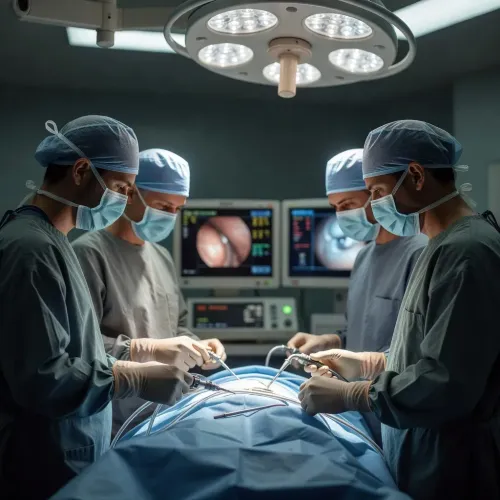
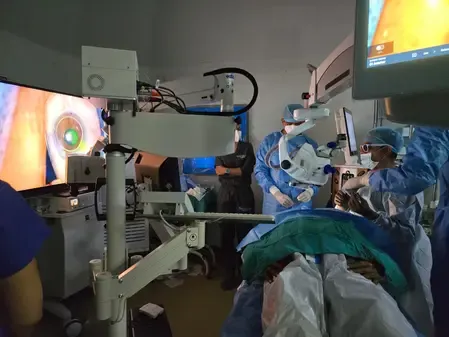
30 doctors at AIIMS Delhi performed a rare spinal surgery on a 25-week foetus still inside the mother's womb, lasting over six hours .
Kishan Reddy linked the procedure to PM Modi's Janani Suraksha Yojana , originally launched in 2005 to promote institutional deliveries.
JSY's founding mandate was to increase hospital births among low-income mothers; Kishan Reddy's framing positions it as now enabling high-complexity foetal interventions.
The minister called the surgery 'not an isolated example' but a marker of systemic change in India's public health delivery.
No formal health ministry statement or outcome data has been issued alongside the minister's social media post.
Thirty surgeons working in precise coordination for over six hours — inside one of India's premier public hospitals — to operate on the spine of a foetus still inside its mother's womb at just 25 weeks. Union Coal and Mines Minister G. Kishan Reddy spotlighted this rare procedure at AIIMS Delhi in a post on Sunday, November 15, 2026, connecting it to Prime Minister Narendra Modi's Janani Suraksha Yojana and framing it as proof of what India's public health system can deliver.
A 25-Week Foetus, 30 Doctors, Six Hours
The minister described the surgery as a landmark moment — 30 doctors working in tandem with what he called 'meticulous' planning to perform a spinal intervention on a foetus at 25 weeks of gestation, without removing it from the womb. Such foetal surgeries, while known in advanced centres globally, remain rare in India's public hospital system. Kishan Reddy wrote that the procedure showcased 'not merely the talent of our doctors but their dedication and discipline to the profession.'
Janani Suraksha Yojana's Long Arc
The Janani Suraksha Yojana (JSY) was originally launched in 2005 under the National Rural Health Mission, designed to push up institutional delivery rates and cut maternal and neonatal mortality by offering cash incentives to pregnant women, particularly in low-performing states. Its core mandate was straightforward: get mothers into hospitals, not deliver at home without skilled care. What Kishan Reddy is pointing to — a high-complexity foetal intervention conducted under its umbrella — reflects how that mandate has stretched, at least at apex institutions, into specialised prenatal medicine. The gap between JSY's founding purpose and a six-hour in-utero spinal surgery at AIIMS is itself a signal of ambition.
AIIMS Delhi and India's Public Medicine Moment
AIIMS New Delhi, established as the country's flagship public medical and research institution, has long been the site of procedures unavailable elsewhere in the government health system. The minister's framing is deliberate: a surgery of this complexity, performed free or subsidised in a public hospital linked to a central welfare scheme, is exactly the kind of story the government wants to tell. Kishan Reddy explicitly positioned it as 'not an isolated example but the seminal story of the change that India is witnessing,' drawing a sharp contrast with what he called the 'India block' — a pointed political reference — that he said is 'busy maligning everything about India.'
What the Procedure Signals for Foetal Medicine
Foetal surgery for spinal conditions — most commonly open spina bifida — has been performed at specialist centres in the United States and Europe for over two decades, but access in South Asia's public sector has been extremely limited. If AIIMS Delhi is building a reproducible foetal surgery capability within a government-scheme framework, the question that follows is whether this will extend to other AIIMS campuses now operational across the country, and what the health ministry's formal policy position will be on foetal medicine as a category of publicly funded care. No official health ministry statement has been issued alongside the minister's post.
Point of View
A 2005 maternal cash-incentive scheme, is politically shrewd but analytically contested: JSY was designed for access, not surgical complexity, and the connection is not formally documented. The broader arc here is the BJP's sustained effort to shift the healthcare conversation from systemic gaps to headline achievements at flagship institutions. Whether AIIMS Delhi's foetal surgery capacity becomes a replicable public-health policy or remains a one-off showcase is the real test of that narrative.
NationPress
15 Nov 2026
Frequently Asked Questions
What surgery was performed at AIIMS Delhi on a 25-week foetus?
According to Union Minister G. Kishan Reddy's post, 30 doctors at AIIMS Delhi performed a rare spinal surgery on a 25-week foetus while it was still inside the mother's womb, in a procedure lasting over six hours .
What is the Janani Suraksha Yojana and what does it do?
The Janani Suraksha Yojana (JSY) is a central government scheme launched in 2005 under the National Rural Health Mission. It promotes institutional deliveries by providing cash assistance to pregnant women, particularly those from low-income backgrounds, to reduce maternal and neonatal mortality.
Is foetal surgery available in Indian government hospitals?
AIIMS Delhi is among a very small number of public institutions in India with the capacity for complex foetal interventions. Such procedures remain rare in the broader public health system, and no official national programme for foetal surgery currently exists.
Who is G. Kishan Reddy?
G. Kishan Reddy is India's Union Minister of Coal and Mines and the BJP's Telangana state president . He posted about the AIIMS foetal surgery on November 15, 2026 , framing it as evidence of India's healthcare progress.
Will this type of foetal surgery be available at other AIIMS hospitals?
There is no official government announcement yet on expanding foetal surgery capabilities to other AIIMS campuses across India. Policy watchers are waiting for a formal health ministry position on foetal medicine as a category of publicly funded care.