Rijiju Highlights 12 Years of India's Healthcare Growth

Synopsis
Union Parliamentary Affairs Minister Kiren Rijiju on June 14, 2026 highlighted 12 years of government health initiatives — from Ayushman Bharat and Jan Aushadhi Kendras to new AIIMS campuses and Ayushman Arogya Mandirs — as evidence of a strengthened and more accessible national healthcare ecosystem.
Key Takeaways
Kiren Rijiju posted on June 14, 2026 citing 12 years of health sector expansion under the BJP-led government.
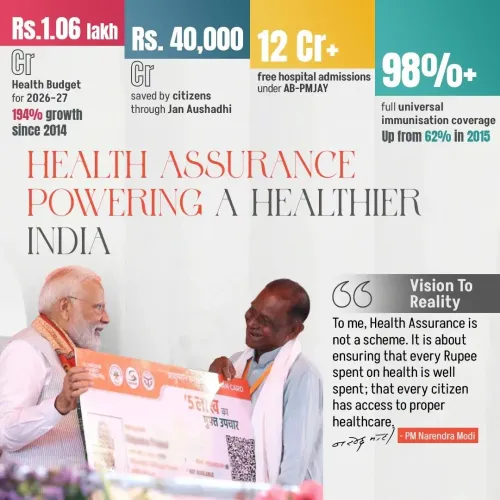
Ayushman Bharat , launched in 2018 , covers up to Rs 5 lakh per year per family for secondary and tertiary care, targeting 10.74 crore vulnerable households.
Jan Aushadhi Kendras sell generic medicines at 50 to 90 per cent lower prices than branded alternatives, revamped under the Pradhan Mantri Bhartiya Janaushadhi Pariyojana from 2015 .
Ayushman Arogya Mandirs (formerly Health and Wellness Centres) have been upgraded to deliver comprehensive primary and preventive healthcare at the community level.
New AIIMS campuses and expanded MBBS seats address the doctor shortage on the supply side, funded through successive central budgets under the National Health Mission .
State-level rollout progress and Ayushman Bharat claim settlement ratios are key metrics to watch in the upcoming parliamentary budget session.
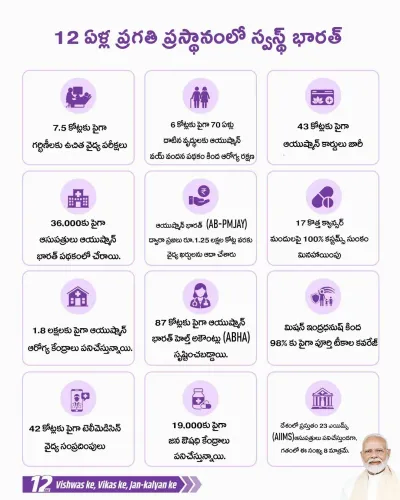
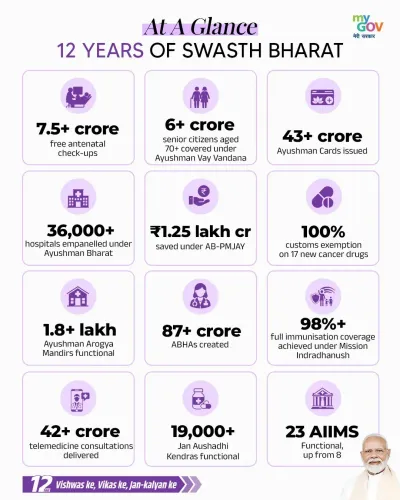
Union Parliamentary Affairs Minister Kiren Rijiju on Sunday, June 14, 2026, highlighted the expansion of India's healthcare ecosystem over the past 12 years, citing flagship programmes including Ayushman Bharat, Jan Aushadhi Kendras, new AIIMS campuses, expanded MBBS seats, and Ayushman Arogya Mandirs as evidence of the government's push to make quality treatment more accessible and affordable.
Context
Rijiju's post, shared under the hashtag #12YearsOfSwasthBharat, comes as the BJP-led central government marks over a decade in power and draws attention to its health policy record. The minister wrote: 'Healthcare is reaching more families than ever before. From Ayushman Bharat and Jan Aushadhi Kendras to new AIIMS, expanded MBBS seats and Ayushman Arogya Mandirs, the last 12 years have strengthened India's healthcare ecosystem and made quality treatment more accessible and affordable.'
The post is part of a broader government communication effort to catalogue welfare and infrastructure milestones tied to the Modi government's tenure since 2014.
Policy Backdrop
Ayushman Bharat Pradhan Mantri Jan Arogya Yojana, launched in 2018, provides health insurance coverage of up to Rs 5 lakh per year per family, targeting an estimated 10.74 crore economically vulnerable households. It remains one of the world's largest publicly funded health assurance schemes.
The Pradhan Mantri Bhartiya Janaushadhi Pariyojana, revamped in 2015, expanded the network of Jan Aushadhi Kendras — outlets that sell quality generic medicines at 50 to 90 per cent lower prices than branded equivalents. Alongside this, Ayushman Arogya Mandirs — formerly known as Health and Wellness Centres — were upgraded to deliver comprehensive primary healthcare including preventive and promotive services at the community level.
The National Health Policy 2017 set the overarching framework for increasing public health spending and expanding medical education capacity, under which successive central budgets funded new AIIMS campuses across states and increased undergraduate medical seats to address doctor shortages.
Stakeholders and Impact
The primary beneficiaries of these programmes are low-income families, rural patients, and medical students. The combination of insurance coverage under Ayushman Bharat, affordable medicines through Jan Aushadhi Kendras, and expanded primary care through Arogya Mandirs is designed to address both the cost and availability barriers that have historically limited healthcare access for poorer households.
New AIIMS campuses and expanded MBBS seats target the supply side — increasing the number of trained doctors and specialists available across regions, particularly in states that previously lacked tertiary medical institutions. Implementation of these schemes runs through state governments with central funding channelled under the National Health Mission umbrella.
What's Next
Parliamentary questions and health ministry reports on AIIMS operationalisation status and Ayushman Bharat claim settlement ratios are expected to feature in the upcoming budget session, providing a more granular picture of on-ground delivery. Progress on the state-level rollout of Ayushman Arogya Mandirs and any new announcements on MBBS seat expansion will be closely watched as indicators of whether the supply-side push is keeping pace with rising demand.
As India's population ages and non-communicable diseases place greater pressure on the public health system, the durability and scale of these foundational investments will increasingly determine whether the gains of the past decade translate into sustained, equitable health outcomes for all citizens.
Point of View
Framing the BJP government's health record as a coherent 12-year arc rather than a collection of discrete schemes — a narrative strategy that becomes more prominent as the party approaches election cycles. The breadth of programmes cited, spanning insurance, generics, primary care, and medical education, reflects a conscious effort to show multi-layered reform rather than a single flagship. However, the real test of this record lies in outcomes data — claim settlement ratios, functional AIIMS capacity, and medicine availability at Jan Aushadhi outlets — which parliamentary scrutiny and budget disclosures will need to substantiate. The post signals that health equity will remain a central pillar of the ruling party's governance communication in the near term.
NationPress
26 Sept 2026
Frequently Asked Questions
What is Ayushman Bharat and who does it cover?
Ayushman Bharat Pradhan Mantri Jan Arogya Yojana is a government health insurance scheme launched in 2018 that provides up to Rs 5 lakh annual coverage per family for secondary and tertiary hospitalisation, targeting approximately 10.74 crore economically vulnerable families across India.
What are Jan Aushadhi Kendras?
Jan Aushadhi Kendras are government-backed outlets that sell quality generic medicines at prices 50 to 90 per cent lower than branded equivalents. The network was significantly expanded after the Pradhan Mantri Bhartiya Janaushadhi Pariyojana was revamped in 2015 .
What are Ayushman Arogya Mandirs?
Ayushman Arogya Mandirs are upgraded primary healthcare centres, formerly called Health and Wellness Centres, designed to deliver comprehensive, preventive, and promotive health services at the community level as part of India's public health strengthening effort.
How many new AIIMS have been built in India since 2014?
The central government announced and funded multiple new AIIMS campuses across India since 2014 to expand tertiary care capacity and address regional disparities in specialist healthcare. Exact operationalisation status of each campus is subject to ongoing parliamentary and ministry reporting.
What did Kiren Rijiju say about India's healthcare on June 14, 2026?
Kiren Rijiju , Union Parliamentary Affairs Minister, posted on June 14, 2026 that healthcare is reaching more families than ever, crediting Ayushman Bharat , Jan Aushadhi Kendras , new AIIMS , expanded MBBS seats , and Ayushman Arogya Mandirs for strengthening India's healthcare ecosystem over the past 12 years .