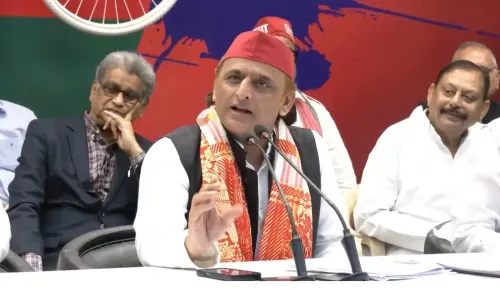
Akhilesh Yadav Slams E20 Ethanol Policy as 'Govt Profiteering'
Synopsis
Samajwadi Party president Akhilesh Yadav on 13 July 2026 attacked India's E20 ethanol-blending programme as a three-way profiteering arrangement between the government, ethanol producers, and oil companies, citing vehicle damage, higher maintenance costs, food inflation, and environmental harm from water-intensive ethanol production.
Key Takeaways
Akhilesh Yadav on 13 July 2026 publicly condemned the E20 ethanol-blending policy as 'sarkari milavat' — government-sanctioned adulteration benefiting a select few.
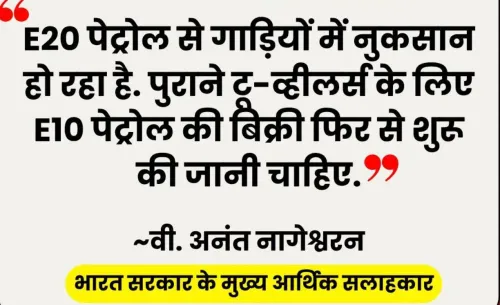
He alleged ethanol-blended fuel causes lower mileage, starting problems, mid-road breakdowns, rusting, and higher maintenance costs for vehicle owners.
Yadav warned that older vehicles were not designed for high-ethanol fuel, giving insurers grounds to deny claims on damaged cars and motorcycles.
He argued that diverting food crops to fuel production raises food inflation and that ethanol's heavy water use adds a hidden environmental cost.
India's E20 target was advanced from 2030 to 2025 under the 2021 biofuel policy notification, intensifying the blending rollout.
The Samajwadi Party's attack signals the issue will be pressed in Parliament and state-level political campaigns , particularly in vehicle-owning middle-class constituencies.
Samajwadi Party president Akhilesh Yadav on Monday, 13 July 2026 launched a sharp attack on the central government's ethanol-blending programme, calling it a new form of profiteering that harms vehicle owners, raises food prices, and damages the environment — while benefiting only a handful of companies.
Context
In a detailed post on X, Yadav described the E20 ethanol-blending policy as a 'tri-mishran' (tri-mixture) — a three-way partnership between the government, ethanol manufacturers, and oil marketing companies — that he characterised as 'sarkari milavat', or government-sanctioned adulteration. He argued that while the government promotes ethanol blending as a pollution-reducing, import-cutting measure, it stays silent on the consumer costs the policy imposes.
Yadav listed a string of grievances: reduced mileage forcing vehicle owners to fill up more frequently, starting trouble, mid-road breakdowns, higher maintenance costs, rusting and gunk build-up, falling resale values, and shorter vehicle lifespans. He noted that older vehicles were never designed for high-ethanol fuel, giving insurance companies an additional pretext to reject claims.
Policy Backdrop
India's Ethanol Blended Petrol (EBP) programme dates to 2003, when a 5 per cent blending target was first set. The National Policy on Biofuels 2018 significantly raised ambitions, linking higher blending targets to energy security and support for sugarcane farmers. In 2021, the government advanced its E20 target — 20 per cent ethanol blending with petrol — from 2030 to 2025, making the push one of the fastest biofuel scale-ups among large economies.
Public-sector oil marketing companies (OMCs) — including Indian Oil Corporation (IOCL), Bharat Petroleum (BPCL), and Hindustan Petroleum (HPCL) — are responsible for procuring and distributing blended fuel. Proponents argue the programme reduces India's crude-oil import bill and cuts vehicular emissions, while also providing an additional revenue stream for sugarcane growers.
Stakeholders and Impact
Yadav's post explicitly invokes the financial pressures on ordinary families, noting that parents spend lakhs of rupees to buy a motorcycle for their children, or young people take car loans to fulfil the dream of owning a vehicle — only to face expensive fuel and rising repair bills. He argued that producing fuel from food crops inevitably pushes up food inflation, and that ethanol production's heavy water consumption adds an environmental cost that official messaging ignores.
The concerns he raises — vehicle compatibility, insurance claim denials, and food-price spillovers — have been flagged periodically by consumer groups and automotive industry bodies as blending percentages have climbed. Sugarcane farmers, however, remain key beneficiaries of ethanol procurement pricing, and the farm lobby has broadly supported the programme. The tension between these constituencies sits at the heart of the policy debate.
What's Next
Yadav closed his post with a direct question to the government: 'Sarkar bataye ki chand munafakhoron ke liye wo janta ka shoshan kyon kar rahi hai' — 'Let the government explain why it is exploiting the public for the benefit of a handful of profiteers.' The post, tagged #E20, #Ethanol, #PetrolPrice, #Mileage, and #Insurance, signals that the Samajwadi Party intends to press the issue in the political arena.
Nationwide enforcement of E20 fuel standards is ongoing, and any parliamentary committee review of vehicle performance data or insurance claim patterns under high-ethanol blends could sharpen the debate. The petroleum ministry's next revision of biofuel procurement prices will also be closely watched by both industry and opposition benches.
Point of View
Vehicle-owning middle class — a constituency that has drifted from the Samajwadi Party's traditional base but whose economic anxieties around fuel costs and vehicle upkeep are real and growing. By framing the policy as a triangular rent-extraction deal rather than a green initiative, he attempts to neutralise the government's environmental narrative and recast it as a consumer-welfare issue. The post's enumeration of specific harms — mileage, insurance, resale value — is more granular than typical opposition rhetoric, suggesting a deliberate effort to anchor the attack in everyday experience rather than ideology. Whether the critique translates into legislative pressure or merely social-media traction will depend on whether the party can sustain it with data when Parliament is in session.
NationPress
12 Oct 2026
Frequently Asked Questions
What is the E20 ethanol blending policy in India?
The E20 policy mandates blending 20 per cent ethanol with petrol across India. Rooted in the National Policy on Biofuels 2018 , the target was advanced from 2030 to 2025 to reduce crude-oil import dependence and support sugarcane farmers.
Why is Akhilesh Yadav opposing ethanol blending?
Akhilesh Yadav argues that ethanol-blended fuel reduces vehicle mileage, causes engine damage and rusting, raises maintenance costs, and gives insurance companies a reason to deny claims — all while benefiting only the government, ethanol producers, and oil companies.
Does ethanol blending reduce vehicle mileage?
Ethanol has a lower energy density than pure petrol, which can reduce fuel efficiency. The extent of mileage loss depends on the blending percentage and vehicle type; specific figures cited in political statements have not been independently verified by NationPress.
Can ethanol blending increase food prices in India?
Critics argue that diverting sugarcane and other food crops to ethanol production reduces supply available for food, potentially raising food inflation . The government maintains that surplus crop stocks are used, limiting the impact on food prices.
Will insurance companies reject claims for ethanol-related vehicle damage?
Yadav's post raises the concern that because older vehicles were not built for high-ethanol fuel, insurers may use this as grounds to deny claims. Insurance policy terms vary, and the regulatory position of IRDAI on ethanol-related damage claims has not been formally clarified in public guidelines.