Assam CM Office: Black Softshell Turtles Released to Wild
Synopsis
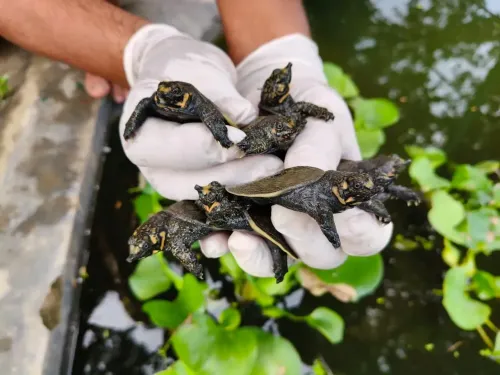
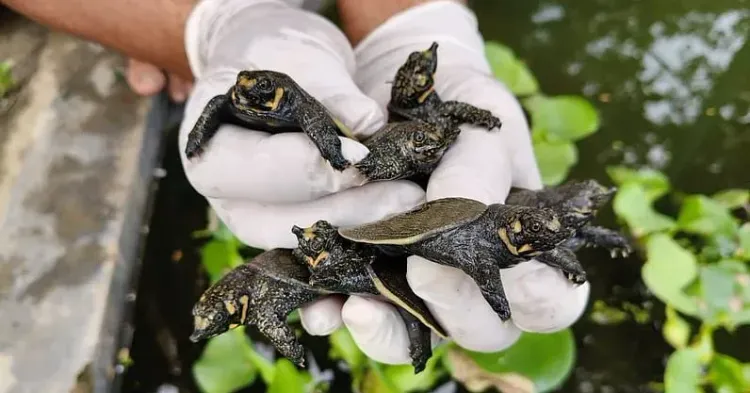
Assam has released black softshell turtle hatchlings into the wild, the Chief Minister's Office announced on November 9, 2026. The critically endangered Nilssonia nigricans, historically sheltered in temple ponds, is the focus of a state captive-breeding drive running since the mid-2000s.
Key Takeaways
The Chief Minister's Office of Assam announced the release of black softshell turtle hatchlings on November 9, 2026 .
The black softshell turtle ( Nilssonia nigricans ) is classified as critically endangered by the IUCN and is native to the Brahmaputra basin.
Small populations have historically survived in protected temple ponds, most notably at the Hayagriva Madhava temple in Hajo, Assam .
The Assam Forest Department has run captive-breeding programmes under the Wildlife (Protection) Act, 1972 since the mid-2000s.
The release is part of a broader Northeast India push to recover critically endangered riverine species through ex-situ breeding and habitat protection along the Brahmaputra.
A critically endangered species gets a second chance in the Brahmaputra basin — the Chief Minister's Office of Assam announced on Monday, November 9, 2026 that the state has released black softshell turtle hatchlings into the wild as part of an ongoing effort to revive the species' dwindling population.
The black softshell turtle (Nilssonia nigricans) is one of freshwater conservation's most urgent cases. Listed as critically endangered by the IUCN, the species has long been confined largely to the sanctuary of temple ponds — most famously at the Hayagriva Madhava temple in Hajo, Assam — where religious protection kept small populations alive while numbers collapsed everywhere else due to habitat destruction and poaching across the Brahmaputra basin.
From Temple Ponds to Captive-Breeding Science
Assam's conservation effort has not happened overnight. The Assam Forest Department, working with wildlife partners, has maintained captive-breeding programmes for the species since the mid-2000s under the framework of the Wildlife (Protection) Act, 1972. The logic is deliberate: hatch the eggs in controlled, predator-free conditions, raise the young to a survivable size, then release them into natural river systems. Each hatchling returned to the wild represents years of careful husbandry. The release announced today follows that established playbook — a structured intervention designed to push the wild population past the fragile threshold where natural breeding can begin to sustain itself.Northeast India's Broader Riverine Recovery Push
Assam's hatchling release sits inside a wider conservation frame. Across Northeast India, states have accelerated ex-situ recovery programmes for riverine species facing collapse, combining captive breeding with in-situ habitat protection along the Brahmaputra and its tributaries. For a river system of the Brahmaputra's scale — one of the longest and most biodiverse in Asia — the health of its turtle population is a direct indicator of ecosystem integrity. Wildlife conservationists and the temple communities that have historically acted as informal custodians of the species are the two most invested stakeholders in whether these releases translate into self-sustaining wild populations. Population-monitoring data from the Forest Department, expected in follow-up reporting, will be the real scorecard. Every hatchling that survives to adulthood in the Brahmaputra's currents is a small but concrete victory for a species that came perilously close to vanishing outside temple walls entirely.Point of View
The government is also staking political capital on biodiversity outcomes, which raises accountability. The real test will come when population-monitoring data shows whether released turtles are surviving and eventually breeding in open river systems. If the numbers hold, Assam's model could become a template for other Brahmaputra-basin states facing similar riverine species crises.
NationPress
9 Nov 2026
Frequently Asked Questions
What is the black softshell turtle and why is it endangered?
The black softshell turtle (Nilssonia nigricans) is a freshwater turtle native to the Brahmaputra basin in Northeast India. It is classified as critically endangered by the IUCN, with wild populations devastated by habitat loss and poaching; surviving individuals have largely been confined to protected temple ponds in Assam.
Where are black softshell turtles found in Assam?
The species is historically associated with the Hayagriva Madhava temple pond in Hajo, Assam, where religious protection kept a small population alive. The Brahmaputra river and its tributaries are the natural habitat the state's captive-breeding programme aims to restore them to.
What is Assam doing to save the black softshell turtle?
The Assam Forest Department has operated captive-breeding programmes since the mid-2000s under the Wildlife (Protection) Act, 1972, hatching eggs in controlled conditions and releasing hatchlings into the wild once they are large enough to survive predators.
What is the significance of releasing turtle hatchlings into the wild?
Releasing captive-bred hatchlings into natural river systems is designed to supplement wild populations past the threshold where natural breeding can sustain them, and is a standard ex-situ conservation intervention for critically endangered species.
How does Assam's turtle conservation fit into broader Northeast India efforts?
Northeast Indian states have collectively expanded ex-situ recovery programmes for riverine species listed as critically endangered, combining captive breeding with in-situ habitat protection along the Brahmaputra and its tributaries to protect overall ecosystem health.