Assam CMO highlights AI expansion to boost livestock sector
Synopsis
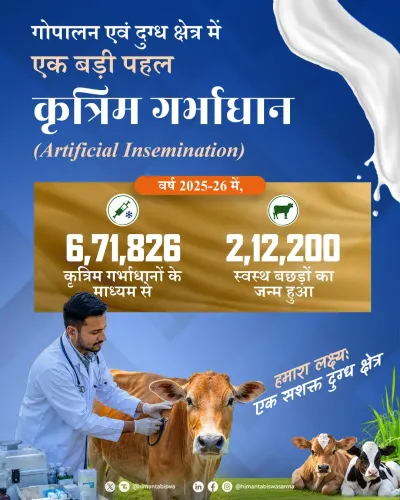
The Chief Minister's Office of Assam announced on 1 July 2026 that the state is expanding its Artificial Insemination programme to improve bovine breed quality, raise milk productivity, and increase incomes for dairy farmers and small livestock rearers across the state.
Key Takeaways
The Chief Minister's Office of Assam announced on 1 July 2026 an expansion of the state's Artificial Insemination programme for the livestock sector.
The stated objectives are boosting livestock productivity and improving incomes for rural farmers.
The initiative aligns with the Rashtriya Gokul Mission , the central scheme launched in December 2014 for bovine breed improvement through AI.
Assam has participated in national bovine breeding programmes since 2004 , with AI centres established in several districts.
Primary beneficiaries are dairy farmers and small livestock rearers across Assam's rural districts.
Northeast states including Assam have received targeted central assistance under breed improvement schemes given historically lower baseline productivity.
The Chief Minister's Office of Assam on Wednesday, 1 July 2026 announced that the state is expanding its Artificial Insemination (AI) programme to strengthen the livestock sector, with the stated aim of raising farm productivity and improving incomes for rural households.
Context
The post from the Chief Minister's Office of Assam states: 'Assam is strengthening its livestock sector through the expansion of Artificial Insemination, boosting productivity and improving farmer incomes.' The announcement was accompanied by a video, signalling an active communication push around the programme. Chief Minister Himanta Biswa Sarma, who has helmed the state since May 2021, has consistently positioned rural economy modernisation as a priority of his administration.
Policy Backdrop
Artificial Insemination for bovine breed improvement has a long policy lineage in India. The Rashtriya Gokul Mission, launched by the Government of India in December 2014, was designed to expand AI coverage and establish breed multiplication farms to raise indigenous cattle productivity. Assam has participated in national bovine breeding programmes since at least 2004, when several districts received dedicated AI centres under the National Programme for Bovine Breeding and Dairy Development.
The Assam Animal Husbandry and Veterinary Department oversees these breeding programmes and extension services across the state's districts. Northeast states, including Assam, have historically received targeted central assistance under breed improvement schemes, given that baseline livestock productivity in the region has lagged behind the national average.
Stakeholders and Impact
The primary beneficiaries of an expanded AI programme are dairy farmers and small livestock rearers across Assam's rural districts. By improving genetic stock through AI rather than natural service, farmers can access higher-yielding breeds without the cost of maintaining bulls, reducing input costs while raising milk output. Improved livestock productivity feeds directly into household incomes, which is significant in a state where agriculture and allied activities remain a primary livelihood for a large share of the population.
At the national level, scaling AI in animal husbandry has been positioned as a key lever for achieving the broader goal of doubling farmers' incomes through technology adoption. Assam's push aligns with this wider pattern seen across Indian states that have invested in veterinary infrastructure and semen stations in recent years.
What's Next
Attention will now turn to the specifics of the rollout — including state budget allocations for new AI centres or semen stations, the districts targeted for expansion, and how the programme integrates with any revised guidelines under the Rashtriya Gokul Mission in the current fiscal cycle. The video released alongside the announcement is expected to detail operational progress, though the precise scale and district-level targets of the 2026 expansion are yet to be formally published. Sustained investment in veterinary extension services will be critical to translating the AI push into measurable gains for farmers on the ground.
Point of View
The administration is tapping into a politically resonant national narrative — one that successive central governments have also championed through schemes like the Rashtriya Gokul Mission. For a state where livestock rearing is deeply embedded in rural livelihoods, sustained AI scale-up could translate into meaningful income gains, but the proof will lie in district-level reach and veterinary service quality. The video-led communication format also signals an intent to build public awareness and political credit around what is traditionally a low-visibility agricultural programme.
NationPress
1 Jul 2026
Frequently Asked Questions
What is the Assam government's Artificial Insemination programme for livestock?
The Assam government, through the Assam Animal Husbandry and Veterinary Department, runs Artificial Insemination centres across districts to improve the genetic quality of cattle, raise milk yields, and increase incomes for dairy farmers. The state is now expanding this programme as announced by the Chief Minister's Office on 1 July 2026.
What is the Rashtriya Gokul Mission and how does it relate to Assam?
The Rashtriya Gokul Mission is a central government scheme launched in December 2014 to improve indigenous cattle breeds and expand artificial insemination coverage across India. Assam participates in this scheme and has received targeted central assistance for breed improvement, given the Northeast region's historically lower livestock productivity baseline.
How does Artificial Insemination help farmers in Assam?
Artificial Insemination allows dairy farmers and small livestock rearers to access improved, higher-yielding bovine genetics without the cost of maintaining bulls. This raises milk output, reduces input costs, and contributes to better household incomes in rural Assam.
Which department oversees livestock breeding programmes in Assam?
The Assam Animal Husbandry and Veterinary Department is the nodal state agency responsible for livestock health, breeding programmes, and veterinary extension services across Assam's districts.
When did Assam begin participating in national bovine breeding programmes?
Assam has participated in national bovine breeding and dairy development programmes since at least 2004, when several districts received dedicated Artificial Insemination centres under the National Programme for Bovine Breeding and Dairy Development.