Assam rolls out Solid Waste Management Rules, 2026
Synopsis
Assam has enacted the Solid Waste Management Rules, 2026, mandating source segregation, scientific disposal, and shared accountability among citizens, institutions, and urban local bodies — advancing the state's alignment with India's national Swachh Bharat framework.
Key Takeaways
The Chief Minister's Office of Assam announced the Solid Waste Management Rules, 2026 on 24 October 2026 .
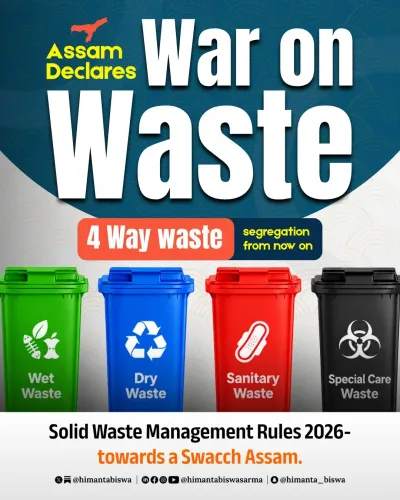
The rules mandate waste segregation at source across households, institutions, and local bodies.
The framework promotes scientific waste disposal , targeting open dumping and burning practices.
Responsibility is shared among citizens, institutions, and urban local bodies .
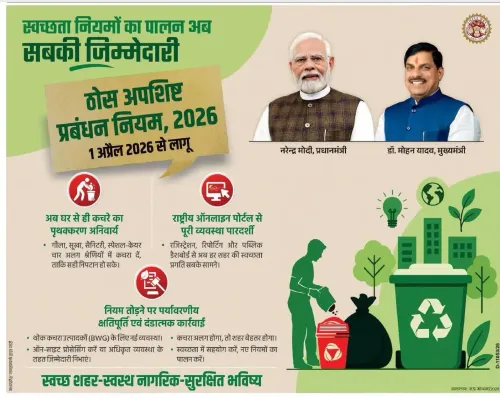
The rules build on India's national Solid Waste Management Rules, 2016 and the Swachh Bharat Mission launched in 2014.
Enforcement mechanisms and compliance reporting by Assam's urban local bodies remain the key watch-point.
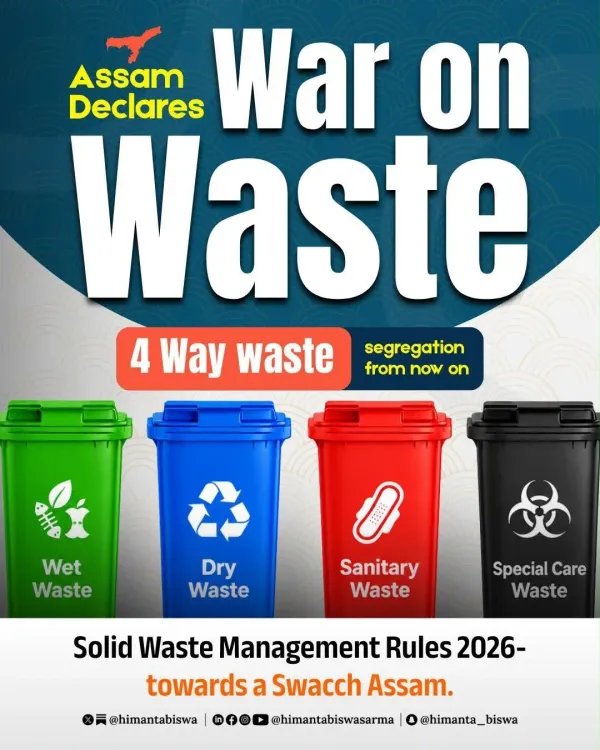
Assam has drawn a sharper line in its fight against urban waste. The Chief Minister's Office of Assam announced on Saturday, 24 October 2026, that the state has enacted the Solid Waste Management Rules, 2026 — a new regulatory framework mandating waste segregation at source, scientific disposal, and shared responsibility across citizens, institutions, and local bodies.
What the 2026 Rules demand of Assam's cities
The core thrust of the new rules is deceptively simple: stop the waste problem before it starts. Segregation at source — separating wet, dry, and hazardous waste at the household or institutional level — has long been the weak link in India's urban waste chain. Assam's 2026 framework places that responsibility squarely on generators, not just collectors.
Scientific disposal, the second pillar, targets the legacy of open dumping and burning that plagues smaller towns across the Northeast. By institutionalising processing norms, the rules push urban local bodies in Assam toward engineered landfills, composting, and material-recovery systems rather than ad-hoc disposal.
Assam stepping into a national framework a decade in the making
The policy lineage here matters. India's national Solid Waste Management Rules, 2016 — notified by the Ministry of Environment, Forest and Climate Change — set the baseline: segregation, bulk-generator accountability, and processing mandates. A full decade on, state-level follow-through has been uneven across the country. Assam's 2026 rules signal an attempt to close that implementation gap at the state level.
The announcement also slots neatly into the Swachh Bharat Mission architecture launched in 2014, which has consistently pushed decentralised waste management as the scalable answer to India's solid-waste crisis. For Assam — a state that combines dense river-basin settlements with smaller, under-resourced urban local bodies — decentralised compliance is both the challenge and the opportunity.
The enforcement test ahead
Rules on paper are the easy part. The real metric will be how Assam's urban local bodies report compliance, what penalties are prescribed for defaulters, and whether bulk generators — hospitals, markets, hotels — are brought into the chain. These specifics are yet to be made public. What is clear is that the state has formally committed to a framework where responsibility is shared, not siloed.
A cleaner Assam, as the CMO framed it, begins with source segregation — but it lands on the desks of every municipal commissioner in the state.
Point of View
2026 represent a state-level legislative push to operationalise what India's 2016 national rules and the Swachh Bharat Mission outlined conceptually — a decade after the national framework was set. The political signal is clear: the Himanta Biswa Sarma administration is aligning environmental governance with urban-development optics ahead of continued scrutiny on Northeast India's infrastructure trajectory. The real test, however, is institutional: Assam's urban local bodies are, on average, smaller and less resourced than those in larger states, making enforcement the decisive variable. If compliance mechanisms are robust, this could become a model for other Northeastern states watching closely.
NationPress
24 Oct 2026
Frequently Asked Questions
What are Assam's Solid Waste Management Rules, 2026?
The Solid Waste Management Rules, 2026 are state regulations introduced by the Government of Assam that mandate waste segregation at source, scientific disposal of waste, and shared responsibility among citizens, institutions, and urban local bodies for cleaner waste management.
How do Assam's 2026 rules differ from India's existing waste rules?
India's national Solid Waste Management Rules were notified in 2016 by the Ministry of Environment, Forest and Climate Change. Assam's 2026 rules operate within that national framework but create a state-specific regulatory layer with local enforcement obligations for Assam's urban local bodies.
What does 'waste segregation at source' mean in practice?
Waste segregation at source means households, institutions, and bulk generators separate wet (organic), dry (recyclable), and hazardous waste before handing it over to collectors — preventing mixed waste from reaching disposal sites and enabling more efficient processing.
How does the Swachh Bharat Mission relate to Assam's waste rules?
The Swachh Bharat Mission, launched in 2014, is India's national sanitation and cleanliness programme that emphasises decentralised waste management. Assam's 2026 rules align the state more closely with this framework by formalising source segregation and local-body accountability.
Who is responsible for enforcing the new waste rules in Assam?
Primary enforcement responsibility lies with Assam's urban local bodies — municipal corporations, town committees, and panchayats — which are required to ensure compliance from citizens, institutions, and bulk generators within their jurisdictions.