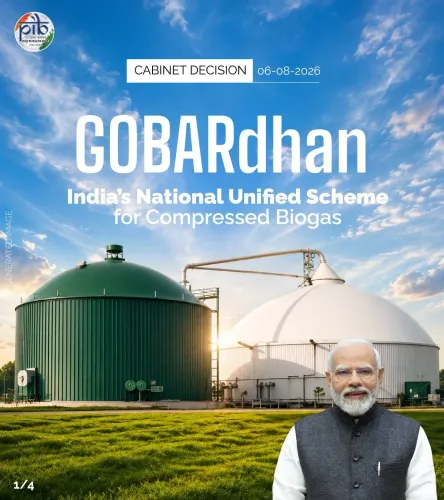
CM Himanta Launches 5 CBG Plants Under GOBARdhan in Assam
Synopsis
Assam CM Himanta Biswa Sarma announced five Compressed Biogas plants under the Centre's GOBARdhan scheme, partnering with Oil India Limited to convert municipal waste and agricultural residue into clean fuel, backed by a forthcoming state CBG Policy.
Key Takeaways
Five CBG plants are being set up in Assam under the Centre's GOBARdhan scheme , launched in 2018 under Swachh Bharat Mission.
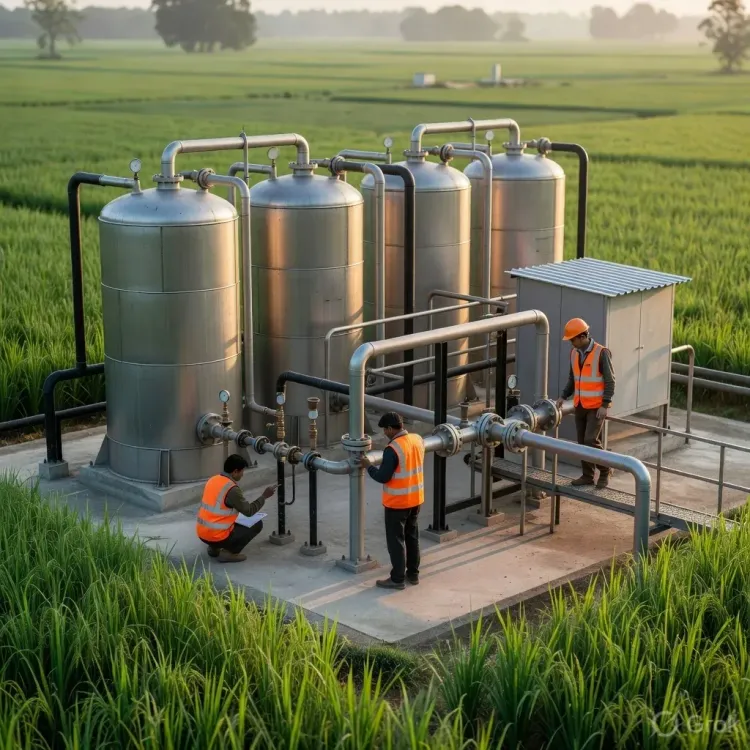
The plants will convert municipal waste and agricultural residue into Compressed Biogas for homes and farms.
Oil India Limited , the Maharatna PSU based in Assam, is a key partner in the project.
A dedicated Assam CBG Policy is in the works to provide further regulatory and policy momentum.
The initiative targets both urban local bodies and farmers , addressing waste management and stubble burning simultaneously.
Assam is turning its garbage and crop stubble into cooking gas. Chief Minister Himanta Biswa Sarma announced on Tuesday, August 11, 2026, that five Compressed Biogas (CBG) plants are coming up across the state — converting municipal waste and agricultural residue into clean energy, backed by the Centre's GOBARdhan scheme and the state's own emerging CBG Policy.
GOBARdhan's Northeast Footprint
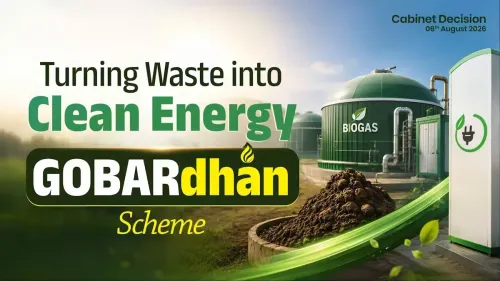
Launched nationally in 2018 under the Swachh Bharat Mission, GOBARdhan — short for Galvanising Organic Bio-Agro Resources Dhan — was designed precisely for this: diverting cattle dung, crop residue, and organic waste away from open burning and landfills, and routing it instead into biogas digesters. The scheme has steadily pushed states to align local waste management with renewable energy targets, and Assam is now among the northeastern states formalising that alignment. The five plants will serve a dual constituency: urban local bodies grappling with mounting municipal waste, and farmers sitting on tonnes of agricultural residue that would otherwise be burnt in the fields. CBG — essentially bio-CNG compressed to the same pressure as natural gas — can feed directly into cooking and farm-energy supply chains, cutting dependence on fossil fuel imports in the process.Oil India's Pivot to Green Energy
Oil India Limited, the Maharatna public-sector undertaking headquartered in Duliajan, Assam, is a key partner in the rollout. A company historically synonymous with crude oil and natural gas exploration in the Northeast, OIL's involvement signals how India's legacy energy majors are repositioning themselves inside the country's circular-economy push — from extracting hydrocarbons to processing biological waste into clean fuel.Assam's CBG Policy: The State-Level Accelerant
Beyond the five plants, CM Sarma pointed to a dedicated Assam CBG Policy that will 'give further momentum to this green energy push.' The specifics of the policy — its incentive structure, land-allocation provisions, and offtake guarantees — are yet to be formally detailed, but its announcement signals that the state intends to build a regulatory scaffold around what is currently a project-by-project rollout. Assam's large agricultural base and its chronic municipal waste challenge make it a natural candidate for CBG scale-up. The Northeast's relative distance from national gas pipelines also raises the strategic value of locally produced bio-CNG — energy that doesn't have to travel thousands of kilometres to reach a village kitchen. Five plants are a beginning, not a destination. Whether Assam's CBG Policy translates that beginning into a replicable, investable model for the rest of the Northeast is the real test ahead.Point of View
Urban garbage, fossil-fuel dependency — in a single policy stroke. Pairing the GOBARdhan framework with a state-level CBG policy and a legacy PSU like Oil India signals an attempt to institutionalise, not just pilot, the waste-to-energy transition. For BJP-governed Assam, it also threads the needle between the Centre's renewable energy narrative and the state's own rural development imperatives. The real indicator of ambition will be whether the CBG Policy offers bankable incentives that attract private investment beyond the initial five plants.
NationPress
25 Sept 2026
Frequently Asked Questions
What is the GOBARdhan scheme and how does it relate to Assam's CBG plants?
GOBARdhan is a Central government scheme launched in 2018 under the Swachh Bharat Mission to convert cattle dung, agricultural residue and organic waste into biogas and manure. Assam's five new CBG plants are being set up under this scheme, with the Centre's support channelled through it.
What is Compressed Biogas (CBG) and how is it different from regular biogas?
Compressed Biogas is biogas that has been purified and compressed to the same pressure and energy content as Compressed Natural Gas (CNG). Unlike basic biogas used in low-pressure burners, CBG can be used in vehicles, piped into gas grids, and supplied to farms and homes as a direct fossil-fuel substitute.
What role is Oil India Limited playing in Assam's CBG plants?
Oil India Limited, a Maharatna public-sector undertaking headquartered in Assam, is a partner in setting up the CBG plants. The company is traditionally focused on oil and gas exploration but is now participating in renewable and bio-energy projects.
What is Assam's CBG Policy?
Assam's CBG Policy is a state-level policy framework announced by Chief Minister Himanta Biswa Sarma to provide further regulatory and financial momentum to the state's Compressed Biogas sector. Specific details of the policy's incentives and provisions have not yet been formally released.
Who benefits from the CBG plants being set up in Assam?
The primary beneficiaries are farmers, who can reduce agricultural residue burning, and urban local bodies managing municipal solid waste. Both groups gain from cleaner waste disposal, while homes and farms in the region gain access to locally produced clean fuel.