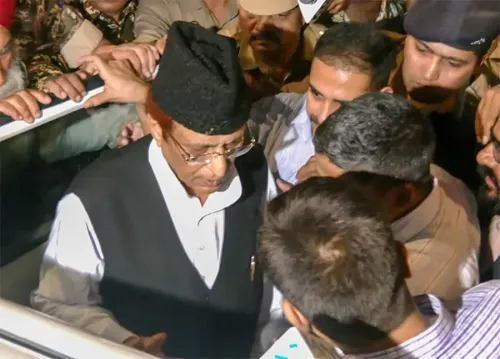
Allahabad HC grants Azam Khan interim bail till Dec 10 in ₹426 crore money laundering case

Synopsis
The Allahabad High Court has granted interim bail to SP leader Azam Khan in the ₹426 crore Jauhar University money laundering case — a significant, if temporary, reprieve for a politician who was arrested by the ED on 31 October, remanded to custody, and turned away by the Supreme Court before finally winning relief at the High Court.
Key Takeaways
The Allahabad High Court granted Azam Khan interim bail on 17 November 2026 , valid until 10 December .
The order was passed by Justices Rajiv Gupta and Devendra Singh against a personal bond and two sureties.
The case involves alleged money laundering of ₹426.46 crore linked to Mohammad Ali Jauhar University in Rampur .
The ED arrested Khan on 31 October ; the Supreme Court had declined interim relief on 5 November .
The ED has provisionally attached university land and buildings worth ₹426.46 crore as alleged proceeds of crime.
The ED has been given one week to file a counter-affidavit; the next hearing is on 10 December .
The Allahabad High Court on Tuesday, 17 November 2026, granted interim bail to Samajwadi Party (SP) leader Mohammad Azam Khan until 10 December in the ₹426 crore money laundering case linked to Mohammad Ali Jauhar University in Rampur. The order was passed by a division bench of Justices Rajiv Gupta and Devendra Singh, who granted the interim relief against a personal bond and two sureties of like amount.
What the Court Ordered
The bench granted Khan the interim relief until the next date of listing, with the case likely to be heard again on 10 December. The court also directed the Enforcement Directorate (ED) to file a counter-affidavit within one week addressing the broader merits of the case. The Allahabad High Court had heard Khan's appeal over two days before arriving at its order.
Background: Arrest and Earlier Legal Proceedings
The ED arrested Khan on 31 October in connection with a money laundering investigation stemming from FIRs alleging the forcible acquisition of agricultural land belonging to farmers for the construction of the university. The federal financial agency has further claimed that government funds and resources were diverted towards the development of the institution.
On 12 November, a Special Court (PMLA) in Ghaziabad had remanded Khan to ED custody for four days. Prior to that, on 5 November, the Supreme Court declined to grant him immediate relief, asking him instead to approach the Allahabad High Court — which he subsequently did.
The ₹426 Crore Attachment
The ED has provisionally attached land and buildings belonging to Mohammad Ali Jauhar University worth ₹426.46 crore, asserting these represent alleged proceeds of crime. The university is owned by the Maulana Mohammad Ali Jauhar Trust, which was founded and is controlled by Khan. He also serves as its honorary Chancellor.
What Happens Next
Khan remains on interim bail until the matter comes up again on 10 December, when the High Court is expected to take a fuller view of the ED's case. The agency's counter-affidavit, due within a week, will be a key document shaping those proceedings. The case is being closely watched as one of the most consequential PMLA proceedings involving a sitting elected politician in Uttar Pradesh.
Point of View
Not an acquittal — but it matters politically because Khan remains a sitting legislator and a central figure in SP's Uttar Pradesh calculus. The ED case raises structural questions about how a public university allegedly became the instrument of financial misconduct, with government funds reportedly diverted and farmer land forcibly acquired. The Supreme Court's refusal to grant immediate relief and the subsequent High Court order trace a familiar pattern in high-profile PMLA cases: bail at the High Court level while the merits remain deeply contested. The real test comes on 10 December, when the ED's counter-affidavit will put the government's full case on record for the first time.
NationPress
17 Nov 2026
Frequently Asked Questions
Why was Azam Khan arrested by the ED?
The ED arrested Azam Khan on 31 October 2026 in a money laundering investigation tied to FIRs alleging forcible acquisition of farmers' agricultural land for Mohammad Ali Jauhar University in Rampur, and the alleged diversion of government funds towards the institution.
What did the Allahabad High Court order on 17 November?
A division bench of Justices Rajiv Gupta and Devendra Singh granted Khan interim bail until 10 December 2026 , against a personal bond and two sureties of like amount. The court also gave the ED one week to file a counter-affidavit.
What is the ₹426 crore attachment in the Jauhar University case?
The ED has provisionally attached land and buildings of Mohammad Ali Jauhar University worth ₹426.46 crore , claiming they constitute alleged proceeds of crime under the Prevention of Money Laundering Act (PMLA) .
Did the Supreme Court grant Azam Khan bail?
No. On 5 November 2026 , the Supreme Court declined to grant Khan immediate relief and asked him to approach the Allahabad High Court, which he subsequently did and where he won interim bail.
What happens next in the Azam Khan money laundering case?
The case is next listed for hearing on 10 December 2026 at the Allahabad High Court. The ED is expected to file a counter-affidavit within a week addressing the merits of Khan's bail application.