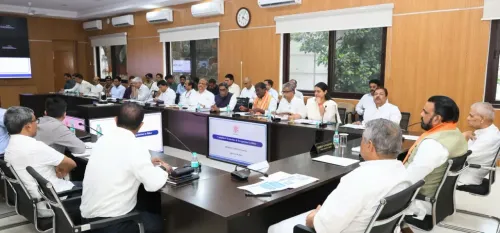
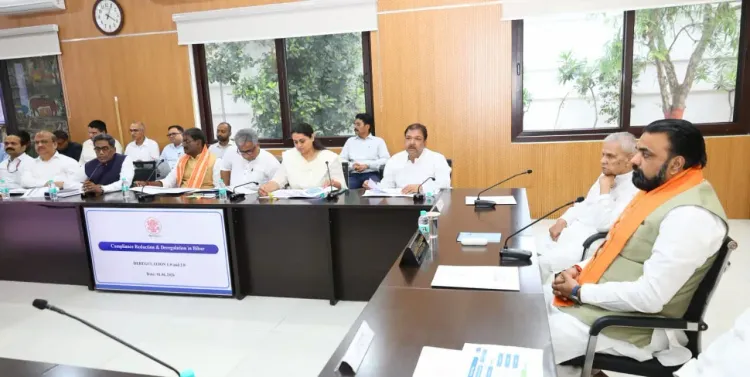
Bihar CM Office Stresses Transparent Governance for Investment
Synopsis
The Chief Minister's Office of Bihar on 1 June 2026 shared remarks calling for a convenient, transparent and accountable government system for citizens and entrepreneurs, positioning regulatory simplification as the key to accelerating development and investment in the state.
Key Takeaways
The Chief Minister's Office of Bihar posted on 1 June 2026 stressing that government must be a transparent, convenient and accountable facilitator for citizens and entrepreneurs.
The remarks frame regulatory simplification and accountability as prerequisites for attracting new investment and accelerating development in Bihar .
Bihar launched a single-window clearance system in 2015 and implemented 80–90 per cent of national Ease of Doing Business recommendations from 2016 onward.
The statement addresses two key groups: citizens seeking better public services and entrepreneurs and investors requiring predictable regulatory conditions.
Analysts are watching for a revised Bihar Industrial Investment Promotion Policy or a new investor summit announcement as a follow-up to these remarks.
The Chief Minister's Office of Bihar shared remarks on Monday, 1 June 2026 emphasising that the government's role must be to provide a convenient, transparent and accountable system for citizens and entrepreneurs, so that development and investment can gain new momentum.
Context
The post, shared from the official @officecmbihar account, quotes a statement — 'sarkaar ki bhumika nagarikon evam udyamiyon ke liye suvidhajanank, pardarshi aur uttardayi vyavastha uplabdh karaane ki honi chahiye' ('the government's role should be to provide a convenient, transparent and accountable system for citizens and entrepreneurs') — framing regulatory ease and accountability as the twin engines of economic acceleration in Bihar.
The remarks underscore a governance philosophy that positions the state administration not as a gatekeeper but as a facilitator, a framing Chief Minister Nitish Kumar's government has consistently advanced since the mid-2000s as part of broader efforts to attract private capital to one of India's most agrarian states.
Policy Backdrop
Bihar introduced a single-window clearance system and an investor facilitation centre in 2015 to cut procedural delays for new projects. From 2016 onward, the state participated in the Department for Promotion of Industry and Internal Trade's Ease of Doing Business reform exercise, implementing between 80 and 90 per cent of recommended regulatory changes in subsequent years.
These steps were part of a longer arc that began with the Nitish Kumar administration's early focus on law-and-order restoration and rural road connectivity, which were seen as prerequisites before industrial policy could gain traction. The latest remarks suggest the state continues to treat transparent administration as a structural lever for economic growth rather than a procedural formality.
Stakeholders and Impact
The statement directly addresses two constituencies: citizens seeking frictionless public services, and entrepreneurs and investors looking for predictable regulatory environments. For a state where the private-sector industrial base remains relatively thin compared to peers, the signal is aimed at reducing the perception of bureaucratic opacity that has historically tempered investor confidence.
Comparable governance-simplification drives in Odisha, Madhya Pradesh and Andhra Pradesh have been credited with improving those states' positions in national investment rankings, providing a benchmark against which Bihar's progress is often measured. The emphasis on 'accountability' alongside convenience suggests the government is also responding to citizen-level demands for responsive public administration.
What's Next
Observers will watch for concrete follow-through in the form of a revised Bihar Industrial Investment Promotion Policy, an upgraded single-window portal, or announcements at a forthcoming investor summit or state budget session. The framing of government as a service-provider rather than a regulator, if backed by measurable reforms, could strengthen Bihar's case as a destination for manufacturing and services investment in the next planning cycle.
Whether the remarks precede a formal policy announcement or reflect an ongoing administrative posture, they reinforce Bihar's stated commitment to aligning governance structures with the demands of a faster-growing economy.
Point of View
Transparent and accountable' governance is a recurrent signal in the state's long-running effort to reposition itself from a law-and-order reform story to an investment-destination narrative. By publicly reaffirming the facilitator role of government, the administration is speaking simultaneously to domestic entrepreneurs wary of bureaucratic friction and to larger investors benchmarking Bihar against more industrialised states. The language mirrors a broader national pattern in which state governments compete on governance quality as much as on fiscal incentives. The real test, as always, will be whether the rhetoric is followed by measurable improvements in clearance timelines, portal upgrades, or policy revisions that analysts and investors can independently verify.
NationPress
15 Oct 2026
Frequently Asked Questions
What did the Bihar Chief Minister's Office say about governance on 1 June 2026?
The Bihar Chief Minister's Office shared a statement on 1 June 2026 saying the government's role should be to provide a convenient, transparent and accountable system for citizens and entrepreneurs so that development and investment can gain new momentum.
What is Bihar's Ease of Doing Business track record?
Bihar participated in the national Ease of Doing Business reform exercise from 2016 onward and implemented between 80 and 90 per cent of the recommended regulatory changes. The state also set up a single-window clearance system in 2015 to reduce procedural delays for investors.
Who is the Chief Minister of Bihar?
Nitish Kumar has served as Chief Minister of Bihar for multiple terms since 2005 and is associated with administrative reforms, infrastructure development and efforts to improve the state's investment climate.
How is Bihar trying to attract investment?
Bihar has pursued regulatory simplification, a single-window clearance mechanism, and investor facilitation measures, while framing transparent and accountable governance as the foundation for attracting private capital to the predominantly agrarian state.
Which other Indian states have adopted similar governance reforms?
Odisha, Madhya Pradesh and Andhra Pradesh have undertaken comparable governance-simplification drives, which have been credited with improving their positions in national investment rankings and are often used as benchmarks for Bihar's progress.