BJP MP Konda Reddy links 2015 enclave deal to Delhi voter-roll protests, alleges regime-change plot
Synopsis
A Telangana BJP MP has recast the Delhi voter-roll protests in a sweeping historical frame — connecting Partition-era India-Bangladesh enclaves, the 2015 Land Boundary Agreement, and what he alleges is a coordinated international campaign for regime change against Prime Minister Modi. The claim that over 130 million names have been struck from electoral rolls sits at the heart of one of India's sharpest current political fault lines.
Key Takeaways
Telangana BJP MP Konda Vishweshwar Reddy linked India's pre-2015 border enclaves with Bangladesh to ongoing protests in Delhi against the ECI's Special Intensive Revision (SIR) of electoral rolls.
Before the 2015 Land Boundary Agreement , India held 111 enclaves inside Bangladesh and Bangladesh held 51 enclaves inside India , creating stateless zones for decades.
Critics of the SIR allege that more than 130 million names have been removed from electoral rolls; protesters have demanded the resignation of Chief Election Commissioner Gyanesh Kumar .
Reddy alleged that protests are part of a coordinated effort involving Congress , Samajwadi Party , DMK and external actors aimed at regime change against PM Modi .
He also alleged that a surge of millions of Instagram followers for an AAP -linked figure was '100 per cent fake, 100 per cent paid.'
Telangana Bharatiya Janata Party (BJP) MP Konda Vishweshwar Reddy has drawn a direct line between India's decades-old border enclave anomalies with Bangladesh and the ongoing protests in New Delhi against the Election Commission of India (ECI)'s Special Intensive Revision (SIR) of electoral rolls, arguing that unresolved territorial irregularities enabled illegal migration that continues to distort voter lists. His remarks, circulating widely in a video on 17 October 2026, have injected a sharply historical dimension into an already polarised national debate.
The Enclave History Reddy Invoked
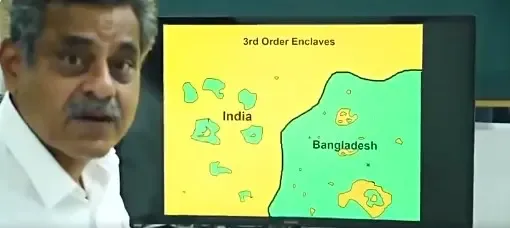
Reddy described the pre-2015 border situation between India and Bangladesh as among the most complex in the world. India held 111 enclaves inside Bangladesh, while Bangladesh held 51 enclaves inside India. The complexity extended further: second-order enclaves existed, where a Bangladeshi pocket lay inside an Indian enclave that itself sat inside Bangladesh, and vice versa.
He characterised these territories — relics of the Partition era — as 'service-less zones' in which residents lacked reliable access to administration, identity documents, and clear citizenship pathways for decades. 'Such stupid borders were designed for political interests... and they continued from the day of Partition till recently, till 2015 until the Narendra Modi government came,' Reddy said.
The anomalies were formally resolved through the 2015 Land Boundary Agreement, negotiated and ratified by Parliament under Prime Minister Narendra Modi. Under the swap, residents were given the choice of citizenship and the last pockets of foreign territory on either side of the border were eliminated.
The Link to Delhi's Electoral Roll Protests
Reddy presented the enclave resolution as the closure of a structural irregularity that had, in his framing, facilitated unchecked cross-border movement for decades. He then connected that history directly to the current controversy over the ECI's SIR exercise.
Protesters have opposed the SIR, with critics alleging that the revision has removed more than 130 million names from electoral rolls. Demonstrators have also demanded the resignation of Chief Election Commissioner Gyanesh Kumar. Supporters of Reddy's position, however, argue the revision is a necessary housekeeping measure to identify and delete illegal or ineligible entries.
The Telangana BJP MP contended that porous borders and political patronage had previously allowed illegal migration to function as a form of vote-bank politics — naming the All India Trinamool Congress (TMC) in West Bengal and the Indian National Congress (Congress) in Assam, with effects reportedly felt as far as Hyderabad, Delhi, Bihar, and Odisha.
Regime-Change Allegation and Opposition Charge
Reddy broadened his argument further, alleging that the protests and accompanying digital campaigns form part of a coordinated international effort aimed at unseating the Modi government. He described a coalition of opposition parties — including Congress, the Samajwadi Party, and the Dravida Munnetra Kazhagam (DMK) — as well as what he called fringe organisations and external actors, as sharing a single objective.
'They do not have a common cause. The common cause is not NEET, not the UPI payment system, not the Election Commission... The common cause is to defeat PM Modi, regime change,' he said, insisting that leadership change in a democracy must occur only through elections and not through what he described as orchestrated street agitation.
Social Media Metrics and External Economic Pressures
Reddy also raised concerns about alleged manipulation of social media metrics, referring to a political figure associated with the Aam Aadmi Party (AAP) who, he claimed, experienced a sudden surge of millions of Instagram followers, which he described as '100 per cent fake, 100 per cent paid' — contrasting the online numbers with what he characterised as modest physical turnout at early stages of the protests.
He additionally warned of what he described as multifaceted external pressures targeting India's economic stability, citing currency volatility, disruptions in oil trade, and potential adverse impacts on the information-technology and pharmaceutical sectors. In his assessment, strong leadership under Prime Minister Modi has so far allowed India to navigate these pressures while preserving strategic and economic autonomy.
Where the Debate Stands
While the 2015 Land Boundary Agreement resolved the enclave question on paper, disputes over migration, documentation, and the accuracy of voter lists continue to surface. The SIR exercise remains sharply contested: one side characterises it as a safeguard against ineligible entries, the other as an overreach that disenfranchises legitimate citizens. With protests continuing in Delhi, Reddy's intervention has reframed the voter-roll controversy as, in his view, the unfinished business of determining who legitimately belongs on India's electoral lists — a debate unlikely to be resolved quickly.
Point of View
The BJP is attempting to shift the debate from disenfranchisement — the opposition's strongest line — to infiltration, where it holds electoral ground. The allegation of a coordinated regime-change plot is a recurring BJP template, one that tends to consolidate the base while drawing scrutiny from centrist voters. What mainstream coverage is missing is the sheer scale of what the protesters are citing — 130 million removed names is not a marginal administrative discrepancy; if accurate, it would be one of the largest single disenfranchisement events in democratic history, and that number demands independent verification before either side's narrative can be taken at face value.
NationPress
17 Oct 2026
Frequently Asked Questions
What is the Election Commission's Special Intensive Revision (SIR) and why is it controversial?
The SIR is an exercise by the Election Commission of India to review and revise electoral rolls, aimed at removing ineligible or duplicate entries. It is controversial because critics allege that the revision has wrongly deleted more than 130 million genuine voter names, while the BJP and its supporters argue it is a necessary step to remove illegal or fraudulent entries from the rolls.
What were the India-Bangladesh border enclaves that Konda Vishweshwar Reddy referred to?
These were small pockets of territory — 111 Indian enclaves inside Bangladesh and 51 Bangladeshi enclaves inside India — left over from the Partition era. Residents of these zones lacked clear citizenship, identity documents, or access to government services for decades, until the 2015 Land Boundary Agreement resolved the issue and gave residents a choice of citizenship.
What exactly did Reddy allege about the protests in Delhi?
Reddy alleged that the protests against the electoral roll revision are not driven by genuine policy grievances but form part of a coordinated effort — involving Congress, the Samajwadi Party, the DMK, fringe groups, and external actors — aimed at achieving regime change against Prime Minister Modi. He argued that leadership transitions in a democracy must happen through elections, not street agitation.
Who is demanding the Chief Election Commissioner's resignation and why?
Protesters opposed to the SIR have demanded the resignation of Chief Election Commissioner Gyanesh Kumar, arguing that the revision exercise has disenfranchised large numbers of legitimate voters. The scale of names allegedly removed — cited by critics as over 130 million — is the central flashpoint of their demand.
How does the 2015 Land Boundary Agreement connect to current voter-list disputes?
The 2015 Land Boundary Agreement formally resolved the India-Bangladesh enclave problem and eliminated the last pockets of disputed territory on both sides of the border. Reddy argues that these enclaves had enabled illegal cross-border migration for decades, and that effects of that migration are still embedded in voter rolls — making the current SIR, in his view, a continuation of the same regularisation process.