BJP Women March in Chandigarh for 33% Women Quota Law
Synopsis
Hundreds of BJP women activists marched in Chandigarh on April 25, demanding AAP explain its opposition to the Nari Shakti Vandan Adhiniyam — India's landmark 33% women's reservation law. Several senior BJP leaders, including former Union Minister Parneet Kaur, were detained by police, escalating tensions between BJP and the AAP-led Punjab government.
Key Takeaways
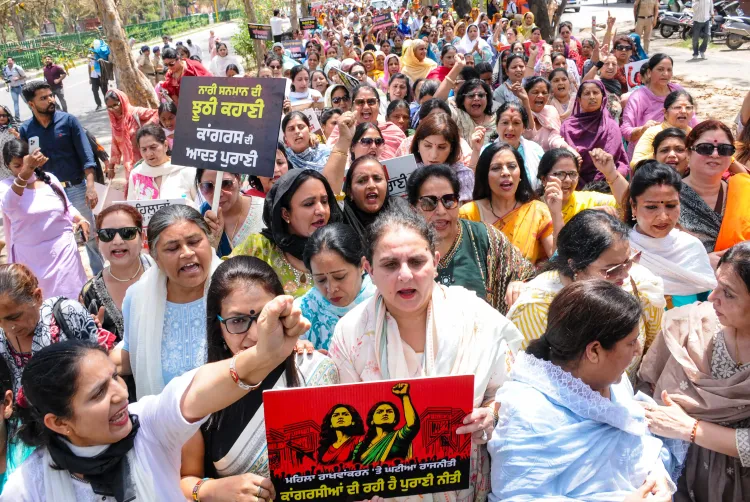
Hundreds of BJP women activists from across Punjab marched in Chandigarh on April 25, 2025 , targeting Chief Minister Bhagwant Singh Mann's residence over the Women's Reservation Bill.
Chandigarh Police detained multiple BJP leaders, including former Union Minister Parneet Kaur and BJP Mahila Morcha President Jai Inder Kaur .
The protest demanded that AAP justify its opposition to the Nari Shakti Vandan Adhiniyam , which guarantees 33% reservation for women in Parliament.
BJP state working President Ashwani Sharma accused both Congress and AAP of political opportunism and vote-bank politics on the women's reservation issue.
Mahila Morcha President Jai Inder Kaur called the blocking of the Women's Reservation Bill a "black day" for Indian democracy.
BJP has signalled this is the beginning of a sustained statewide campaign across Punjab ahead of future electoral contests.
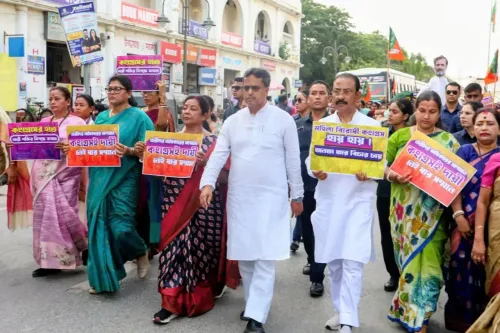
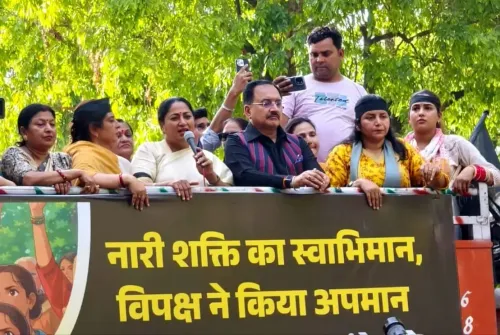
Chandigarh, April 25: Hundreds of women activists from across Punjab, spearheaded by BJP state working President Ashwani Sharma, staged a major demonstration in Chandigarh on Saturday, marching toward the official residence of Chief Minister Bhagwant Singh Mann to demand that the Aam Aadmi Party (AAP) justify its opposition to the Nari Shakti Vandan Adhiniyam — the landmark legislation guaranteeing 33 per cent reservation for women in the Indian Parliament. The protest marked one of the most visible mobilisations by BJP's women's wing in Punjab in recent months, signalling a deliberate political strategy ahead of upcoming electoral cycles.
Police Detentions and Key Leaders Arrested
Chandigarh Police moved swiftly to contain the march, detaining several senior BJP leaders before they could reach the Chief Minister's residence. Among those detained were Parneet Kaur, former Union Minister; Jai Inder Kaur, state President of BJP Mahila Morcha; Mohinder Kaur Joshi and Mona Jaiswal, both Vice Presidents of the state BJP unit; State Secretaries Meenu Sethi, Vandana Sangwan, and Renu Thappar; along with Ekta Nagpal.
The detentions drew sharp reactions from the BJP camp, which accused the AAP-led Punjab government of suppressing democratic dissent and silencing women's voices on a constitutional issue.
Slogans, Speeches, and the Core Demand
Protesters raised fervent slogans of "Nari Shakti Zindabad" as they assembled in large numbers, vowing to sustain their campaign until the Women's Reservation Bill is fully implemented. The charged atmosphere reflected deep frustration among BJP's women cadre over what they described as deliberate obstruction by opposition parties.
Addressing the gathering, Ashwani Sharma said the Narendra Modi-led BJP has been an unwavering champion of women's empowerment. "While political parties often disagree on various issues, it is surprising that the Congress and AAP have come together in opposing reservation for women," Sharma stated. He further argued that this convergence "reflects sheer political opportunism, with both parties indulging in vote-bank politics and resisting structural reforms that could alter their internal power dynamics."
BJP Mahila Morcha Calls It a 'Black Day' for Democracy
Mahila Morcha President Jai Inder Kaur did not mince words, labelling the blocking of the Women's Reservation Bill a "black day" for Indian democracy. "The Congress and AAP have consistently treated women merely as a vote bank and have failed them when it comes to ensuring rightful representation," she said.
She further warned that the INDI alliance appears threatened by the growing political empowerment of women, adding: "Women across India will respond strongly to this insult." Her remarks are significant, as they frame the issue not merely as a policy dispute but as a question of democratic accountability.
Parneet Kaur, the former Union Minister, urged all political parties to transcend narrow self-interest and work collectively for the upliftment of women, who constitute nearly half of India's population. She criticised the Opposition for playing a "negative role" in obstructing a bill that could fundamentally reshape India's legislative landscape.
Deeper Context: Why This Protest Matters Politically
The Nari Shakti Vandan Adhiniyam, passed by the BJP-led central government in September 2023, was hailed as a historic step toward gender parity in Indian politics. However, its implementation is contingent on a delimitation exercise, which critics argue could delay actual enforcement by several years — a point that opposition parties have used to question the bill's sincerity.
This comes amid a broader pattern of the BJP leveraging the Women's Reservation Bill as a key electoral narrative, particularly in states like Punjab where the party is in opposition and seeking to rebuild ground. The protest in Chandigarh is widely seen as a dual-purpose exercise — keeping the women's empowerment agenda alive nationally while simultaneously putting the AAP government on the defensive at the state level.
Notably, AAP has previously positioned itself as a pro-women party, making its opposition to the bill — or its perceived lack of enthusiasm — a political contradiction that BJP is keen to exploit. The Congress party's historical record on the Women's Reservation Bill is equally complex; the legislation was first introduced during UPA governments but never passed, a fact that adds irony to the current political battle.
What Happens Next
The BJP's Mahila Morcha has signalled that this protest is not a one-off event but the beginning of a sustained statewide campaign across Punjab. With elections always on the horizon in India's political calendar, the women's reservation issue is set to remain a flashpoint between the BJP and the AAP-Congress bloc. Political observers will watch closely whether the Opposition parties respond with a counter-narrative or choose to reposition their stance on the bill to neutralise BJP's campaign.
Point of View
Yet finds itself accused of blocking a constitutional reform that would directly empower women voters it claims to champion. Meanwhile, the BJP's own Women's Reservation Bill carries a built-in delay mechanism tied to delimitation, raising legitimate questions about whether either side is genuinely committed to implementation or simply weaponising women's rights for electoral gain. India's women deserve more than becoming the battlefield of rival political ambitions.
NationPress
25 Sept 2026
Frequently Asked Questions
What is the Nari Shakti Vandan Adhiniyam?
The Nari Shakti Vandan Adhiniyam is a law passed by the Indian Parliament in September 2023 that provides 33 per cent reservation for women in the Lok Sabha and state legislative assemblies. Its implementation, however, is linked to a future delimitation exercise, which could delay its effect by several years.
Why did BJP women protest in Chandigarh on April 25?
BJP women activists marched in Chandigarh on April 25, 2025, to demand that the AAP-led Punjab government explain its opposition to the Women's Reservation Bill. The protest was led by BJP state working President Ashwani Sharma and included hundreds of women from across Punjab.
Who was detained during the BJP protest in Chandigarh?
Chandigarh Police detained several BJP leaders during the march, including former Union Minister Parneet Kaur, BJP Mahila Morcha state President Jai Inder Kaur, Vice Presidents Mohinder Kaur Joshi and Mona Jaiswal, and State Secretaries Meenu Sethi, Vandana Sangwan, Renu Thappar, and Ekta Nagpal.
What has AAP said about the Women's Reservation Bill?
AAP has been accused by the BJP of opposing the Nari Shakti Vandan Adhiniyam, though the party has not formally endorsed the bill with the same enthusiasm as the ruling BJP. Critics argue that AAP's stance reflects political calculations over the bill's delayed implementation timeline.
What is the BJP Mahila Morcha's next step after the Chandigarh protest?
BJP's Mahila Morcha has indicated that the Chandigarh march is the start of a sustained statewide campaign across Punjab to highlight the Opposition's stance on the Women's Reservation Bill. Further protests and public outreach drives are expected in the coming weeks.