Cabinet Clears ₹14,115 Cr Kanpur-Kabrai Highway, Dwarka Tunnel
Synopsis
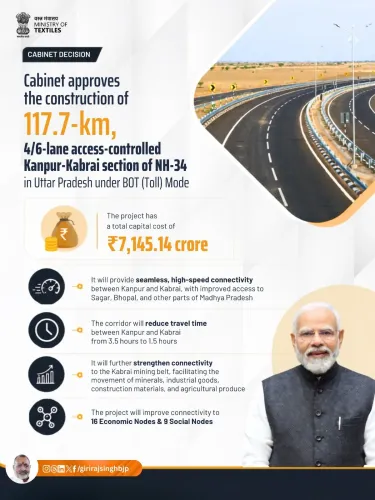
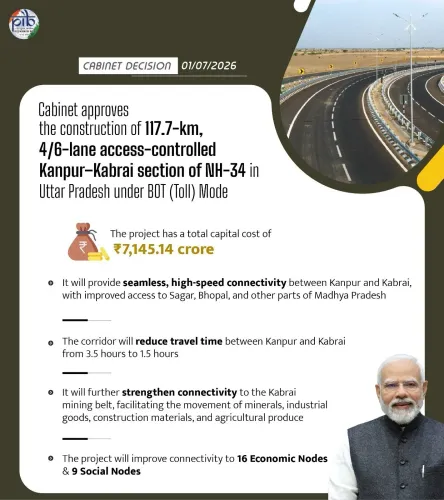
The Union Cabinet has approved a six-lane Dwarka Tunnel and the Kanpur-Kabrai Highway at a combined cost of ₹14,115 crore, strengthening road infrastructure in Uttar Pradesh's Bundelkhand region under the Bharatmala Pariyojana framework.
Key Takeaways
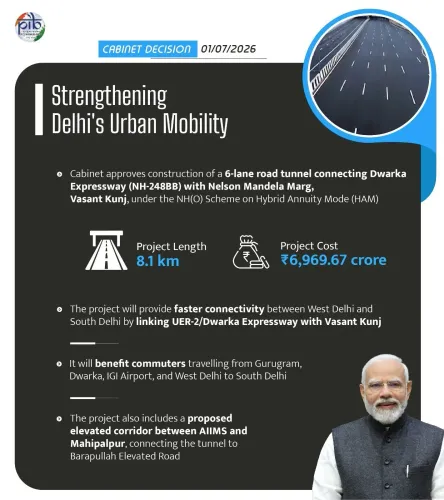
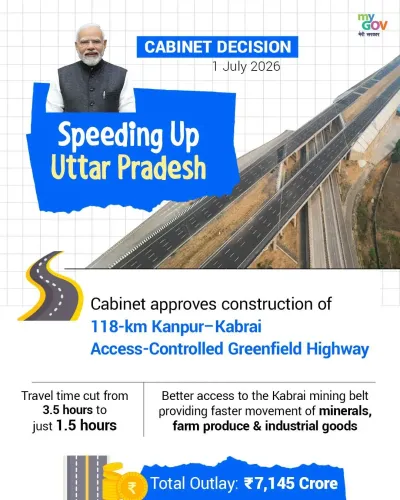
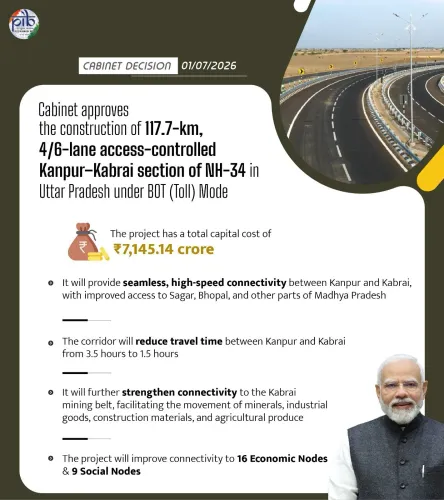
The Union Cabinet approved two projects — a six-lane Dwarka Tunnel and the Kanpur-Kabrai Highway — at a total cost of ₹14,115 crore .
The Kanpur-Kabrai corridor will improve connectivity in the Bundelkhand region of Uttar Pradesh .
The project falls under the Bharatmala Pariyojana , India's flagship national highway programme launched in 2015 .
NHAI is expected to handle execution, with tendering and land acquisition as key next steps.
Union Textiles Minister Giriraj Singh shared the Cabinet decision via the NaMo App on 2 July 2026 .
The Union Cabinet has approved two major infrastructure projects — a six-lane tunnel and the Kanpur-Kabrai Highway — at a combined cost of ₹14,115 crore, Union Textiles Minister Giriraj Singh announced on Thursday, 2 July 2026. Singh shared the development on X, highlighting the Cabinet's decision as a significant boost to national highway infrastructure.
Context
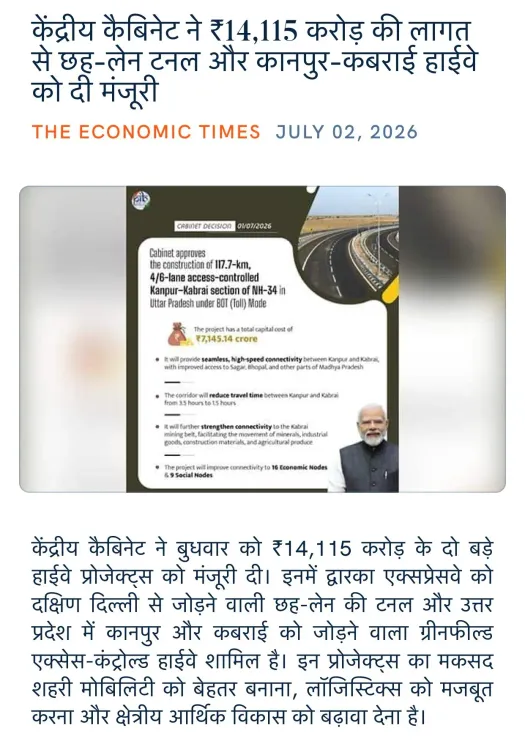
Singh's post — shared via the NaMo App — stated: 'केंद्रीय कैबिनेट ने ₹14,115 करोड़ की लागत से छह-लेन टनल और कानपुर-कबराई हाईवे को दी मंजूरी' ['The Union Cabinet has approved a six-lane tunnel and the Kanpur-Kabrai Highway at a cost of ₹14,115 crore']. The announcement covers two distinct components: a six-lane Dwarka Tunnel and a new highway corridor connecting Kanpur in Uttar Pradesh with Kabrai in the Bundelkhand region. Singh, though Textiles Minister, is a senior BJP leader and routinely amplifies Cabinet decisions on social media.
Policy Backdrop
The project aligns with Bharatmala Pariyojana, the central government's flagship highway programme launched in 2015 targeting construction and upgradation of 34,800 km of national highways, including expressways and tunnels. Uttar Pradesh has been a consistent beneficiary of the programme, with the Cabinet clearing multiple highway packages worth over ₹10,000 crore each during 2023-24 under national corridor schemes. The Kanpur-Kabrai corridor is expected to strengthen logistics connectivity in the historically underserved Bundelkhand belt, which straddles southern Uttar Pradesh and northern Madhya Pradesh.
Stakeholders and Impact
The approved corridor is expected to benefit daily commuters, freight operators, and truck drivers who currently navigate congested two-lane stretches between Kanpur and the Bundelkhand hinterland. Improved connectivity could reduce logistics costs and travel time for agricultural produce and industrial goods moving through the region. Highway construction contractors and the National Highways Authority of India (NHAI) will be key execution stakeholders once the project moves to the tendering stage.
What's Next
The project's progress will now hinge on timelines for tendering, land acquisition, and construction milestone setting by NHAI. Large corridor projects of this scale typically require multi-year execution windows, and land acquisition in densely populated stretches of Uttar Pradesh has historically been a pacing constraint. The Dwarka Tunnel component, being a technically complex structure, will also require detailed engineering and environmental clearances before ground-breaking. Successful execution would mark a significant addition to Bundelkhand's infrastructure spine and could catalyse broader economic activity in the region.
Point of View
115 crore Kanpur-Kabrai corridor and Dwarka Tunnel reinforces the central government's sustained infrastructure push in Uttar Pradesh ahead of what remains a politically consequential state. Bundelkhand has long been cited as a region requiring urgent connectivity investment, and large-ticket approvals signal an intent to close that gap through Bharatmala's national corridor framework. The fact that a Textiles Minister is amplifying a highways decision underscores how BJP leaders across portfolios are mobilised to broadcast Cabinet actions as part of a coordinated governance narrative. Whether execution timelines match the scale of the announcement will be the real test of this project's political and economic dividend.
NationPress
2 Jul 2026
Frequently Asked Questions
What did the Union Cabinet approve for Kanpur and Kabrai?
The Union Cabinet approved a six-lane Dwarka Tunnel and a new highway corridor connecting Kanpur with Kabrai at a combined cost of ₹14,115 crore.
What is the Kanpur-Kabrai Highway project?
The Kanpur-Kabrai Highway is a proposed six-lane road corridor linking Kanpur in Uttar Pradesh with Kabrai in the Bundelkhand region, aimed at improving freight and commuter connectivity in the area.
What is the Dwarka Tunnel approved by the Cabinet?
The Dwarka Tunnel is a six-lane tunnel component included in the Cabinet-approved infrastructure package, forming part of the upgraded highway alignment near the Kanpur-Kabrai corridor.
Is the Kanpur-Kabrai Highway part of Bharatmala Pariyojana?
The project aligns with Bharatmala Pariyojana, the central government's flagship programme for national highway construction and upgradation launched in 2015 with a target of 34,800 km of roads.
Who announced the Cabinet approval for the Kanpur-Kabrai Highway?
Union Textiles Minister Giriraj Singh announced the Cabinet approval on X on 2 July 2026, sharing the update via the NaMo App.