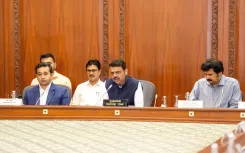
Cabinet Clears ₹7,395 Cr PMVGSY for Village Governance
Synopsis
The Union Cabinet chaired by PM Narendra Modi approved the Pradhan Mantri Viksit Gram Swaraj Yojana (PMVGSY) with an outlay of ₹7,395.55 crore, aiming to strengthen grassroots governance and accelerate holistic rural development across India's villages.
Key Takeaways
The Union Cabinet , chaired by PM Narendra Modi , approved the Pradhan Mantri Viksit Gram Swaraj Yojana (PMVGSY) on October 28, 2026 .
The scheme carries a total outlay of ₹7,395.55 crore .
Its stated objectives are strengthening grassroots governance and promoting holistic village development.
Primary beneficiaries are gram panchayats and rural communities across India.
The scheme builds on the policy lineage of the Rashtriya Gram Swaraj Abhiyan , approved in 2018 .
State-wise implementation guidelines and fund-release schedules are expected from the Ministry of Panchayati Raj .
A ₹7,395.55 crore bet on grassroots democracy — that is what the Union Cabinet placed on Wednesday, October 28, 2026, when it approved the Pradhan Mantri Viksit Gram Swaraj Yojana (PMVGSY), a scheme designed to deepen rural governance and accelerate village-level development across India. Union Education Minister Dharmendra Pradhan announced the Cabinet decision, framing it as a significant stride toward empowering gram panchayats and delivering what he called 'sampoorn vikas' — holistic development — to the country's villages.
What PMVGSY promises at the village level
At its core, the scheme targets two interlocking goals: strengthening grassroots governance structures and giving rural development a 'new momentum,' as Pradhan's post described it. The focus on suशासन — good governance at the ground level — signals a push to make gram panchayats more capable, more accountable, and better resourced. With a corpus of nearly ₹7,400 crore, the outlay is substantial enough to move the needle on institutional capacity across hundreds of thousands of villages.
The scheme was cleared under the chairmanship of Prime Minister Narendra Modi, whose government has consistently positioned local self-government as the foundation of its rural development architecture. Pradhan described the approval as an 'important step in the direction of empowering villages and giving new momentum to rural development.'
Building on the Panchayati Raj lineage
PMVGSY does not arrive in a vacuum. The Rashtriya Gram Swaraj Abhiyan, approved by the Cabinet in 2018, laid earlier groundwork for strengthening Panchayati Raj institutions through capacity building and devolution of powers. The new scheme continues and expands that policy lineage, reflecting a long-running central government conviction that sustainable rural development runs through empowered local bodies — not just infrastructure spending from above.
Successive administrations have channelled funds into rural roads, housing, and electrification. What distinguishes the current thrust is the explicit emphasis on governance quality alongside physical infrastructure — the idea that a well-run gram panchayat is itself a development outcome.
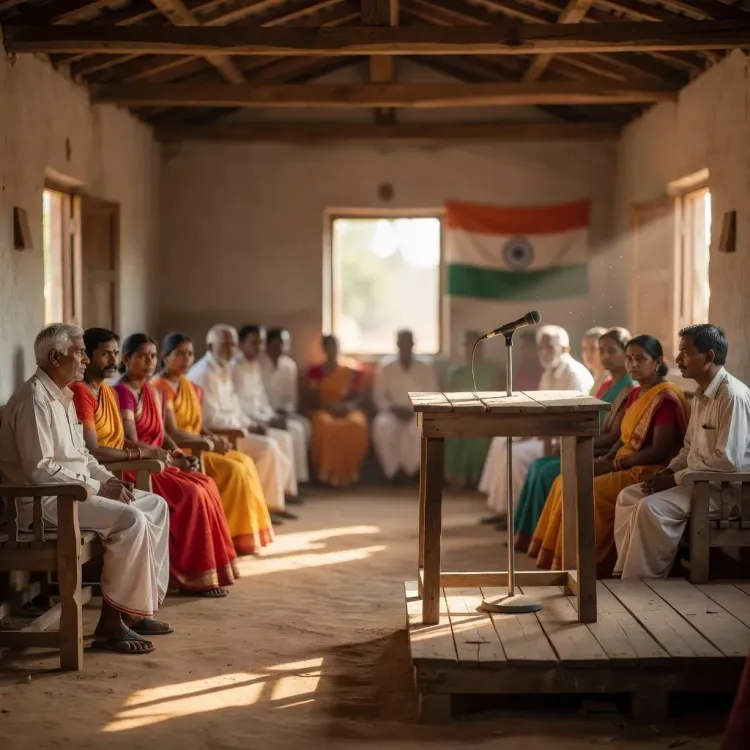
Gram panchayats and rural communities in focus
The primary beneficiaries are gram panchayats and the rural communities they serve. Implementation details — state-wise guidelines and the fund-release schedule — are expected to flow from the Ministry of Panchayati Raj, and those contours will determine how quickly and equitably the money reaches the ground. States with stronger administrative capacity are likely to move faster; the scheme's real test will be in lagging regions where governance institutions are thinnest.
For the BJP-led NDA government, the approval also carries political resonance ahead of an ongoing cycle of state elections, reinforcing its outreach to rural India — which still accounts for roughly two-thirds of the country's population.
The scheme is approved; the implementation clock has started. How fast those ₹7,395.55 crore translate into stronger panchayats — and whether the governance gains outlast the funding cycle — is the question rural India will be watching.
Point of View
Not just top-down transfers. By linking a large fiscal outlay explicitly to governance quality at the panchayat level, the Cabinet is signalling a shift from purely infrastructure-led rural spending toward institutional capacity building. Politically, the timing keeps BJP's rural development narrative active and visible. The real policy test, however, will come in implementation — particularly in states where panchayat capacity is weakest and the marginal gain from governance investment would be highest.
NationPress
28 Oct 2026
Frequently Asked Questions
What is the Pradhan Mantri Viksit Gram Swaraj Yojana (PMVGSY)?
PMVGSY is a centrally approved scheme with an outlay of ₹7,395.55 crore aimed at empowering gram panchayats, strengthening grassroots governance, and promoting holistic development of villages across India.
How much money has been allocated for PMVGSY?
The Union Cabinet approved PMVGSY with a total financial outlay of ₹7,395.55 crore.
When was PMVGSY approved by the Cabinet?
The Union Cabinet, chaired by Prime Minister Narendra Modi, approved PMVGSY on Wednesday, October 28, 2026.
Who will benefit from the PMVGSY scheme?
Gram panchayats and rural communities across India are the primary beneficiaries. The scheme is designed to build institutional capacity at the local governance level.
How is PMVGSY different from earlier rural schemes?
While earlier schemes like the Rashtriya Gram Swaraj Abhiyan (2018) focused on Panchayati Raj capacity building, PMVGSY explicitly links a large fiscal outlay to grassroots governance quality, going beyond physical infrastructure to strengthen local self-government institutions.