Chhattisgarh Cabinet Clears Key Amendment to Bastar Fighters Rules
Synopsis
The Chhattisgarh cabinet has approved a significant amendment to the Bastar Fighters Fighter Aarakshak Service (Recruitment and Conditions of Service) Rules, 2026, reinforcing the state's strategy of using locally recruited tribal youth to combat Left-Wing Extremism in the Bastar region.
Key Takeaways
The Chhattisgarh Council of Ministers approved an amendment to the Bastar Fighters Fighter Aarakshak Service Rules, 2026 on 8 July 2026 .
The Bastar Fighters are a specialised police unit recruited from local tribal youth in southern Chhattisgarh for counter-insurgency duties.
The force was established in the mid-2010s alongside the District Reserve Guard (DRG) to localise anti-Naxal operations in LWE-affected districts .
Amended rules will be published in the Chhattisgarh state gazette before taking statutory effect.
Recruitment advertisements and training calendars from state police headquarters are expected to follow gazette notification.
The decision reflects a sustained state policy of improving retention and service conditions for personnel in hard-posting areas of Bastar .
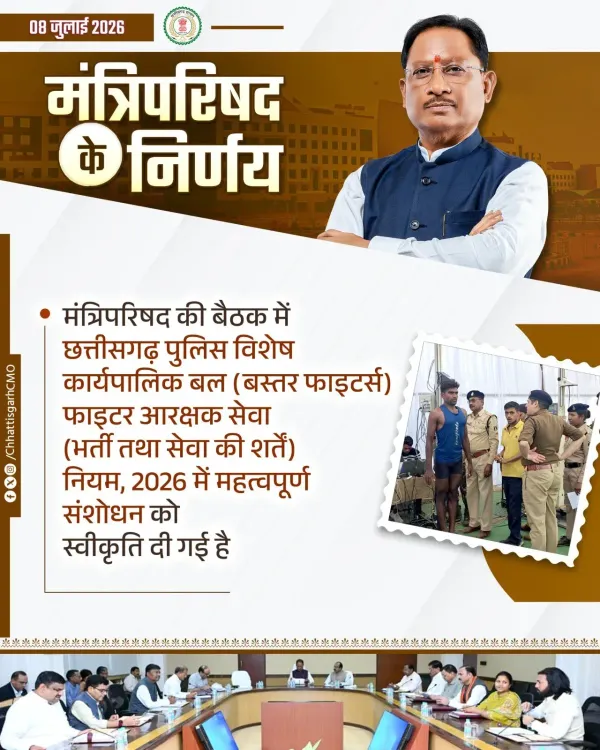
The Chief Minister's Office of Chhattisgarh announced on Wednesday, 8 July 2026 that the state cabinet has approved a significant amendment to the Chhattisgarh Police Special Executive Force (Bastar Fighters), Fighter Aarakshak Service (Recruitment and Conditions of Service) Rules, 2026. The decision was taken at a meeting of the Mantriparishad (Council of Ministers) and signals a continued policy push to strengthen locally raised security forces in the Bastar region.
Context
The official post stated: 'Mantriparishad ki baithak mein Chhattisgarh Police Vishesh Karyapalik Bal (Bastar Fighters), Fighter Aarakshak Seva (Bharti tatha Seva ki Sharten) Niyam, 2026 mein mahatvapurn sanshodhan ko swikrti di gayi hai' — meaning, 'In the cabinet meeting, an important amendment to the Chhattisgarh Police Special Executive Force (Bastar Fighters), Fighter Aarakshak Service (Recruitment and Conditions of Service) Rules, 2026 has been approved.' The Bastar Fighters are a specialised police unit raised from local youth to conduct counter-insurgency operations in the forested districts of southern Chhattisgarh.
The force was conceived as a terrain-aware, language-familiar alternative to outside deployments in one of India's most challenging Left-Wing Extremism (LWE) theatres. Its personnel are drawn predominantly from tribal communities in and around the Bastar division, giving the unit both operational and community intelligence advantages.
Policy Backdrop
Chhattisgarh has a long history of building locally raised auxiliary and special police units to supplement its regular constabulary in LWE-affected districts. The Bastar Fighters and the District Reserve Guard (DRG) were both established in the mid-2010s as part of a broader national and state strategy to localise counter-insurgency efforts. Periodic amendments to recruitment and service-condition rules have been a recurring feature of this policy, aimed at improving retention, pay parity, and career progression for personnel serving in hard-postings.
The 2026 rules being amended represent the most current statutory framework governing how Fighter Aarakshaks are recruited, trained, and retained. Cabinet-level approval of amendments to such rules underscores the political priority the state attaches to keeping these forces operationally ready and attractive to recruits from vulnerable communities.
Stakeholders and Impact
The primary beneficiaries of any liberalised service rules are the Bastar Fighters personnel themselves — largely young tribal men and women from districts such as Sukma, Bijapur, Dantewada, Bastar, Kondagaon, Narayanpur, and Kanker. Improved recruitment and service conditions can make enlistment more attractive, potentially widening the talent pool for a force that depends on local knowledge for its effectiveness.
Broader stakeholders include the Chhattisgarh Police command, which relies on the Bastar Fighters for ground operations, and the tribal communities of southern Chhattisgarh, who live in areas where security conditions directly affect access to development programmes, schools, and health services. A stronger, better-retained local force can contribute to the gradual restoration of civil administration in previously insurgency-affected pockets.
What's Next
The amended rules are expected to be published in the Chhattisgarh Rajpatra (state gazette), after which they will carry statutory force. Observers will watch for subsequent recruitment advertisements and training calendars issued by the state police headquarters, which will indicate the scale and pace of any expansion or restructuring envisaged under the revised framework.
With security conditions in Bastar showing incremental improvement over recent years, the cabinet's decision to fine-tune the statutory backbone of the Bastar Fighters signals that the state intends to sustain and institutionalise its locally rooted counter-insurgency model for the foreseeable future.
Point of View
The state is attempting to make enlistment in a high-risk unit sustainably attractive — addressing a chronic tension between operational demand and personnel retention in LWE theatres. This fits a broader national pattern of states with active insurgency challenges investing in local police capacity rather than relying on central paramilitary deployments. The long-term test will be whether improved rules translate into measurable gains in recruitment numbers and force retention in the most volatile Bastar districts.
NationPress
7 Oct 2026
Frequently Asked Questions
What are the Bastar Fighters in Chhattisgarh?
The Bastar Fighters, formally the Chhattisgarh Police Special Executive Force, are a specialised police unit recruited from local tribal youth in southern Chhattisgarh to conduct counter-insurgency operations against Left-Wing Extremist groups in the Bastar region.
What did the Chhattisgarh cabinet decide on 8 July 2026?
The Chhattisgarh Council of Ministers approved a significant amendment to the Fighter Aarakshak Service (Recruitment and Conditions of Service) Rules, 2026, which govern how Bastar Fighters personnel are recruited and retained.
Why are the Bastar Fighters important for Chhattisgarh security?
The Bastar Fighters are drawn from communities with local terrain knowledge and language familiarity, making them more effective in forested LWE-affected districts than outside deployments, and they supplement the regular police in some of India's most challenging security environments.
When will the amended Bastar Fighters rules come into effect?
The amended rules will take statutory effect after they are published in the Chhattisgarh state gazette; subsequent recruitment and training notifications from state police headquarters are expected to follow.
What is the District Reserve Guard and how does it relate to Bastar Fighters?
The District Reserve Guard (DRG) is another locally raised police unit created alongside the Bastar Fighters in the mid-2010s; both forces form the core of Chhattisgarh's strategy to use local tribal recruits for counter-insurgency duties in Bastar.