Chirag Paswan calls for India to lead in value-added food exports
Synopsis
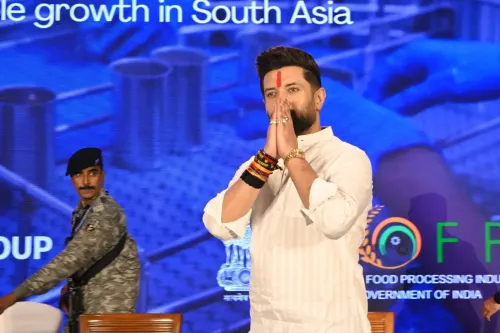
Union Food Processing Minister Chirag Paswan addressed the 17th Agriculture Leadership Summit and Awards 2026 as chief guest, pledging to make India a global leader in value-added food products and calling farmer prosperity, innovation, and quality agriculture the bedrock of a developed India.
Key Takeaways
Chirag Paswan was chief guest at the 17th Agriculture Leadership Summit and Awards 2026 on 8 July 2026 .
He committed to making India the world's leading nation in value-added food products , not merely a raw food producer.
Farmer prosperity, technological innovation, and quality-based agriculture were cited as the foundations of Viksit Bharat .
The PMFME scheme (launched 2020 ) supports micro food processing enterprises and underpins the ministry's value-addition agenda.
Doubling farmers' incomes through post-harvest processing has been a stated government goal since 2016 .
Industry focus now shifts to the next Union Budget for allocations that match the minister's stated ambitions.
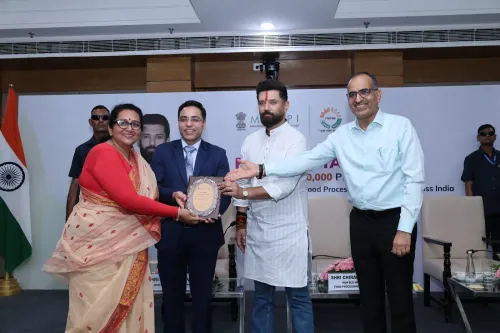
Union Food Processing Minister Chirag Paswan addressed the 17th Agriculture Leadership Summit and Awards 2026 as chief guest on Wednesday, 8 July 2026, sharing his vision for transforming India from a raw food producer into a global leader in value-added food products.
Context
Speaking at the summit, Paswan outlined a resolve — 'hamara sankalp hai' (it is our commitment) — that India must not remain merely a food producer but must emerge as the world's foremost nation in value-added food products. He underscored that farmer prosperity, technological innovation, and quality-based agriculture are the 'strong foundations of a developed India.' The minister also extended congratulations to all award winners at the event.
The summit brought together stakeholders from agriculture, food processing, and allied sectors, providing a platform to debate the role of value addition in boosting farmer incomes — a theme that sits at the heart of the government's rural economy agenda.
Policy Backdrop
The Ministry of Food Processing Industries has long positioned value addition as the most effective lever to reduce post-harvest losses and raise farm-gate returns. The Pradhan Mantri Formalisation of Micro Food Processing Enterprises (PMFME) scheme, launched in 2020, specifically targets micro enterprises, helping them formalise operations and invest in processing technology.
Since 2016, successive governments have pursued the goal of doubling farmers' incomes, consistently identifying post-harvest processing as a key instrument. Paswan's remarks at the summit reinforce this policy lineage and connect it to the broader Viksit Bharat (Developed India) vision — the national goal of making India a developed economy by 2047.
India's policy framework has steadily shifted emphasis from raw agricultural output toward processed and branded food products, with successive Union Budgets prioritising technology adoption, quality standards, and reduced wastage to grow the sector's share of GDP. This trajectory is embedded in both the Atmanirbhar Bharat and Viksit Bharat agendas.
Stakeholders and Impact
Small and marginal farmers stand to gain most directly from a robust food processing ecosystem, as value addition at or near the farm gate translates raw produce into higher-margin commodities. Food processing units — particularly micro and small enterprises — benefit from policy support, formalisation incentives, and easier access to credit and technology.
For consumers and export markets, a stronger value-added food sector means greater product diversity, improved quality standards, and competitive pricing. Industry observers note that India's share in global processed food trade remains below its potential, making ministerial-level advocacy at platforms such as this summit significant for setting the direction of upcoming policy decisions.
What's Next
Attention will now turn to the next Union Budget and whether allocations for food-processing infrastructure schemes reflect the ambitions articulated by the minister. Any new export incentives or quality-certification frameworks for value-added products will be closely watched by the industry. Paswan's public commitment at a high-profile national summit is likely to set expectations for concrete policy announcements in the months ahead.
Point of View
He is aligning the ministry's agenda with the government's flagship long-term narrative — a deliberate move that can strengthen budget-negotiation leverage. The emphasis on farmer income rather than just industrial output is also politically calibrated for an LJP leader whose core constituency is rural Bihar. Whether the rhetoric translates into enhanced scheme allocations or new export frameworks will be the real test of this commitment.
NationPress
7 Oct 2026
Frequently Asked Questions
What did Chirag Paswan say at the Agriculture Leadership Summit 2026?
Chirag Paswan, as chief guest at the 17th Agriculture Leadership Summit and Awards 2026, called for India to become a global leader in value-added food products and said farmer prosperity, innovation, and quality agriculture are the foundations of a developed India.
What is the PMFME scheme and how does it help farmers?
The Pradhan Mantri Formalisation of Micro Food Processing Enterprises (PMFME) scheme, launched in 2020, supports micro enterprises in the food processing sector by helping them formalise operations and invest in processing technology, thereby enabling value addition and higher farmer incomes.
What is India's goal for value-added food products?
India's policy goal, articulated repeatedly by the Ministry of Food Processing Industries, is to shift from being a raw food producer to a leading exporter of processed and value-added food products, capturing higher domestic and global market value.
What is Viksit Bharat and how does food processing relate to it?
Viksit Bharat is India's national vision to become a developed economy by 2047. Food processing, quality agriculture, and technological innovation are positioned as foundational pillars of this goal, as they directly raise farm incomes and strengthen agro-industrial GDP contribution.
Who is Chirag Paswan and what ministry does he lead?
Chirag Paswan is the Union Minister of Food Processing Industries and national president of the Lok Janshakti Party (Ram Vilas). His ministry is responsible for promoting food processing infrastructure, reducing post-harvest losses, and enabling value addition in agricultural produce.