Chirag Paswan Calls for South Asia Food Processing Leap
Synopsis
Union Food Processing Minister Chirag Paswan has called on South Asia to move beyond agricultural production and invest in processing infrastructure that converts farm abundance into higher incomes. Writing on June 8, 2026, he cited the SAPLING platform as the forum framing this regional challenge.
Key Takeaways
Chirag Paswan , Union Minister of Food Processing Industries, published an editorial on June 8, 2026 arguing that South Asia must convert its food production scale into greater economic value.
The minister referenced the SAPLING initiative as the platform putting the food-processing challenge at the centre of regional food-security debate.
India's PMFME scheme (launched 2020 ) and the Agriculture Export Policy of 2018 form the domestic policy lineage behind the minister's regional argument.
Small farmers and food processing enterprises are the primary stakeholders who stand to benefit from expanded processing infrastructure across South Asia.
Upcoming BIMSTEC and SAARC ministerial meetings, as well as the forthcoming Union Budget , are the next forums where this agenda could be formalised.
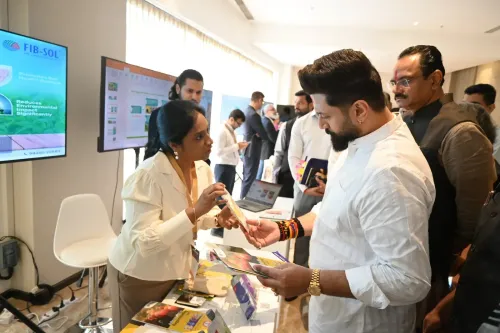
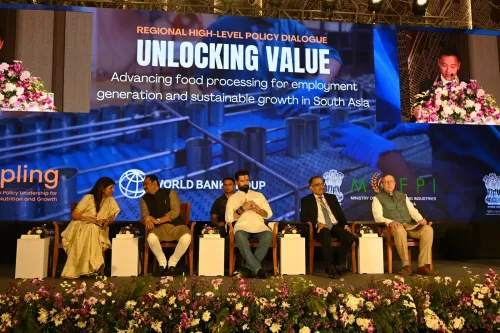
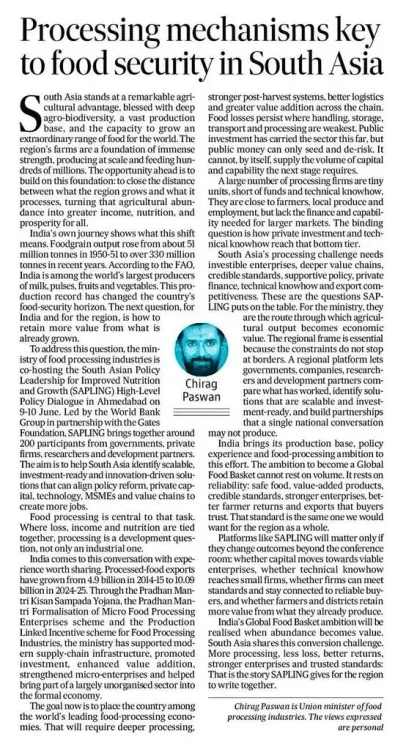
Union Food Processing Minister Chirag Paswan on Monday, June 8, 2026, called for transforming South Asia's agricultural abundance into greater economic value, writing in an editorial that the region's next challenge is converting its food production scale into higher incomes and stronger enterprises. The minister referenced the SAPLING initiative as the platform putting that challenge on the table.
Context
In his post, Paswan wrote: 'South Asia is already growing food at an extraordinary scale. The next leap is to turn that abundance into greater value, better incomes and stronger enterprises.' The statement signals a deliberate shift in the ministerial framing — away from production volumes and toward the downstream question of value capture and processing infrastructure.
The editorial, published on June 8, 2026, engages with the SAPLING platform, which the minister describes as placing this processing challenge at the centre of regional food-security discourse. The precise institutional mandate of SAPLING has not been independently detailed in official public records available at the time of publication.
Policy Backdrop
India's food-processing policy has evolved steadily from a production-first orientation toward reducing post-harvest losses and extracting greater value within domestic and regional supply chains. The Pradhan Mantri Formalisation of Micro Food Processing Enterprises (PMFME) scheme, launched in 2020, extended credit-linked subsidies and technical support to micro food-processing units as part of that shift.
The Agriculture Export Policy of 2018 similarly identified value addition and processing infrastructure as key levers for raising farmer incomes and expanding agricultural exports. Paswan's editorial argument continues that lineage, now extending it explicitly to the South Asian regional level rather than confining it to domestic supply chains.
The Ministry of Food Processing Industries is the nodal body responsible for policy support, infrastructure development and promotion of the sector. A ministerial op-ed framing processing as a regional imperative carries institutional weight beyond a routine statement, signalling that the ministry may seek to internationalise its advocacy within upcoming multilateral forums.
Stakeholders and Impact
Small and marginal farmers stand to gain most directly if processing infrastructure expands, since they bear the heaviest burden of post-harvest losses and price volatility. Greater value addition at the farm gate or in nearby agro-processing clusters can translate raw commodity prices into more stable, higher incomes.
Food processing enterprises — from micro units supported under PMFME to larger export-oriented processors — would benefit from a coordinated regional approach that expands both input supply and market access. South Asia's shared agro-climatic profile means that policy coordination among neighbouring countries could reduce duplication and lower infrastructure costs across the region.
What's Next
Observers will watch whether the themes in Paswan's editorial translate into formal agenda items at the next BIMSTEC or SAARC ministerial meetings, where regional food-security cooperation is a standing concern. Domestically, the forthcoming Union Budget will be a key indicator of whether allocations for food-processing infrastructure are scaled up in line with the minister's stated ambitions.
If SAPLING gains formal institutional standing as a regional platform, it could become a vehicle for coordinating investment, standards harmonisation and market-access negotiations across South Asian economies — moving the minister's editorial argument from advocacy into actionable regional policy.
Point of View
Not merely a domestic regulator. The invocation of SAPLING, a platform whose institutional status remains opaque, suggests the minister is testing multilateral appetite for a processing-centred food-security agenda ahead of upcoming regional summits. This sits within a broader pattern of Indian ministers using op-eds to signal policy priorities before they are formalised in budgets or bilateral agreements. Whether the argument converts into concrete regional commitments will depend on diplomatic traction and domestic budgetary headroom.
NationPress
23 Oct 2026
Frequently Asked Questions
What did Chirag Paswan say about South Asia food processing?
Chirag Paswan argued on June 8, 2026, that South Asia must move beyond its large-scale food production and invest in processing infrastructure to generate greater value, better farmer incomes, and stronger enterprises.
What is SAPLING and what does it have to do with food security?
SAPLING is a platform referenced by Minister Paswan as a forum that places the challenge of food processing and value addition at the centre of South Asian food-security discussions. Its precise institutional mandate has not been detailed in official public records.
What is the PMFME scheme and how does it relate to Paswan's editorial?
The Pradhan Mantri Formalisation of Micro Food Processing Enterprises scheme, launched in 2020, provides credit-linked subsidies and technical support to micro food-processing units in India. It is part of the domestic policy lineage that underpins Paswan's broader argument for expanding processing infrastructure across South Asia.
How could South Asia food processing help farmers?
Expanding processing infrastructure near farm clusters reduces post-harvest losses and allows farmers to receive higher prices for value-added products rather than raw commodities, translating into more stable and improved incomes.
What happens next after Chirag Paswan's food processing editorial?
Observers are watching for food-processing agenda items at the next BIMSTEC or SAARC ministerial meetings and for enhanced budgetary allocations in the forthcoming Union Budget as the clearest indicators of whether the minister's stated ambitions will be formalised.