CJI Surya Kant: Retired Judges Are Nation's 'Bawris', Must Not Be Sidelined
Synopsis
CJI Surya Kant stunned a Jaipur seminar by comparing retired judges to ancient bawris — stepwells that must not be left dry. He proposed four concrete roles for former judges and declared 'Once a judge, always a judge', warning that sidelining judicial wisdom is a national waste amid India's 5-crore case backlog.
Key Takeaways
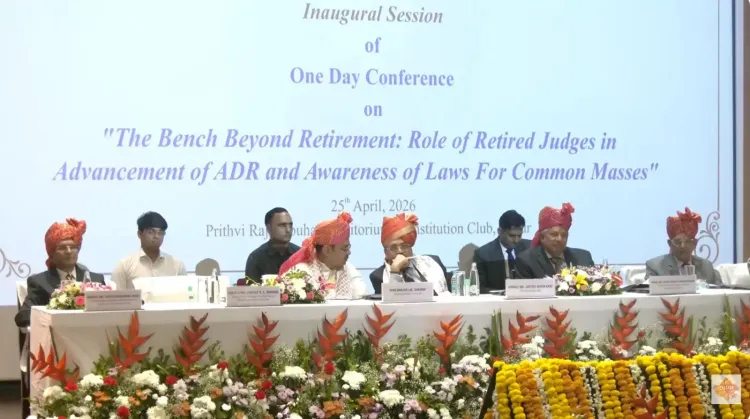
CJI Surya Kant addressed the seminar The Bench Beyond Retirement in Jaipur on April 25, 2025 , calling for structured post-retirement roles for former judges.
He declared Once a judge, always a judge , arguing that judicial experience cannot be replicated by committees or training programmes.
The CJI compared retired judges to Rajasthan's traditional bawris (stepwells) , calling them a national resource that must not be left idle.
He proposed four key roles for retired judges: mediators and arbitrators, legal educators, pre-litigation counsellors, and institution builders.
The CJI called for a formal, dignified framework to engage retired judges, replacing existing ad-hoc arrangements.
The address comes amid India's judicial pendency crisis , with over 5 crore cases pending across courts at various levels.
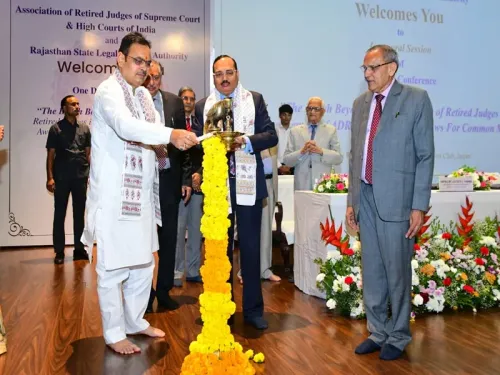
Chief Justice of India (CJI) Surya Kant on Saturday, April 25, delivered a landmark address at a seminar in Jaipur, asserting that retired judges remain indispensable pillars of the Indian justice system and should never be treated as institutional afterthoughts. Speaking at the one-day seminar titled The Bench Beyond Retirement, the CJI invoked the powerful metaphor of Rajasthan's ancient stepwells (bawris) to describe the enduring value of former judges — reservoirs of wisdom that must not be allowed to run dry.
The Bawri Metaphor: A Deep-Rooted Vision for Judicial Legacy
Drawing from his personal roots in Churu, Rajasthan, CJI Surya Kant explained how bawris — traditional stepwells — silently collect rainwater over years and become lifelines for communities during droughts. He used this imagery to highlight how retired judges, having accumulated decades of legal and human experience, represent a similar reservoir of institutional strength.
Our former judges are like those bawris, the CJI stated, noting that their wisdom is actively sought in Lok Adalats, courts, mediation centres, and arbitration proceedings during periods of systemic pressure.
He challenged the prevailing culture of farewell ceremonies followed by institutional disengagement: We organise a farewell, garland them, speak warmly of their service... and then quietly assume that the system will move on just fine without them. But this assumption is not just incorrect — it is a wasteful tradition.
Once a Judge, Always a Judge: CJI Challenges Retirement Culture
CJI Surya Kant was unequivocal in his assertion: A judge never truly retires. Once a judge, always a judge. He argued that the experiential knowledge judges carry — forged through years of courtroom engagement with real human struggles — cannot be replicated by any committee or condensed into any training module.
He elaborated that retired judges do not merely carry knowledge of law — they carry knowledge of people. They have seen the struggles of a rural farmer whose life savings are at stake, the anxieties of a first-generation entrepreneur, the silent battles of families at their most vulnerable moments, he said.
This human dimension of judicial wisdom, the CJI argued, makes retired judges uniquely equipped to serve the justice system in capacities beyond the bench. He stressed that the trust earned by judges over decades constitutes a national resource — and leaving it underutilised amounts to a direct public loss.
Four Key Roles for Retired Judges: A Structured Roadmap
Moving beyond rhetoric, CJI Surya Kant proposed a concrete, four-pronged framework for meaningfully engaging retired judges within the justice ecosystem.
First, as Mediators and Arbitrators: Their stature and impartiality can resolve disputes efficiently, reducing the burden on overburdened trial courts.
Second, as Legal Educators: Reaching schools, colleges, and even gram panchayats — explaining constitutional rights in accessible language to citizens who may not even know they possess them.
Third, as Pre-Litigation Counsellors: Helping parties resolve conflicts before they escalate into prolonged, exhausting legal battles that clog the system.
Fourth, as Institution Builders: Mentoring young mediators, training legal aid lawyers, and preserving institutional memory for the generations of legal professionals who follow.
The CJI acknowledged positive strides through existing mechanisms like Lok Adalats and emerging arbitration centres but called for a formal, dignified, and accountable framework — replacing the current ad-hoc arrangements that often leave retired judges either overextended or completely idle.
Poetry, Resilience, and the Responsibility of the Judiciary
Invoking the celebrated Urdu poet Dushyant Kumar, CJI Surya Kant underscored the enduring faith that ordinary citizens place in the judiciary — a faith the institution must honour through structural reform, not just ceremonial goodwill.
He recited: Woh aadmi nahin, mukammal bayan hai, Mathe pe uske chot ka gehra nishaan hai, Fatehaal hai, par jhole mein ek Samvidhaan hai — a verse that evokes the resilience of the common person who, despite hardship, still carries the Constitution as their shield.
He concluded with a stirring couplet: Jisko toofanon se uljhne ki aadat ho, Aisi kashti ko samandar bhi dua deta hai — affirming that a justice system built on experience and wisdom can weather any storm.
Let us not allow our bawris to dry up in neglect, the CJI urged, calling on the legal fraternity to treat the post-retirement engagement of judges not as a favour, but as a constitutional and institutional imperative.
Why This Matters: Judicial Pendency and the Case for Structural Reform
This address comes at a critical juncture for India's judiciary. With over 5 crore cases pending across courts at various levels, the systemic strain on the justice delivery mechanism has never been more acute. The CJI's vision for structured post-retirement engagement directly addresses this crisis — by channelling experienced judicial wisdom into alternative dispute resolution and pre-litigation frameworks that can decongest the formal court system.
Notably, India's arbitration and mediation ecosystem, while growing, still lacks the institutional depth of mature legal markets. A formal framework for retired judges — as proposed by CJI Surya Kant — could accelerate India's emergence as a preferred seat for domestic and international dispute resolution, with direct implications for investor confidence and ease of doing business.
As the Supreme Court and various High Courts continue to push for ADR adoption, the seminar's outcomes and any subsequent policy recommendations are expected to shape the next phase of judicial reform in India.
Point of View
The failure to institutionalise post-retirement judicial engagement is not just inefficient — it is a policy failure hiding in plain sight. The CJI's four-point framework deserves legislative backing, not just seminar applause. The deeper irony: India spends years training judges to understand law and humanity, then discards that investment at the retirement gate — while simultaneously spending crores on new judicial infrastructure that cannot substitute for lived experience.
NationPress
19 Sept 2026
Frequently Asked Questions
What did CJI Surya Kant say about retired judges at the Jaipur seminar?
CJI Surya Kant declared that once a judge, always a judge, arguing that retired judges never truly leave the justice system. He compared them to Rajasthan's traditional bawris, calling their accumulated wisdom a national resource that must not be left underutilised.
What is the Bench Beyond Retirement seminar held in Jaipur?
The Bench Beyond Retirement was a one-day seminar held in Jaipur on April 25, 2025, addressed by Chief Justice of India Surya Kant. It focused on how retired judges can continue contributing meaningfully to India's justice system through structured roles.
What four roles did CJI Surya Kant propose for retired judges?
CJI Surya Kant proposed that retired judges serve as mediators and arbitrators, legal educators reaching schools and gram panchayats, pre-litigation counsellors, and institution builders mentoring the next generation of legal professionals.
Why did CJI Surya Kant compare retired judges to bawris?
Drawing from his roots in Churu, Rajasthan, the CJI used the bawri stepwell metaphor to illustrate how retired judges silently accumulate wisdom over years and become vital resources during times of institutional stress or crisis.
What is the significance of CJI Surya Kant's speech for India's judiciary?
The speech calls for a formal, accountable framework for post-retirement judicial engagement, addressing India's massive case backlog of over 5 crore pending cases. It signals a push toward structured alternative dispute resolution using experienced former judges.