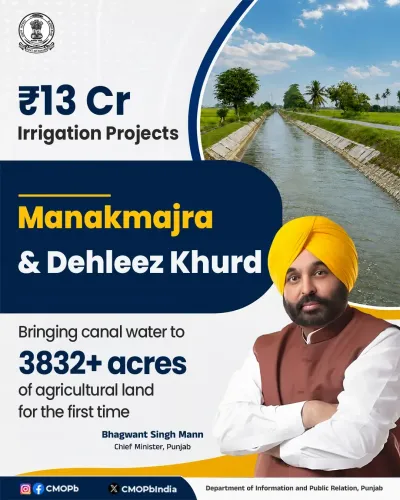
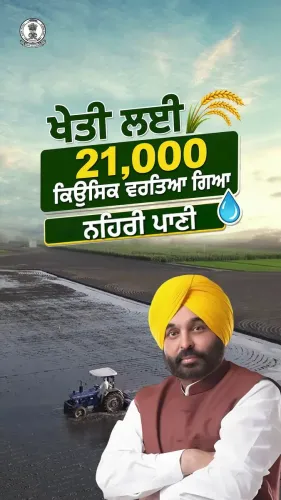
CM Bhagwant Mann: Punjab delivers 18,000 cusecs to farms

Synopsis
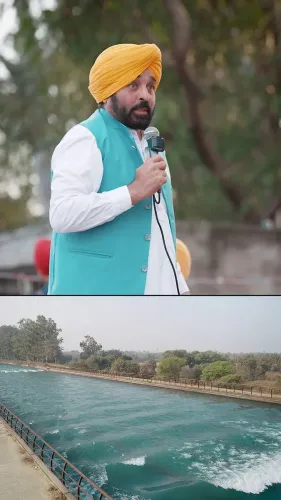
Chief Minister Bhagwant Mann, addressing a public meeting in Sarenh village, Nakodar, Jalandhar on 29 October 2026, declared that the Punjab government has delivered 18,000 cusecs of water to farmland, calling irrigation access essential to the state's agricultural economy.
Key Takeaways
Chief Minister Bhagwant Mann addressed a lok milni in Sarenh village, Nakodar constituency, Jalandhar on 29 October 2026 .
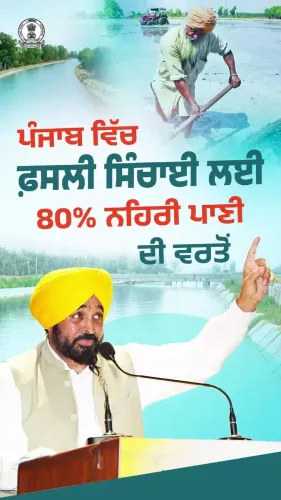
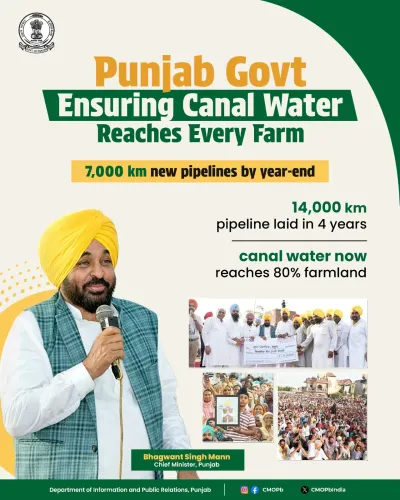
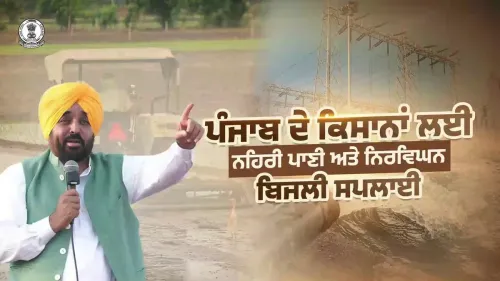
Mann stated that the Punjab government has channelled 18,000 cusecs of water to agricultural fields.
He described agriculture as 'the vital foundation of Punjab's economy' and adequate irrigation as 'absolutely essential' for farmers.
The announcement comes amid a sustained state push since 2022 to increase surface water delivery and reduce groundwater extraction.
Nakodar is part of central Jalandhar, a district heavily reliant on canal-fed irrigation for its paddy-wheat cycle.
Water is the lifeblood of Punjab's fields — and at a public meeting in the village of Sarenh, Nakodar constituency, Jalandhar district, Chief Minister Bhagwant Mann made a pointed claim on Thursday, 29 October 2026: his government has pushed 18,000 cusecs of irrigation water directly to farmland, a figure he placed at the centre of Punjab's agricultural survival story.
Addressing the lok milni (public interaction), Mann said: 'Agriculture is the vital foundation of Punjab's economy, and ensuring farmers receive adequate water for irrigation is absolutely essential.' The statement came as part of a direct outreach event designed to bring the Chief Minister face-to-face with rural constituents in one of Punjab's farming heartlands.
Why Nakodar heard this message first
Nakodar sits in central Jalandhar, a district whose agricultural belt is deeply dependent on canal-fed irrigation. The lok milni format — a signature Aam Aadmi Party outreach mechanism — puts ministers in direct conversation with villagers, bypassing layers of local administration. Holding it in Sarenh village signals that the government is taking the irrigation message to the ground level rather than announcing it from Chandigarh.
The chronic pressure behind the 18,000-cusec claim
Punjab's irrigation challenge is not new. Decades of groundwater extraction to sustain the paddy-wheat cycle have pushed the state's water table into alarming territory in several districts. Surface water delivery through the canal network is seen as the most immediate lever to slow that decline. Since 2022, the Mann government has made canal desilting and water augmentation a stated priority, framing surface water access as both an agrarian and an ecological imperative.
The 18,000 cusecs figure cited by the Chief Minister represents the volume of water the state government claims to have channelled to agricultural fields through its canal infrastructure. A cusec — one cubic foot per second — is the standard unit for measuring canal discharge in Punjab, and releasing such volumes at scale requires coordinated operation of headworks and distribution channels across multiple districts.
Farmers at the centre of Punjab's political economy
Punjab's farmers have remained a politically decisive constituency, especially after the prolonged agitation against the now-repealed central farm laws. For the Aam Aadmi Party government, demonstrating tangible delivery on irrigation — rather than just policy intent — carries electoral as well as administrative weight. Water-sharing disputes with neighbouring states add another layer of complexity: any expansion of surface water delivery domestically also feeds into the broader argument about Punjab's entitlement to river waters.
The next signal to watch will be whether the canal augmentation figures translate into reduced groundwater extraction data in the next state agricultural survey — the only metric that will tell whether the 18,000-cusec push is changing farming behaviour on the ground.
Point of View
000-cusecs announcement is less a standalone infrastructure figure and more a political signal — Mann's government is staking its rural credibility on visible, measurable water delivery at a time when Punjab's groundwater crisis has moved from agronomic concern to political liability. Holding the announcement at a village-level lok milni rather than a press conference is deliberate: it bypasses media mediation and lands the message directly with the constituency that matters most to AAP's Punjab base. The deeper test, however, is whether canal augmentation is genuinely displacing tubewell use or simply running parallel to it — a distinction that will define whether this is structural reform or campaign-cycle optics.
NationPress
29 Oct 2026
Frequently Asked Questions
What did CM Bhagwant Mann say at the Nakodar lok milni?
Bhagwant Mann said that agriculture is the vital foundation of Punjab's economy and that ensuring adequate irrigation water for farmers is essential. He stated that the Punjab government has delivered 18,000 cusecs of water to farmland.
Where is Sarenh village and why was the event held there?
Sarenh is a village in the Nakodar constituency of Jalandhar district in central Punjab. The lok milni was a public outreach event where the Chief Minister directly addresses rural constituents on governance and development issues.
What is a cusec and why does it matter for Punjab farmers?
A cusec — one cubic foot of water per second — is the standard unit for measuring canal discharge in Punjab. Higher cusec releases through the canal network reduce farmers' dependence on groundwater pumping, which has severely depleted the state's water table.
What is Punjab's irrigation policy under the AAP government?
Since 2022, the Bhagwant Mann government has prioritised canal desilting and water augmentation to increase surface water delivery to fields, aiming to slow chronic groundwater depletion while supporting the dominant paddy-wheat agricultural cycle.
How serious is Punjab's groundwater crisis?
Punjab faces one of India's most acute groundwater depletion challenges, driven by decades of intensive paddy cultivation requiring heavy tubewell irrigation. Expanding surface canal water delivery is the state administration's primary near-term strategy to stabilise the water table.